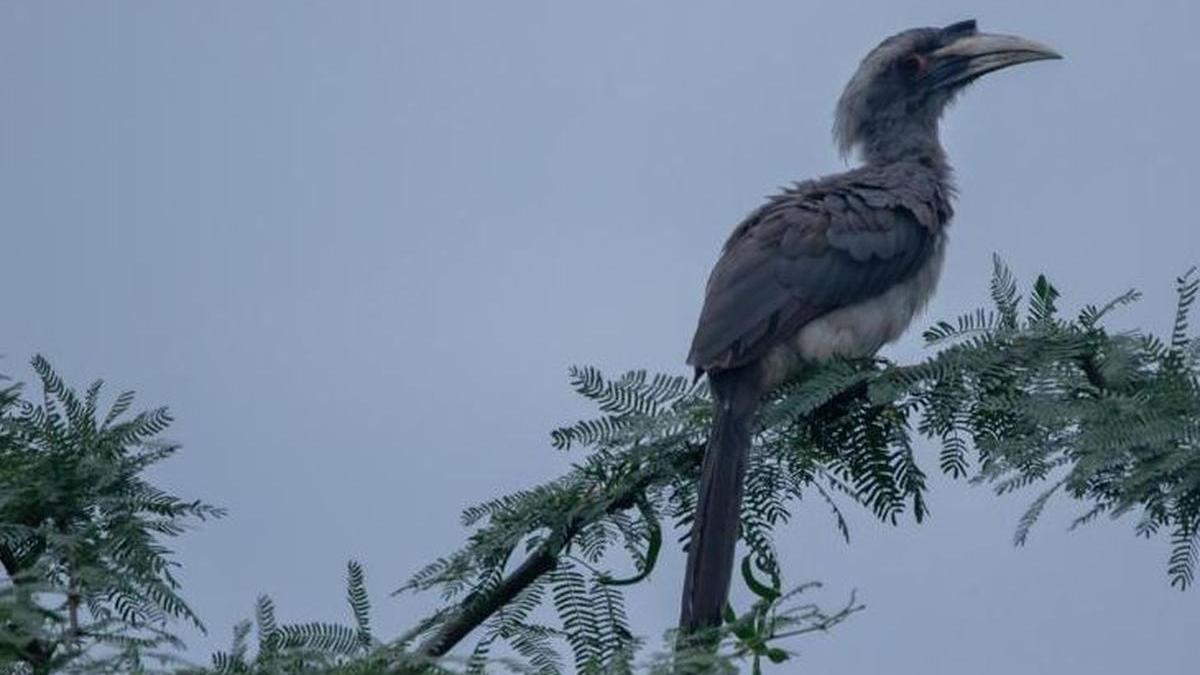
The Indian grey hornbill
| Photo Credit:
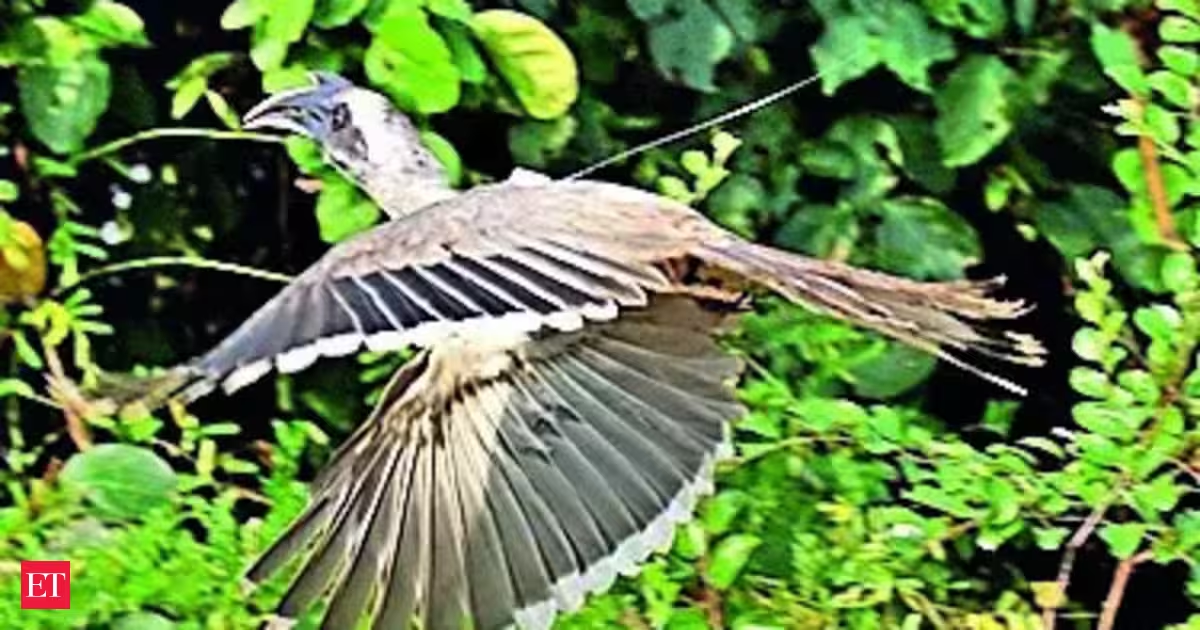
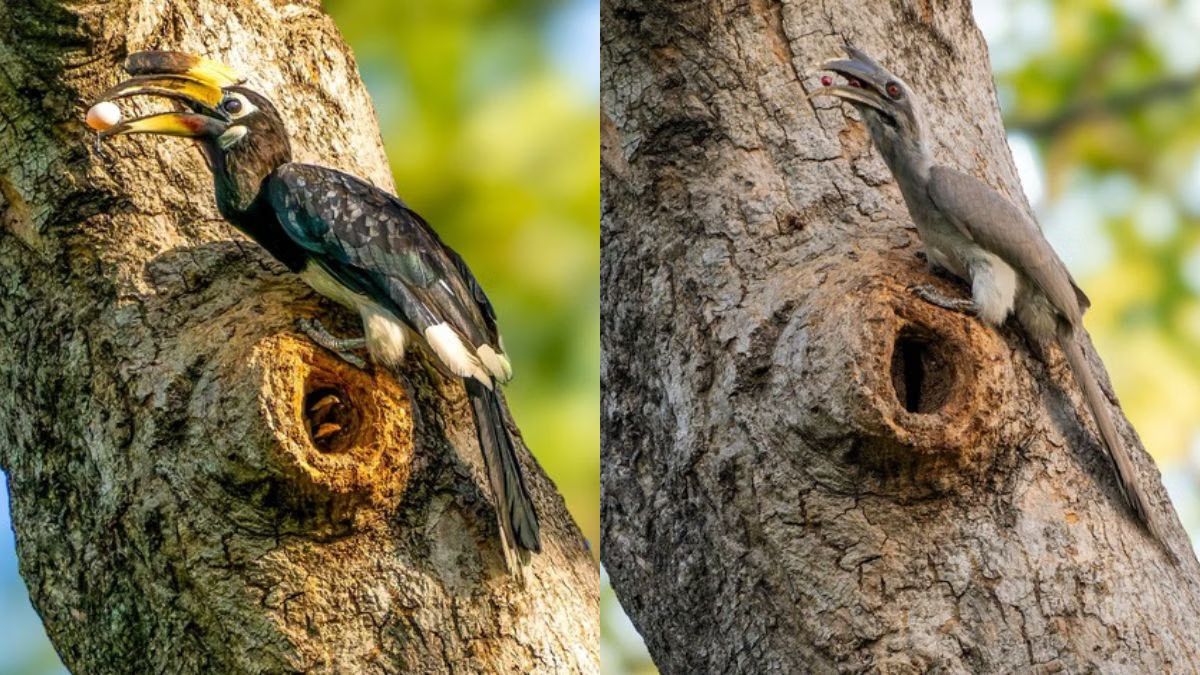
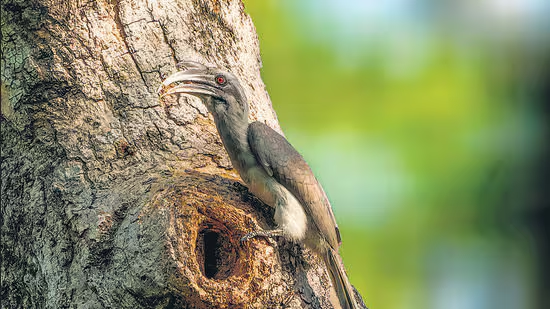
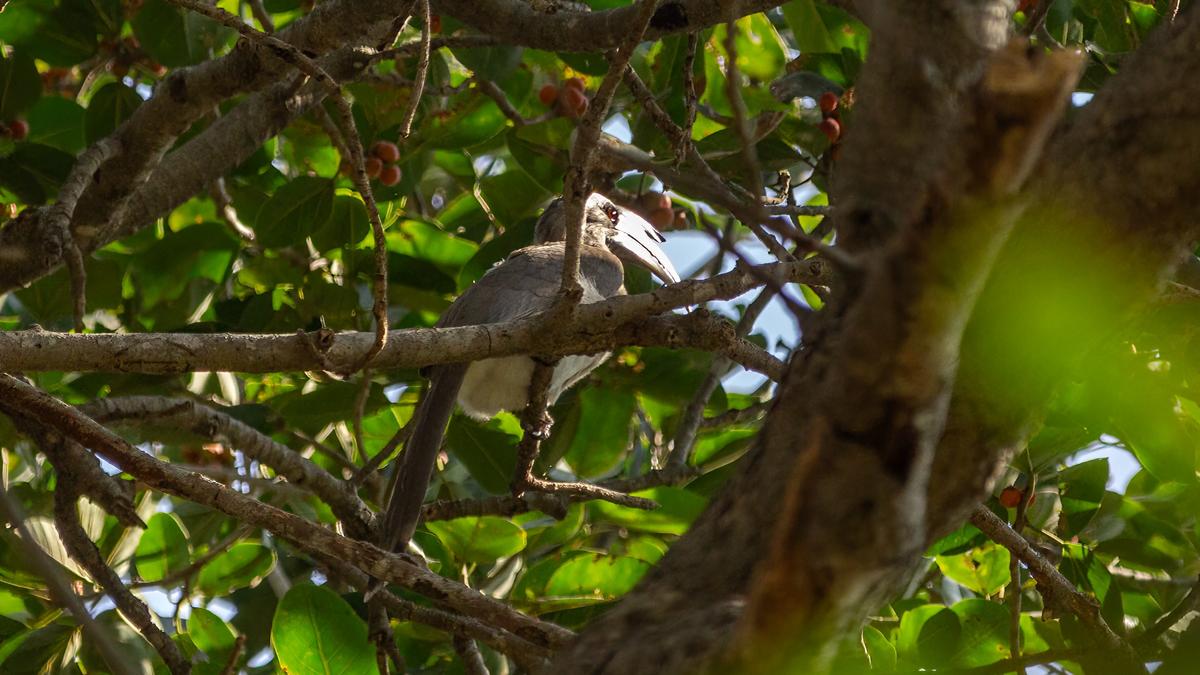
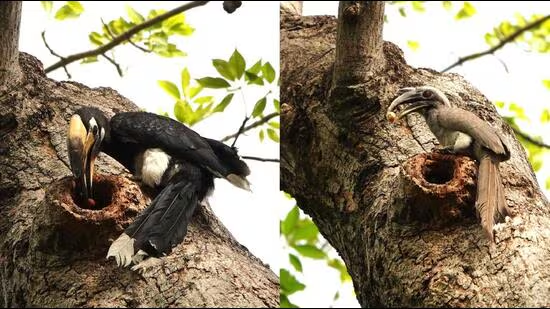
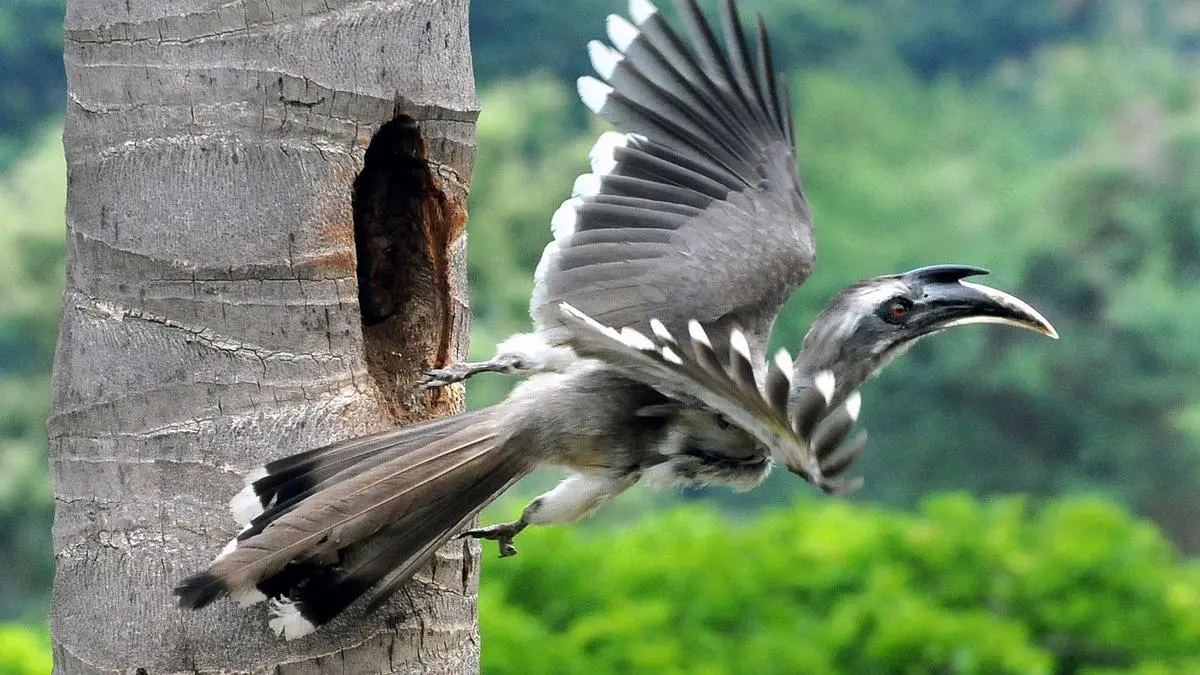
More than 60 years after the Indian Grey Hornbill disappeared from the forests of Gir --- largely due to hunting pressures --- the bird is slowly reclaiming its place in one of India’s most celebrated forest ecosystems that is also home to Asiatic Lions.A new peer-reviewed study has found that hornbills reintroduced into Gir beginning in 2021 have not only survived but have established territories, adapted to the landscape and bred successfully for four consecutive years, marking one of India’s most promising bird reintroduction efforts. The findings, published in the international journal Birds, offer the first detailed assessment of the Gujarat Forest Department’s programme to restore the species to Gir after its disappearance in the 1950s and 1960s.“Grey Hornbills reintroduced into the Gir landscape in 2021 have successfully established territories, adapted to their new habitat, and produced offspring, marking a major milestone in restoring a species that had disappeared from the region between the 1950s and 1960s. The research conducted following the reintroduction of the Grey Hornbill into the Gir forests is a significant success for us,” stated Arjun Modhwadia, Minister for Forests and Environment, Government of Gujarat in an official release on Tuesday.The project involved the phased release of 40 Indian Grey Hornbills. Twenty-eight birds were released between 2021 and 2022, followed by another 12 in 2023. The birds were translocated from healthy populations in Gujarat’s Aravalli forests after scientists concluded that decades of habitat protection had once again made Gir suitable for the species.To understand how the birds adapted, researchers fitted 11 males with satellite transmitters and monitored their movements, habitat preferences and breeding behaviour over several years. The tracking data showed a familiar pattern seen in many wildlife reintroductions. Newly released hornbills initially ranged widely across unfamiliar landscapes, occupying an average home range of nearly 61 square kilometres. As they became familiar with their surroundings, that range contracted sharply to around 5.7 square kilometres. Daily movement also declined substantially—from an average of 4.3 kilometres during the exploratory phase to about 1.4 kilometres after settlement—indicating that the birds had established stable territories.“Though the hornbill disappeared from Gir decades ago, improvements in habitat protection following the declaration of the Gir Wildlife Sanctuary in 1965 and Gir National Park in 1975 created favourable conditions for bringing the species back. Historical records suggest that hunting, rather than habitat degradation, was the primary reason for its disappearance,” stated Jaipal Singh, Principal Chief Conservator of Forests (Wildlife) and Chief Wildlife Warden, Gujarat.Perhaps the strongest indicator of success has been breeding. According to the study, one pair nested successfully during the first year after release. By the second year, three additional breeding pairs had established nests. The programme has now recorded four consecutive years of successful breeding, suggesting that the population is moving towards becoming self-sustaining. Researchers say the birds have shown a clear preference for Gir’s mature dry mixed deciduous and teak forests. Nesting was concentrated in large old-growth trees, particularly Sterculia urens and Terminalia bellirica, underscoring the importance of preserving mature forest stands within protected landscapes.Outside the protected area, some hornbills were also observed using orchards, water bodies and areas close to human settlements, highlighting their adaptability while also pointing to the need for landscape-level conservation beyond park boundaries. The ecological significance of the species extends beyond its return. Indian Grey Hornbills being forest’s most important long-distance seed dispersers feed largely on fruits such as banyan, peepal, karamda and dhraman. They transport these seeds across wide areas, helping regenerate native forests naturally. Published on July 14, 2026