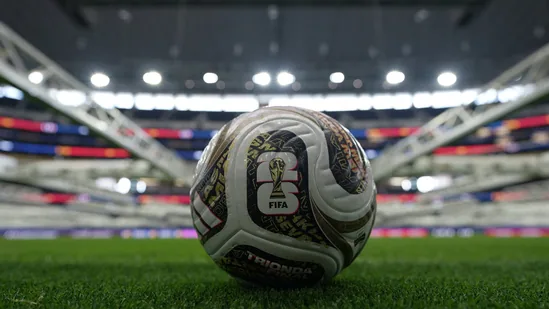
The number of foreign-born players rose from 18 in 2018 to 136 in 2022 and 290 in the ongoing World Cup, accounting for 23.2% of all players. The first part of this two-part series explored whether the expansion of the FIFA World Cup has improved the representation of teams beyond the traditional footballing powers, but only in the tournament’s early stages. This part examines the geographical diversity within World Cup squads as the number of foreign-born players has surged, and what this reveals about the movement of the footballing talent pool beyond the pitch.The new adidas Trionda Final ball, the official match ball for the semi-finals, the third-place play-off and final of the 2026 FIFA World Cup. (REUTERS)More flags than ever, but the same football factoriesThe World Cup’s new competitive edge was born elsewhereForeign-born players were unusually common in the World Cup’s early years, but for reasons quite different from today. FIFA had no firm eligibility rules, allowing footballers to switch national teams. Luis Monti, for instance, played the 1930 final for Argentina before winning the 1934 tournament with Italy. Political upheaval and shifting borders also blurred national affiliations.FIFA subsequently imposed much stricter rules, tying players to the country they had represented in an official competition. As a result, the share of foreign-born players remained in the low single digits through much of the post-war era, touching just 1.3% in 1974. The rules were relaxed again in 2003, particularly for dual nationals who had represented one country at youth level but not its senior team.
More flags than ever, but the same football factories | Number Theory
The number of foreign-born players rose from 18 in 2018 to 136 in 2022 and 290 in the ongoing World Cup, accounting for 23.2% of all players.
857 words~4 min read