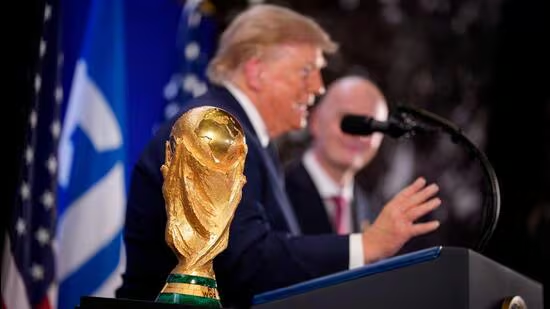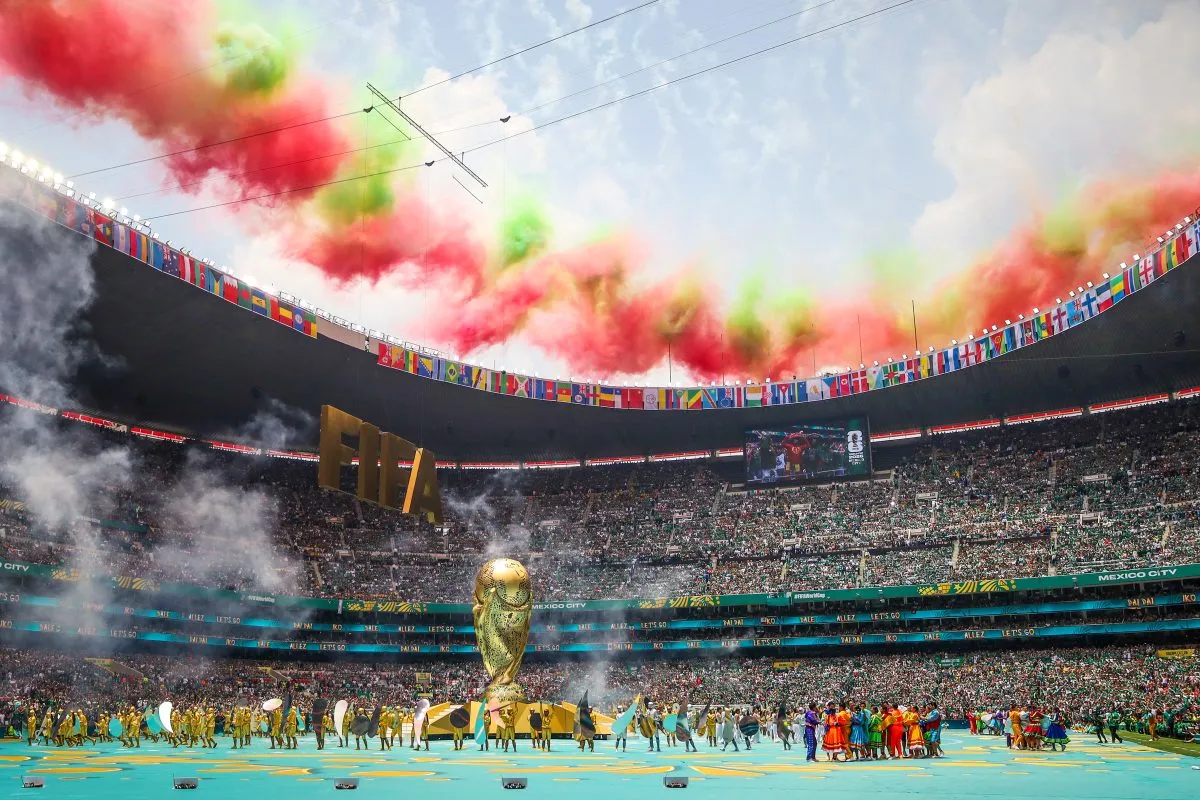
Chris Anderson is Ralf Dahrendorf Professor of European Politics and Society at the London School of Economics (LSE). Speaking with Srijana Mitra Das in ET Evoke, he discusses the political economy of football, games at play in the FIFA 2026 World Cup — and whether the US could take to cricket.Q. In your book The Numbers Game, you write of "the bewildered tone Americans use" when discussing football — so, why has the United States now taken to football so grandly?A. Football was imported to America, unlike "American football", which grew out of rugby. Both rugby and soccer are invasion sports, where you aim to transport a ball to the other end, somehow crossing a line.Originally, there was one such game in the 19th century — this later became two. In one, you were allowed to use your hand while in the other, you couldn't. One became rugby football, the other association football.Both came to America in the 19th century. Rugby football morphed into American football. Association football, in comparison, wasn't played much and mostly engaged in by immigrants from Europe — now, that's changed as America has changed.Over the decades, there's been a huge amount of immigration from all parts of the world and the stock of foreign-born Americans and descendants of foreign-born Americans has grown. Alongside, an appetite for "soccer" has expanded.There is a second story at play here — the advent of Premier League football on American TV.In 1980s United States, you couldn't watch football on TV. It simply wasn't available. Then, suddenly, on cable television, Saturday mornings, Premier League appeared and suburban Americans developed a taste for it.The immigration story began to fuse with the attractiveness of a TV product plus kids finding their way into football through video games — Americans began growing interested in the game.There's an untold story here too — for many years, soccer in America was a women's sport.American women's football is a saga of great success. US women dominated the sport while the men were quite unsuccessful at it, many going into more traditional American sports like baseball, basketball and American football.So, America has an amazing history of footballing success on the women's side while trying to catch up on the men's side.I think the United States Soccer Federation (USSF) thought they could accelerate the men's side also through the commercial opportunities hosting the World Cup provides.---Q. Is the FIFA World Cup 2026 nationalism at play — or globalisation at work?A. World Cups give people togetherness and pride in their country via their teams — there are moments of manufactured patriotism here.Alongside, football has become an incredibly global game.Earlier, teams representing nations at the World Cup were from that country — there was very little flow of players and coaches across the globe. It was considered complete anathema to have a national coach who wasn't a citizen of the country.That's changed now — there is a global labour market for football players and coaches and lots of foreigners in the English Premier League, the Bundesliga in Germany, etc.The World Cup has become a mixed affair with many players representing a country but not necessarily playing or being coached there.So, the knowledge of the game has become much more diffused.World Cup players often contest teammates from their clubs because they are from another country.There's globalisation at work here via the labour flows.---Is football the only place in the West where migration isn't bitter?A. Yes, that's very interesting because it almost seems disconnected from reality.With all the different nationalities playing in Britain's Premier League, football fans don't raise an eyebrow.People almost look at these athletes as not from their country, so to speak.There is plenty of anti-Muslim prejudice in all Western societies, for instance — in stadiums, the political viewpoints many supporters have don't represent the most tolerant slice of society.Yet, they adore Mohamed Salah at Liverpool, a very obvious Muslim player.If people met Mo Salah in the street, they might not have the same attitude.I'd explain this strange juxtaposition with celebrity culture — this makes people seem less connected, less easily identifiable with their nation or culture.Meanwhile, migration in football is only growing.Some countries try to protect their labour market, stating a certain number of players must be from that country.However, other countries aim to attract better players and do away with such regulations.Belgium famously makes it easy for football players from all over the world to get a work permit while the same is not true for the Netherlands next door.---Q. Speaking of teams, the world is watching how Iran is being treated in FIFA 2026, its coach saying this is "the most oppressed team at the World Cup". What is your view?A. Geopolitics has always been part of football World Cups.The Qatar World Cup four years ago, for instance, sparked debate over Qatar's stance on labourers, gay rights, etc.Even earlier in 1934, Mussolini used the World Cup in Italy to marshal support globally.That was perhaps the first sportswashing event, followed by Argentina in 1978 when the junta was in power.Iran is the latest example of geopolitical conflict becoming an obstacle to the team being able to perform at the highest level.Clearly, because of the US-Iran conflict, it's been much harder for the Iranian team to manage basic logistics in terms of travel, how long its players can stay, etc., which is important as athletes need a certain time to recover from games.They are not being treated the same as other teams — that's unfair and unacceptable from a sporting view.The Trump administration's reasons are evident here but there's also the role of FIFA.Gianni Infantino has long been trying to placate Donald Trump and ensure the tournament takes place without a hitch, which is his commercial and organisational perspective — but he hasn't stood up for the athletes.FIFA is somewhat hypocritical in saying it's the host country's right to treat people as its laws outline.That was not true when the World Cup was staged in South Africa in 2010.FIFA showed a strong hand then, extracting significant promises from the South African government about some regulations on immigration, etc.---Q. You write about data illuminating many of football's secrets — can you share some surprising findings?A. First, data shows firing your manager doesn't necessarily make the team better.Second, not conceding a goal is twice as valuable as scoring — keeping a clean sheet is worth two goals scored, which is counterintuitive for those who think only scoring helps you win.Football is really a game of goal difference — and not how many goals you score.Third, a team is only as good as its weakest player.Everyone looks to Ronaldo, Messi, Mbappé or Jamal, but because it's such a low-scoring game, unlike basketball, one mistake can kill you faster than a moment of brilliance can win you the game.Hence, to improve your team, strengthen your weakest link — not your best player.---Q. Is data altering football?A. Yes, that's happened over the last 20 years.The game has also changed significantly in terms of the physical demands on players.We write, for instance, about how the average football player now touches the ball for just about two minutes.Hence, football is not really kicking the ball — it's running around.The physical demands on players have grown significantly, especially with high-intensity running including sprinting, accelerations, turns, etc.Data and analytics are very useful in training players to do these and recover.A lot of data monitors the physical load on players and allows better training.A professional football player at a high level today looks like a middle-distance runner — an average player runs around 11 kilometres per game, a significant part being sprinting.Data helps coaches understand these dynamics.It's also helpful in identifying players in the transfer market and discerning what a player can do with and without the ball.Data captures everything every player does on the pitch every second of the game.It makes the game more precise.---Q. So, is there still any spontaneous genius in football?A. Of course.The beauty of football is that it's about human decision-making.It's human execution — and invention.In games, you could see moves that look rehearsed, but any decision is always a split-second human choice.There's no prescription for it.You can train decision-making but you can't train creativity.---Q. Let's return to our kick-off — do you predict a day the US will adopt cricket, like it has taken football up?**A. ** First, there's a close connection between cricket and baseball and Americans love baseball — so why wouldn't they like cricket?Second, with South Asian immigrants growing in America, an indigenous American taste for cricket is rising.There's been big investment by people from America in the IPL.The US is waking up to Indian cricket as an economic opportunity.One issue is the format.Americans don't spend too much time watching any one thing, so can cricket be modified to make it more easily consumable by Americans?I do see more Americans now thinking about these aspects as commercial opportunities.---**Views expressed are personal. ****Read ET Evoke online:** [economictimes. indiatimes. com/et-evoke? from=mdr](https://economictimes.indiatimes.com/et-evoke?from=mdr)---
‘Football shows a changing America, its tastes shaped by migration’
Football's surge in the US is fueled by immigration, Premier League's TV appeal, and women's success. The FIFA World Cup 2026 blends nationalism and globalization, with a global labor market for players. Data reveals surprising insights, like clean sheets being more valuable than goals. While spontaneous genius remains, physical demands on players have intensified. Cricket's potential adoption in the US is linked to baseball's popularity and South Asian immigration.
1,498 words~7 min read