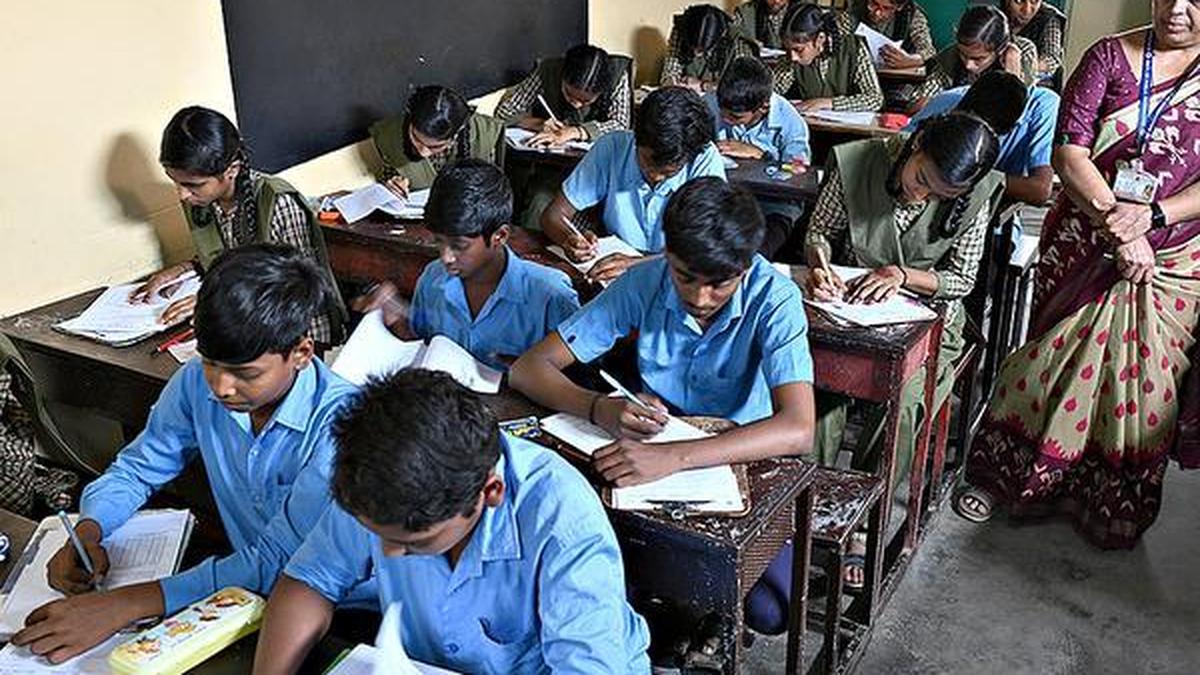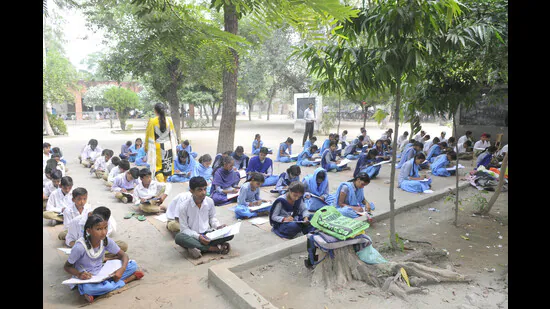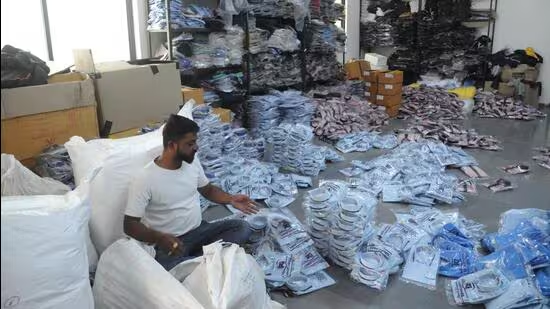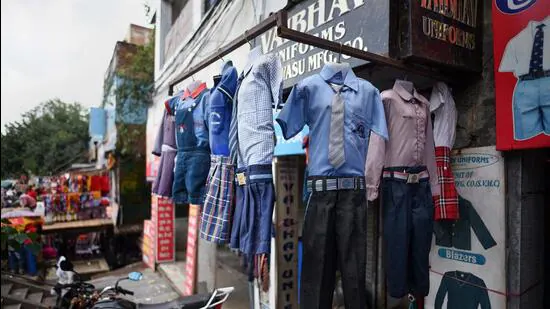
Pune :New Delhi, India - August 16, 2020: School uniforms hanged outside a shop in Gandhi Nagar, New Delhi, India, on Sunday, August 16, 2020. School uniforms manufacturers and sellers are facing many problems as schools are closed amid the Covid-19 pandemic and uniforms are stocked in godowns and shops. (Photo by Biplov Bhuyan/ Hindustan Times) **To go with Manoj Sharma's story (Biplov Bhuyan/HT PHOTO)In a bid to strengthen quality control under the state’s ‘free school uniform scheme’, the Maharashtra Primary Education Council on July 11 directed district authorities to carry out mandatory inspections and laboratory testing of the uniform fabric, warning of legal action against both suppliers and school management committees (SMCs) if the material is found substandard.The directions, issued to all district collectors and chief executive officers of Zilla Parishads/ZPs (excluding the Pimpri-Chinchwad Municipal Corporation), form part of the implementation of the revised ‘free school uniform scheme’ for the academic year 2026-27.According to officials, district administrations have been instructed to ensure that every eligible student receives the benefit of the scheme under the supervision of the district collector, chief executive officer of the ZP, and the superintendent of police.Education Officers (primary) and other local authorities have been asked to closely monitor the implementation of the scheme across villages. The council has made quality verification a prerequisite for releasing payments. Authorities have been instructed not to clear payments until they are satisfied that the uniforms distributed to students are of acceptable quality.To further tighten monitoring, the circular mandates inspections at multiple levels. Cluster heads must inspect 100% of schools, group education officers must inspect at least 30% of schools, while education officers (primary) must inspect a minimum of 10 schools in every taluka.If inspectors suspect that the quality of the fabric is poor, they have been directed to immediately collect samples from the concerned school and send them to an authorised laboratory for testing. In addition, every education officer (primary) must randomly select at least one school in each taluka and send uniform fabric samples for laboratory analysis, irrespective of complaints. The laboratory test reports must subsequently be submitted to the Maharashtra Primary Education Council.The circular further states that if laboratory tests confirm that the fabric supplied is of inferior quality, the education officer (primary) must initiate legal action against both the fabric supplier and the concerned SMC.Officials said that the strengthened inspection and laboratory testing mechanism is aimed at ensuring that eligible students receive uniforms of the prescribed quality and that public funds are not spent on substandard supplies.
Lab testing made compulsory for free school uniform fabric
The council has made quality verification a prerequisite for releasing payments. Authorities have been instructed not to clear payments until they are satisfied that the uniforms distributed to students are of acceptable quality.
421 words~2 min read