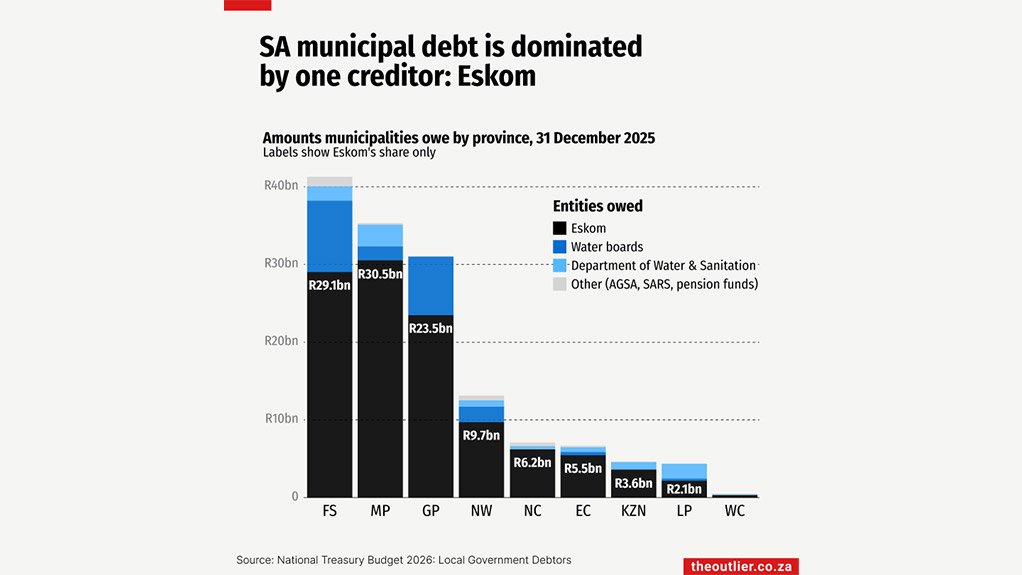
Municipalities do not have an absolute monopoly to supply electricity, Eskom argues in its legal battle against Tshwane metro that has turned into a tussle over the interpretation of the constitution as it seeks to supply electricity directly to residents. The interpretation of the constitutional provision that stipulates a municipality has executive authority and the right to administer electricity reticulation has come into sharp focus in the legal showdown between the Tshwane metro and the power utility. The metro recently succeeded in its legal battle to strip Eskom of the right to supply electricity to a R30bn property development in the east of Pretoria. Pretoria high court judge Anthony Millar, in a judgment last month, found the National Energy Regulator of South Africa’s (Nersa) decision in 2023 to approve a power supply licence to Eskom for the Mooikloof Mega City development was unlawful. The judgment affirmed municipalities’ constitutional authority to supply electricity in their own jurisdictions. The estimated R30bn infrastructure development under construction by Balwin Properties in partnership with the government is expected to involve the building of 50,000 residential units. Eskom has taken issue with Millar’s rejection of its argument that electricity supply does not fall within the exclusive jurisdiction of municipalities and seeks to appeal the judgment before a full bench of the high court or the Supreme Court of Appeal. “The court interpreted the constitution as conferring upon the municipalities an absolute monopoly on the distribution of electricity. The interpretation is plainly wrong,” Eskom’s appeal papers read. “The court erred in finding that the constitution confers ‘exclusive’ executive authority over electricity reticulation upon municipalities. That finding is at odds with undisputed facts that Eskom was supplying customers in the municipality’s [Tshwane] area of supply.” Eskom takes Millar’s judgment as a blow to its plans to widen its footprint in supplying electricity directly to residents. The state-owned entity’s plans come as municipalities struggle to pay the power utility for bulk electricity supply. In May, Eskom disclosed municipalities owed it R111bn. The anchor of Millar’s judgment was not necessarily the interpretation of the constitution but whether Nersa’s amendment of Eskom’s licence to include the Mooikloof development was lawful; he found it was not. The development is built on farmland, and Millar found Tshwane’s licence to distribute electricity included the area under construction. Eskom and Nersa lost the case on the basis that Nersa amended Eskom’s licence and effectively expanded its area to supply electricity to include the development without consent or amendment of Tshwane’s licence, which covers the area under development. Eskom argues that Millar’s judgment contradicted a previous judgment of the high court in Johannesburg on the interpretation of the same section of the constitution. “There are conflicting rulings on the same legal question; this then creates uncertainty and legal instability. In such scenarios, higher court guidance is needed to clarify the law,” Eskom said. “The above reason alone constitutes a compelling reason to grant leave to appeal, as the conflict involves the interpretation of a constitutional section that confers rights on an organ of state to provide the basic service of electricity. The conflict is genuine and materially affected the outcome by Millar J, which differed from that in NCP [case of NCP Chlorchem against Nersa]."Judge Fayeeza Kathree-Setiloane, in a 2017 judgment found that “section 156(1)(a) of the constitution, properly construed, does not give a municipality the exclusive power to supply electricity within its area of jurisdiction”. The 2017 judgment, however, was not mainly about addressing amendments to electricity distribution licence procedures, which was the heart of Millar’s judgment. Nersa has also filed leave to appeal the judgment. The regulator’s grounds for appeal also include arguments on the interpretation of section 156 of the constitution. Business Day
R30bn project: Eskom fights ruling over exclusive municipal authority to supply power
Eskom seeks to supply electricity directly to residents in a legal showdown with Tshwane metro municipality
620 words~3 min read