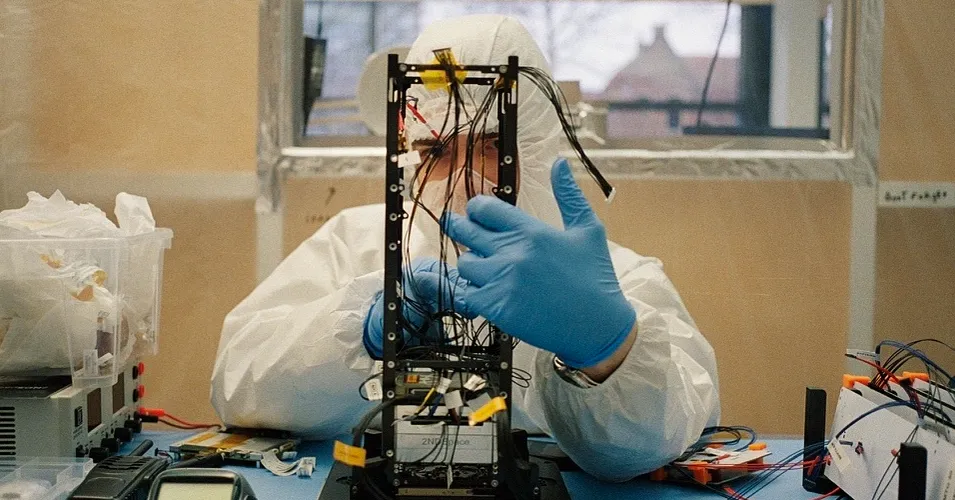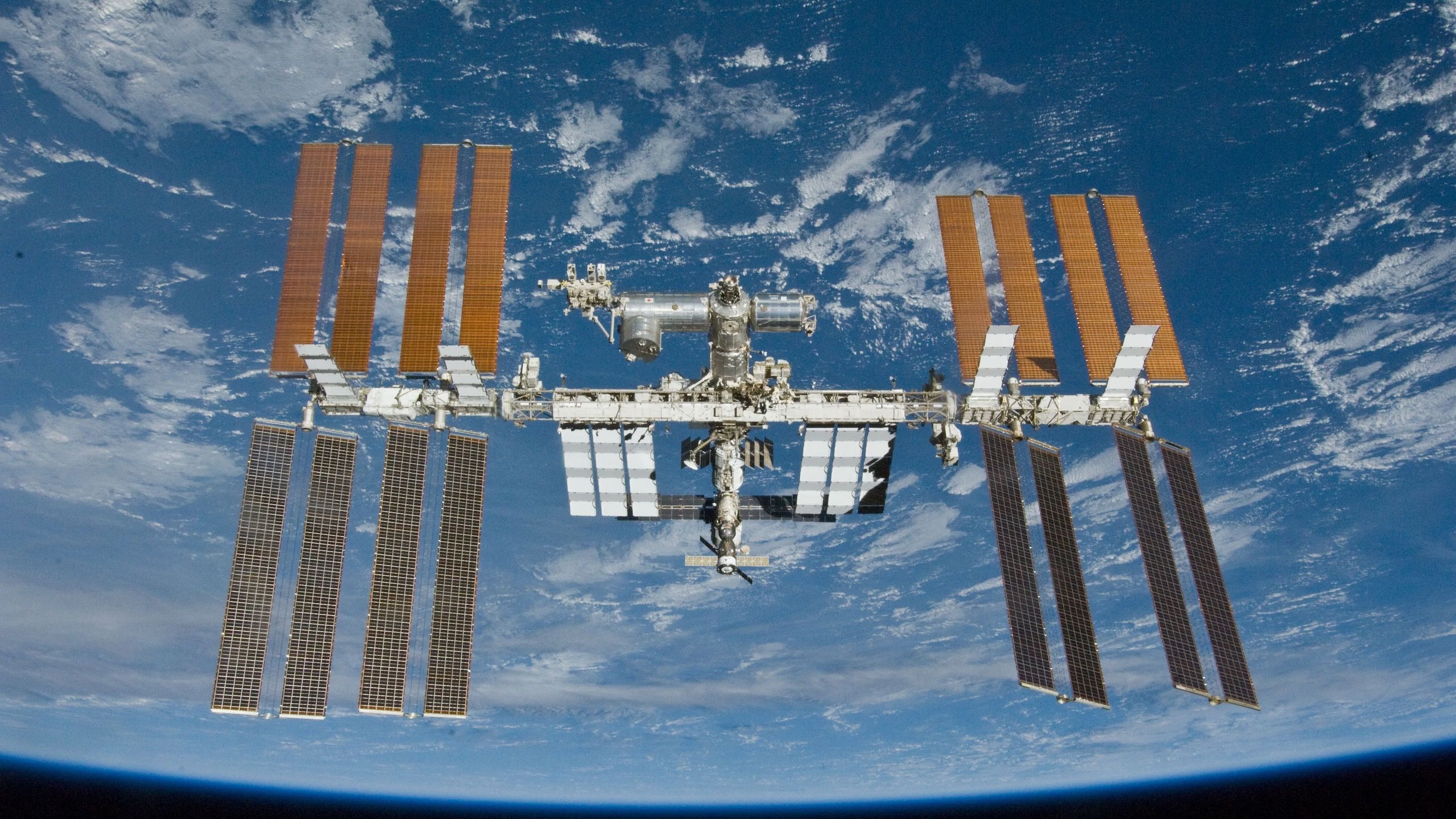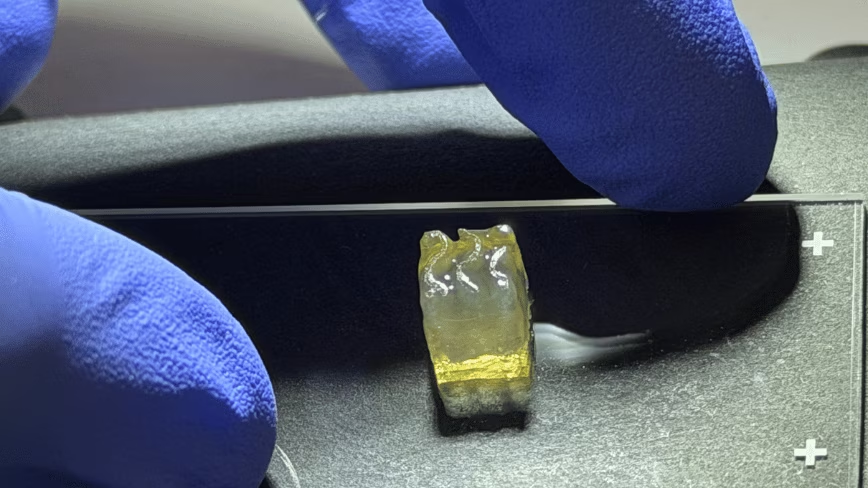
Korean biotech firms join global race to harness microgravity for drug discovery and pharmaceutical manufacturing In this file photo, the International Space Station is pictured from the SpaceX Crew Dragon Endeavour during a fly around of the orbiting lab on Nov. 8, 2021. (NASA) Space, which have been largely dominated by rockets, satellites and astronauts up until now, is gearing up to welcome a relatively new player — drugmakers — with the acceleration of commercial space vehicle race across the globe.As microgravity in space allows proteins to grow into larger and more uniform crystals, it helps scientists better understand the three-dimensional structures of disease-related proteins. This helps drug discovery by giving an accurate picture of the shape drug molecules have to be in order to function.Microgravity can accelerate biological processes linked to aging, including muscle loss, bone density reduction and immune dysfunction, enabling researchers to evaluate potential therapies in shorter timeframes.The space environment also provides an adequate setting for growing organoids and stem cells, which can maintain complex three-dimensional structures more effectively than under Earth's gravity.While global pharmaceutical and biotechnology powerhouses such as the United States, the European Union, Japan and China have already conducted various studies in space, Korea has gotten off to a relatively late start. Despite this, the country’s efforts to play the catch-up game are gaining ground as companies have taken different approaches across the space drug value chain.Biotechnology startup Space LiinTech said Wednesday it has begun preliminary research under the Ministry of SMEs and Startups' new Deep Tech Challenge Project, or DCP, to develop an autonomous microgravity pharmaceutical research and manufacturing platform in collaboration with universities, research institutes, companies and investors.The initiative, which could be receive up to 20 billion won ($13.2 million) in support fund, aims to create infrastructure that pharmaceutical companies can repeatedly use for drug discovery and production in space instead of conducting standalone studies in orbit.“The DCP cooperation marks an important beginning to advance Space LiinTech’s envisioned service space pharmaceutical autonomous service platform based on AI,” said Yoon Harg-soon, CEO of Space LiinTech. “We will lay down groundwork for our space biotechnology firms to enter the global market.”Space LiinTech sent self-developed Biomedical Extra-Terrestrial Enclosure — Protein Crystallization 1, or BEE-PC1, Korea’s first space pharmaceutical research module to the International Space Station aboard a SpaceX Falcon 9 rocket in August last year. The automated platform successfully demonstrated protein crystallization experiments without astronaut intervention.In November, Space LiinTech delivered BEE-1000, Korea’s first cube satellite designed to to perform automated crystallization experiments involving pembrolizumab — the active ingredient in Merck's blockbuster cancer drug Keytruda — to the Low-Earth Orbit on Korea’s space launch vehicle Nuri.The startup plans to send its space drug research platforms three more times this year and eight more times next year, looking to build more microgravity laboratories.In the meantime, Korea’s rather traditional drugmaker Boryung is aiming to build the gateway to those laboratories as it has arguably made the most aggressive long-term bet on space health care in the country.In 2022, Boryung announced a $60 million investment in Axiom Space, a US company trying to build the first private space station in the human history. It also established Brax Space, a 51 to 49 joint venture with Axiom Space to secure the exclusive right to the US firm’s technologies and space station infrastructure in Korea in January 2024, setting up a future passage for Korean players to access the commercial space station.Boryung also invested $10 million in Intuitive Machines, a US space infrastructure company known for designing and building lunar landers, in December 2024. Intuitive Machines made history in February 2024 when its lunar lander achieved the first private, commercial soft landing on the Moon and the first US lunar landing since 1972. The Korean drugmaker also signed an agreement with Intuitive Machines to co-develop a platform for space healthcare experiments leveraging lunar landers and lunar terrain vehicles.Expanding beyond space infrastructures, Boryung launched its Care In Space Challenge — now known as Humans In Space — in 2022, to identify, fund and accelerate startups and researchers hoping to conduct biomedical and pharmaceutical experiments in space.AbTis, a subsidiary of Dong-A ST specializing in antibody-drug conjugate, or ADC, technologies, is taking a more practical approach as it is participating in the Korean government’s initiative to test whether antibodies produced under microgravity can improve the development of next-generation ADC therapies.The company is responsible for designing, optimizing and evaluating ADC candidates using antibodies manufactured in space. Researchers expect that higher-quality protein crystals and antibodies produced under microgravity could eventually improve the precision of complex biologic drugs.Despite various efforts from different space dreamers in the Korean biotechnology sector, experts underscore the need for the need to establish a nationwide consortium, team up with global leaders and craft regulations in advance.“Right now, Space LiinTech and Boryung are moving separately but there is a lack of a nationwide consortium that can integrate them and offer support,” said Kim Jae-uk, a project manager at the K-Health Medical Innovation Research and Evolution.“We need to officially launch a “K-SpaceBio Consortium” so that we can maximize synergy while preventing repetitive investments.”Kim underlined the need to establish a space contract development and manufacturing organization, or CDMO, ecosystem as the country features world’s top-level biologics firms such as Samsung Biologics and Celltrion.He also called for launching a new space biopharmaceutical-dedicated body within the Ministry of Food and Drug Safety and initiating proposals of space good manufacturing practice, or GMP, agenda at the International Council for Harmonization of Technical Requirements for Pharmaceuticals for Human Use to position Korea as a standard-setting country.“The gap with the US and Japan could be narrowed,” said Kim. “The willingness of the government, industry and academia is what will determine the speed (of reducing the gap).”
The next drug lab is in orbit
Space, which have been largely dominated by rockets, satellites and astronauts up until now, is gearing up to welcome a relatively new player — drugmakers — wit
957 words~4 min read