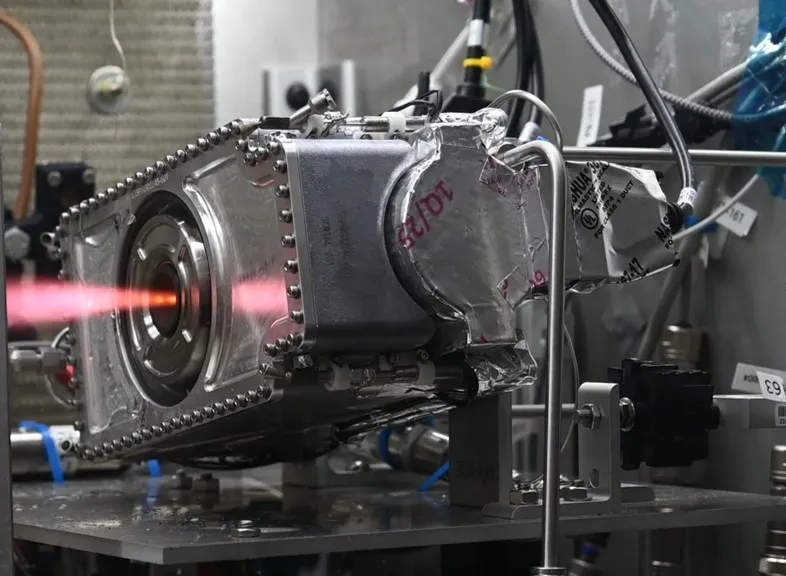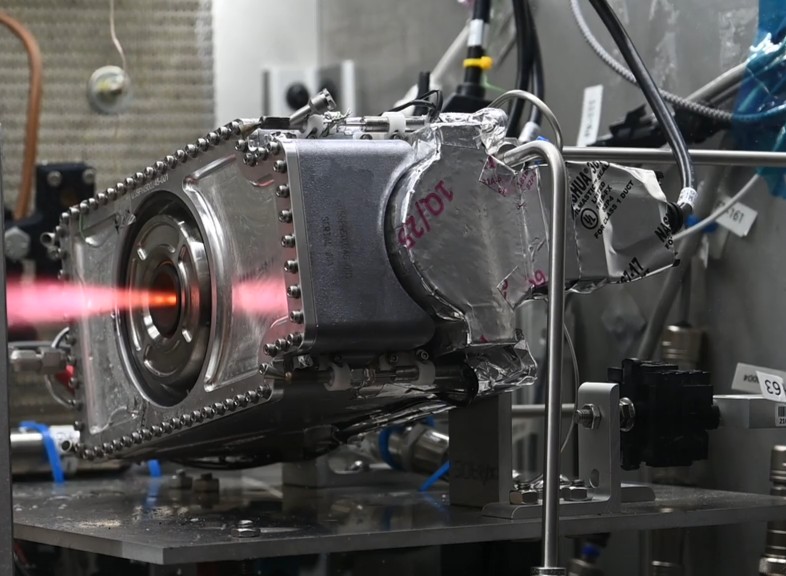
The Dense Orbital Transfer System (DOTS) prototype is seeking to demonstrate a higher thrust and rapid maneuver capability for small satellites. Credit: Parabilis Space Technologies
WASHINGTON — Small satellites have become a staple of military space programs because they are relatively inexpensive and quick to build. Many, however, have little or no ability to maneuver after reaching orbit. The Space Force is working with propulsion startup Parabilis Space Technologies on a system intended to expand the missions those spacecraft can perform.
California-based Parabilis said it has completed hot-fire testing of its Dense Orbital Transfer System, or DOTS, a 2U propulsion module roughly the size of a household toaster. The system uses a hybrid engine that combines solid fuel with a liquid oxidizer, an approach that aims to blend the storage advantages of solid propellants with the controllability and performance of liquid propulsion.
The Space Systems Command described DOTS as a “novel application of heritage space propulsion technology” being evaluated for future military applications.
“While cubesats are cost-effective and useful for one-off experimentation and short-term Earth observation or communications missions, they generally lack any ability to move once they are in space,” Space Systems Command said in a news release announcing the test.