view more
Decaying matter shapes life in soil, but it can also create hostile zones for growing roots. Professor Jiří Friml of the Institute of Science and Technology Austria (ISTA) and international collaborators have now identified “saprotropism,” a root response that guides plants away from decaying plant-derived matter—but not animal-derived decay. The study, led by Yuzhou Zhang, Professor at Northwest A&F University in China and published in Science, reveals how roots adapt their growth direction by sensing local pH gradients around rot.
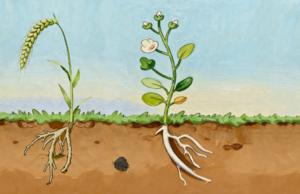
Plants cannot run away from danger or toward something they desire. Instead, they adjust the direction in which they grow. Shoots bend toward light (a well-known phenomenon called phototropism), roots and shoots use gravity to grow downward and upward, respectively (gravitropism), and roots can also bend toward water (hydrotropism). These directional growth responses, known as plant tropisms, help plants navigate changing environments. Now, researchers from China and Austria describe a new member of this family: saprotropism, from “sapro”, meaning rotten or decaying.
“Going beyond the classic tropisms such as gravitropism, phototropism, and hydrotropism was Yuzhou’s idea,” says co-author Jiří Friml, professor at the Institute of Science and Technology Austria (ISTA). “As an alum of my group at ISTA, he took this question further and identified saprotropism, as well as the mechanisms behind it.”