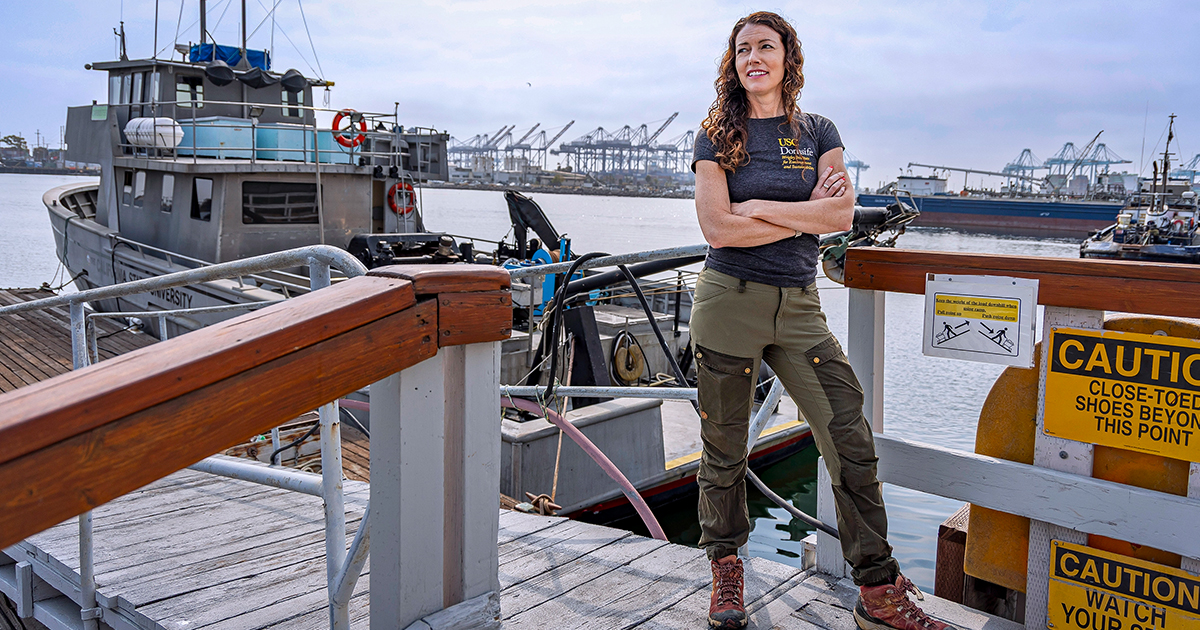
For decades, Jon Zehr was haunted by an organism he knew was here — but couldn’t see.
It all started in the ‘90s on a research boat in the middle of the ocean. Zehr was an oceanographer studying nitrogen-fixing bacteria — simple, microbial life forms that could pull the element straight from the air, making it bioavailable to plants and animals. Scientists at the time had only seriously studied one species of nitrogen-fixing bacteria in the entire ocean, but Zehr wanted to change that. His plan was to gather and test samples of seawater with the hope that he might find something that other scientists had missed.
Left: Jon Zehr (bottom center) sits aboard a research vessel. Right: Zehr studies nitrogen-fixing bacteria in the lab. Courtesy of Jon Zehr.
Zehr’s plans involved something pretty cutting-edge for the time: DNA. He gathered seawater samples and ran tests for the presence of the gene for nitrogenase, the enzyme that gives bacteria the ability to pull nitrogen out of the air. If he got a hit, it would hopefully mean the seawater contained some new kind of nitrogen-fixing bacteria.
And it worked. Almost immediately, he found traces of a species of nitrogen-fixing bacteria previously unknown to science. Looking at the genes themselves, he could get a pretty good idea of what this new bacteria should look like. It was likely a unicellular cyanobacteria, around 3 micrometers in size, that should fluoresce orange under the microscope. Full of anticipation, he popped the seawater samples under the microscope, expecting to see that bacteria everywhere.