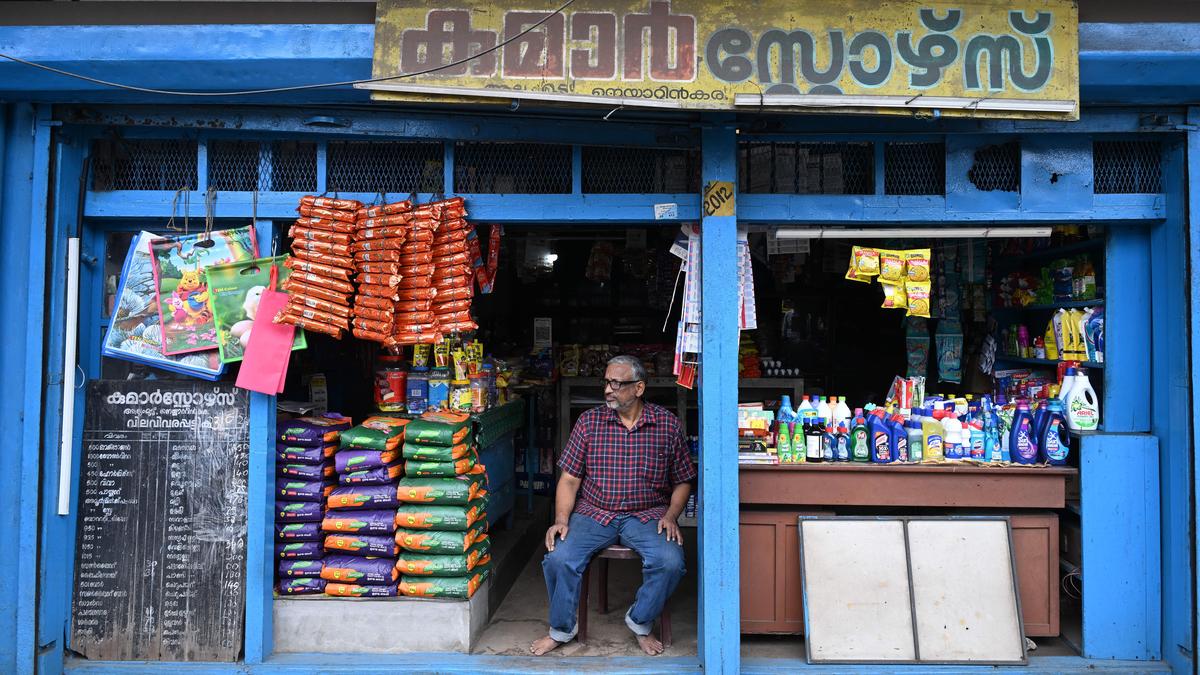
A faint hint of the twilight sun is visible on Mohanan’s face as he sits staring at his mobile screen in front of his shop located a stone’s throw away from the Thamalam level crossing in Thiruvananthapuram in Kerala. Residents walk by, but there is no anticipation in his eyes that one of them would turn to his shop to pick something essential for home.“You can see for yourself. It’s all gone,” says the 62-year-old man, pointing at the shelves with various items arranged haphazardly around, when asked about how his sales have been going.He has sat at this shop for over 50 years now, from the time his father opened it in the neighbourhood in which Mohanan has lived all his life.“It’s all the more sad because I have seen better days in the past. Even five or six years ago, I used to have sales of ₹3,000-₹5,000 daily. Now I hardly manage to have sales of even ₹300 on most days. I stocked a sack of rice about a month ago, but I haven’t sold even half a kilogram of it. Why would anyone come here when they can have it all delivered home? I just come and sit here every morning because it has become a habit. Before long, I will need to shut shop and find some other job, maybe as a security staff somewhere. That will pay more,” rues Mohanan.A common pattern nowMohanan’s plight is not an aberration, but part of a pattern that has been playing out across neighbourhoods in Kerala as well as across the country as quick-commerce platforms and corporate-backed large retail stores spread their wings and penetrate into smaller urban centres and even rural areas.Though early players in the quick-commerce scene began their operations in Kerala in a limited, experimental manner in cities like Kochi about five years ago, the major expansion happened over the past two years. Currently, Swiggy, Instamart, Blinkit, Big Basket, JioMart and Zepto all have operations in the State. With the promise of quick doorstep delivery and attractive prices, these platforms are an appealing proposition for consumers, while many youths have also found employment as delivery partners. Parallelly, major retail chains, including Reliance, have expanded rapidly across towns and rural centres in the State.From a consumer’s perspective, all this makes for a rosy picture, but a walk along the commercial areas as well as neighbourhoods reveals the plight of those who have been struggling to cope in the digital era. The effect has been felt even by relatively large traders who have had flourishing businesses for decades, like the 59-year-old K. Unnikrishnan, whose family has been running Kumar Store in Neyyattinkara for 70 years.
Dwindling Fortunes: quick-commerce platforms, large retail stores sound the death knell for small businesses, neighbourhood shops in Kerala
Small businesses in Kerala struggle to survive as quick-commerce and large retail chains dominate the market, threatening local retail.
1,659 words~8 min read