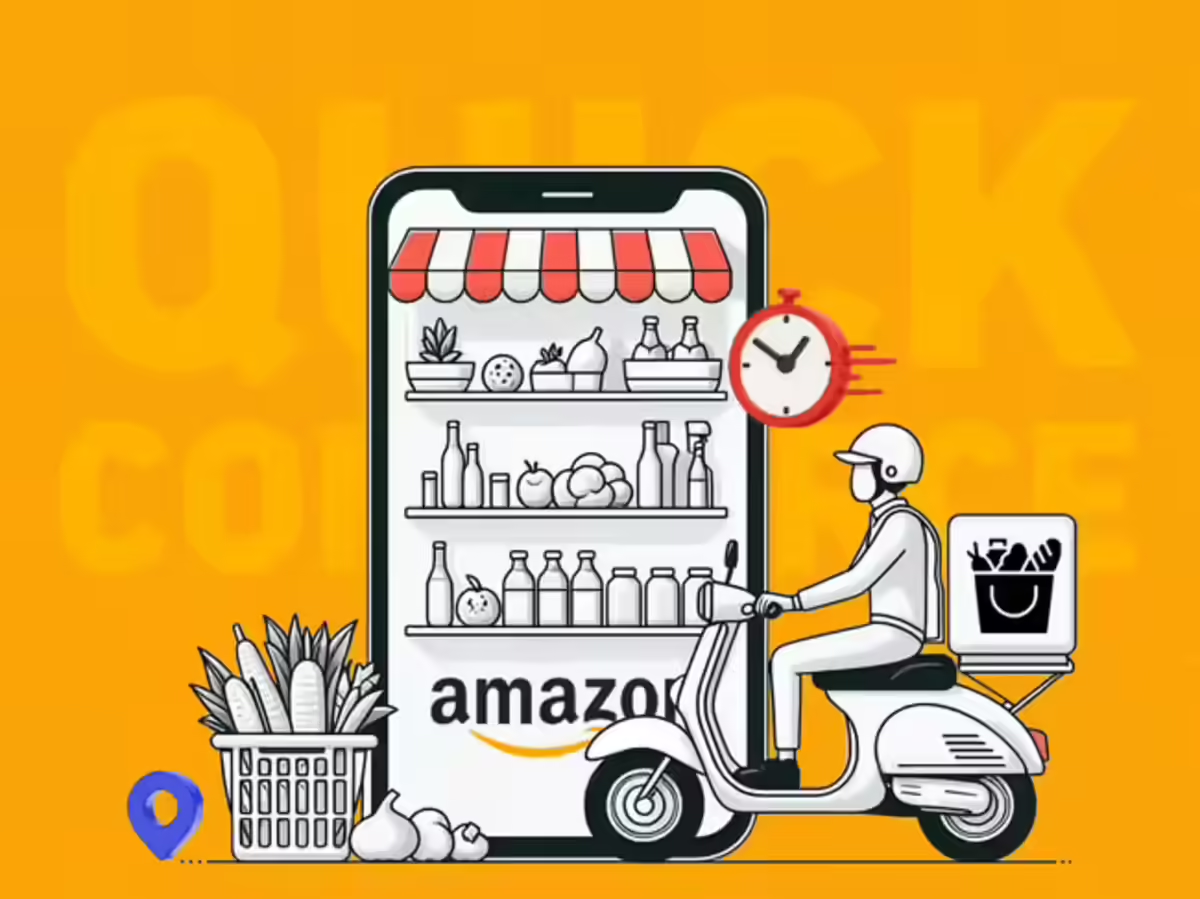
SynopsisQuick commerce is transforming Indian retail. Platforms like Blinkit and Zepto now drive a significant portion of online sales for major FMCG companies. This shift captures impulse buys and premium product sales. However, operational costs and competition pose challenges. Brands must diversify their digital strategies beyond just ten-minute deliveries for long-term growth.iStockIndia's retail landscape is undergoing a tectonic shift as hyper-local delivery platforms, the quick commerce transition from a pandemic-era convenience into dominant digital commerce. Fast-moving consumer goods (FMCG) brands and quick commerce platforms have entered a symbiotic relationship that is rapidly redefining how households shop for daily essentials. By capturing the high-frequency top-up purchases that define Indian grocery habits, these ten-minute delivery networks are outperforming traditional e-commerce giants. The digital takeoverThe transformation of quick commerce from a niche convenience service to the dominant digital sales channel for India’s top FMCG companies has been nothing short of extraordinary. Recent industry data reveals that platforms like Blinkit, Zepto and Swiggy Instamart are no longer just supplementary channels but are actively anchoring the digital balance sheets of major consumer brands. As per a recent ET report, quick commerce accounted for a staggering 60% to 75% of total online sales for corporate giants including ITC Limited, AWL Agri Business, Tata Consumer Products and Parle Products in the fiscal year 2026. This represents a monumental leap from just a year prior when quick commerce accounted for less than half of their digital revenue.The velocity of this migration varies across product portfolios but remains universally high among industry leaders. For Britannia Industries and Tata Consumer Products, the quick commerce channel now contributes more than 70% of all online sales. Dabur India experienced an even more dramatic surge, seeing its quick commerce share climb to 75% in the fourth quarter ended March 2026, up from 50% in the preceding December quarter. Similarly, Parle Products and AWL Agri Business saw their quick commerce online sales shares rise to 65% last fiscal year, up from 50% and 45% respectively in the fiscal year 2025. Even diversified conglomerates like ITC now derive 58% of their online sales from this hyper-fast ecosystem, proving that the trend spans across multiple product categories from snacks to personal care.Also Read| Quick commerce becomes FMCG's biggest online sales channel in IndiaA match made in retail heavenThe underlying chemistry between FMCG brands and quick commerce operators stems from an alignment of consumer psychology and supply chain design. Consumer goods and quick commerce seem to be fundamentally made for each other. Traditional e-commerce models built by companies like Amazon and Flipkart pioneered the digital migration of retail, but they remained heavily skewed toward planned, bulk purchases of staples and long-shelf-life goods. Quick commerce has successfully unlocked the high-frequency, impulse-driven segment of consumer behavior that relies on immediate gratification and mid-week top-ups.This behavioral shift has presented an unprecedented opportunity for FMCG executives to push for premiumization. In traditional brick-and-mortar stores or discount-heavy online marketplaces, consumers are highly price-sensitive and frequently stick to basic necessities. On a quick commerce storefront, the consumer's primary motivation is speed and convenience, which significantly lowers their resistance to higher-value discretionary categories. Corporate leaders have noted that this transition has led to a steep increase in the sales of adjacency categories for companies like Britannia, allowing them to sell far more indulgent, premium products. The instant-replenishment model turns everyday grocery shopping into a series of continuous, micro-transactions, giving brands a constant digital shelf space to tempt buyers with impulse upgrades.The looming operational frictionDespite the glowing sales figures and enthusiastic corporate backing, the road ahead for quick commerce is fraught with systemic friction. As noted in an ET article yesterday, managing high-speed inventory across thousands of hyperlocal dark stores is an incredibly capital-intensive endeavour that burns massive amounts of cash. The thin operating margins inherent to the grocery and FMCG sectors leave very little room for error, especially when these platforms must compete against the aggressive pricing models and deep discounting strategies of established online supermarkets.Furthermore, the physical reality of fulfilling millions of orders within ten minutes is triggering intense social and environmental pushback, the ET article argued. As these platforms scale up, they face growing scrutiny over the labour conditions of delivery executives and the environmental toll of micro-deliveries. There is also an escalating conflict with traditional offline retail ecosystems. India’s millions of local kirana stores and modern trade outlets are seeing their businesses cannibalised by quick commerce networks, and their collective pushback is expected to intensify as dark stores encroach further into their territories. While the centralised warehousing model has proved highly effective in the top eight to ten metros, replicating this infrastructure in smaller, less densely populated tier-two and tier-three towns presents entirely different logistical nightmares.Hedging the hyperlocal betThe ultimate challenge for the quick commerce ecosystem will be converting its current momentum into a permanent, sustainable business model. The industry must prove that it can successfully alter long-term consumer behavior across all market segments, moving buyers away from entrenched price sensitivity toward a permanent preference for impulse buying. This is particularly challenging as platforms attempt to look beyond fast-moving consumer goods and venture higher up the retail hierarchy into non-grocery items that do not inherently require a ten-minute delivery promise.Because quick commerce originally grew out of temporary lifestyle disruptions during the pandemic, it is still too early to conclude that these behavioral alterations are permanent. Globally, the quick commerce experiment has yielded highly mixed results, making India an outlier in its current level of adoption, the ET article argues. As the domestic retail market matures, public awareness regarding the economic and social costs of consumer impatience will inevitably evolve. For FMCG companies, the strategy moving forward cannot rely solely on the quick commerce basket. To safeguard their long-term growth, consumer brands must carefully hedge their bets by continuing to deepen their digital presence across alternative e-commerce channels, traditional trade and automated supply chains rather than surrendering entirely to the allure of the ten-minute delivery window.Read More News on...moreless
For a match made in retail heaven, friction on earth can be real
Quick commerce is transforming Indian retail. Platforms like Blinkit and Zepto now drive a significant portion of online sales for major FMCG companies. This shift captures impulse buys and premium product sales. However, operational costs and competition pose challenges. Brands must diversify their digital strategies beyond just ten-minute deliveries for long-term growth.
997 words~5 min read