The IMF logo. (Yonhap)
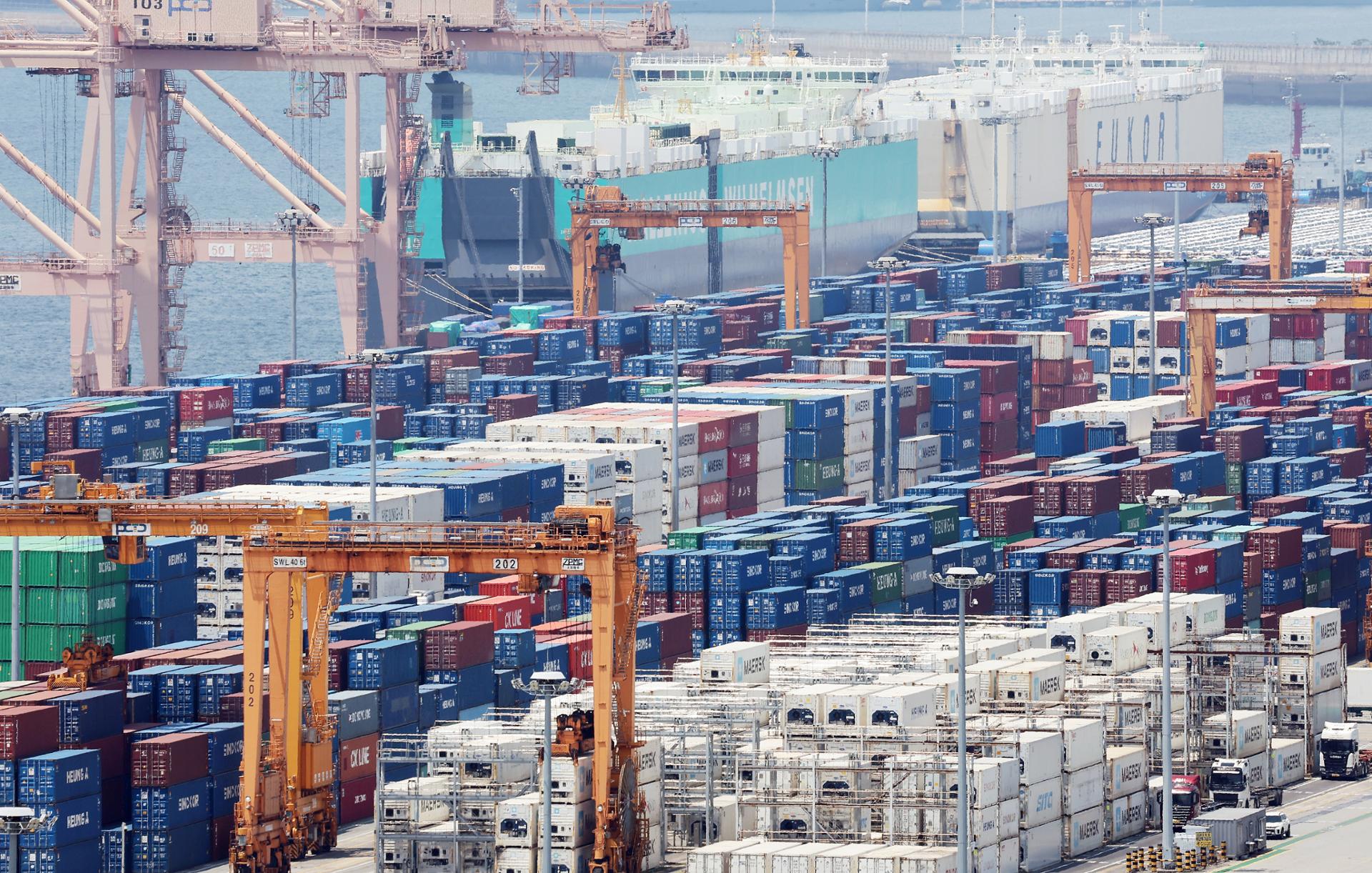
The International Monetary Fund has bumped up Korea’s projected economic growth rate for the year to 2.6%.Surging exports by Korean chipmakers prompted the upward revision despite the economic headwinds of the US and Israel’s war with Iran.In its World Economic Outlook Update released on Wednesday, the IMF predicted that the Korean economy would grow by 2.6% this year, a full 0.7 points higher than its April outlook (1.9%).The IMF’s latest forecast matches earlier projections by the Bank of Korea and the Organisation for Economic Co-operation and Development. Korea’s projected growth rate was the highest of any of the advanced economies included in the forecast.The IMF explained that South Korea’s growth was “buoyed by strong external demand for semiconductors, which dominates the negative impact of the war.”The report named South Korea as one of the top four net exporters of AI-related hardware, alongside Taiwan, Thailand and Malaysia.“Korea, despite its heavy reliance on imported energy from the Middle East, surprised with a 7.5 percent growth rate, more than four times the 1.8 percent projected in April, powered primarily by a semiconductor and AI-hardware export boom,” it said.That suggests that if Korea’s first-quarter growth rate of 1.8% were annualized, it would translate into annual growth of about 7.5%.The IMF forecast that Korea’s growth rate for 2027 would reach 2.5%, up 0.4 points from its earlier prediction. Meanwhile, it downgraded its forecast of global economic growth for 2026 by 0.1 point to 3.0%, and predicted that global headline inflation would reach 4.7%. The agency noted that pressures on the global economy are still “tilted to the downside,” specifically naming instability in the Middle East and trade fragmentation as risk factors. “On the one hand, if the recent surge in AI-related investment were to translate more rapidly into broad-based deployment and efficiency gains, medium-term growth could strengthen,” the report said. “On the other hand, expectations regarding AI-related profitability and productivity gains could be revised downward. In such a scenario, investment in technology-intensive sectors could retrench abruptly, and frothy equity valuations — particularly in AI-exporting economies and markets with high concentration in technology firms — could correct sharply,” it explained. South Korea’s Ministry of Finance and Economy said that the upward revision for both 2026 and 2027 growth outlooks reflected the potential for the country’s semiconductor and AI-related growth momentum to continue into next year. By Shin Min-jung, staff reporterPlease direct questions or comments to [english@hani.co.kr]