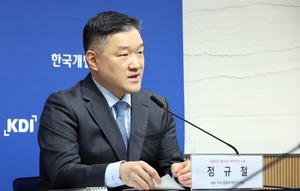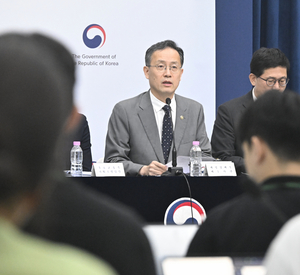
Government raises 2026 growth forecast to 3%, aims to turn semiconductor surge into lasting growth First Vice Finance Minister Lee Hyoung-il speaks during a press briefing on the government's second-half economic policies held in Sejong on Friday. (Ministry of Economy and Finance) First Vice Finance Minister Lee Hyoung-il speaks during a press briefing on the government's second-half economic policies held in Sejong on Friday. (Ministry of Economy and Finance) South Korea on Tuesday raised its 2026 economic growth forecast from 2 percent to 3 percent and unveiled plans to turn the current semiconductor boom into a lasting increase in the country's growth potential.The government expects nominal gross domestic product to expand 12.3 percent this year — the fastest pace in three decades. Exports are projected to surge 40 percent, while the current account surplus is forecast to more than double to a record $290 billion, driven by soaring semiconductor shipments."The biggest change is exports driven by the semiconductor boom," First Vice Finance Minister Lee Hyoung-il said during a briefing. "We also reflected signs that companies are bringing forward facility investment as the chip upcycle strengthens."The government raised its forecast for facility investment growth to 5 percent from just over 2 percent in January.Boom today, slowdown tomorrowDespite the stronger outlook, policymakers acknowledged that the recovery remains uneven. Employment is expected to increase by 150,000 this year, slightly below the previous forecast of 160,000, as much of the growth is concentrated in capital-intensive semiconductor manufacturing. Inflation is projected at 2.6 percent, up from 2.1 percent.The government also expects the boom to moderate. Growth is forecast to slow to 2.2 percent in 2027, with export growth easing sharply to 1 percent as exceptionally strong semiconductor prices and shipments normalize.The challenge, officials said, is to ensure the current chip upcycle leaves a lasting legacy rather than becoming another temporary export-driven rebound.Betting on semiconductors, AITo achieve that goal, the government unveiled what it calls a "3-4-5 Vision" — raising Korea's potential growth rate to 3 percent, making the country one of the world's four largest exporters and lifting per capita gross national income to $50,000. Officials did not set a timetable for achieving a 3 percent potential growth rate, but said the export and income targets remain attainable by 2030 if current trends continue.At the center of the strategy are three large investment projects spanning semiconductors, artificial intelligence infrastructure and industrial AI applications.The semiconductor plan calls for doubling Korea's chip production capacity within five years through 800 trillion won ($537.5 billion) of investment in four fabrication plants in the southwest and 156 trillion won for a high-bandwidth memory and advanced packaging cluster in the Chungcheong region.The government also aims to build 8.4 gigawatts of AI data center capacity backed by 550 trillion won in investment while securing about 50,000 graphics processing units. A separate physical AI initiative will expand AI deployment across factories, robotics, automobiles and shipbuilding.Most of the investment will come from the private sector, with the government supporting projects through infrastructure, financing, research and development, and regulatory reforms. Officials said the goal is to convert today's semiconductor windfall into sustained gains in productivity and capital investment.Building growth beyond boomTo support the expansion, the government plans to broaden visa and residency pathways for foreign national scientists, researchers and graduates, targeting 2,000 highly skilled professionals by 2030.The strategy also expands the role of the Korea Investment Corp. by creating a strategic investment account within the sovereign wealth fund. The new account will provide long-term equity financing for strategic industries, infrastructure and overseas supply chains while remaining separate from KIC's foreign reserve management business.To strengthen economic resilience, the government will introduce a four-pillar supply chain framework covering domestic production, stockpiling, overseas production and import diversification. The package also includes 14.9 trillion won in emergency financing for small and medium-sized businesses affected by the weak won, along with expanded refinancing support for heavily indebted small business owners.Looking beyond the current cycle, the government plans to channel additional tax revenue generated by the semiconductor boom in 2026 and 2027 into a new Future Response Fund, scheduled to launch in the third quarter. The fund will invest in youth, next-generation industries, regional development and education, aiming to turn today's export windfall into longer-term economic growth.
Korea lifts growth outlook, bets big on chip boom
South Korea on Tuesday raised its 2026 economic growth forecast from 2 percent to 3 percent and unveiled plans to turn the current semiconductor boom into a las
707 words~3 min read