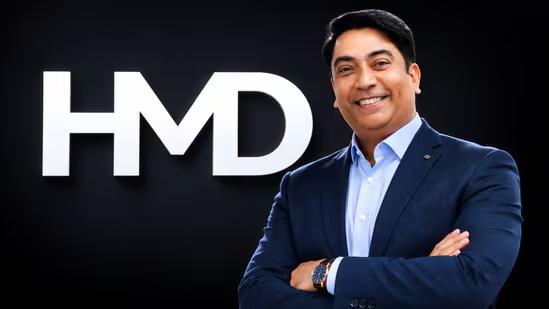
Ravi Kunwar has watched this game long enough to know when the field is out of position. Most of the smartphone industry is bracing for a memory shortage that has already doubled component costs and will, by his own reckoning, keep prices elevated for another 12 to 18 months. Kunwar, VP and CEO for HMD Global India and APAC, is doing the opposite of bracing. He is pushing forward — into the exact price band everyone else is retreating from.The logic is the logic of a batsman who has read the pitch better than the bowlers. When the surface turns and the run rate collapses, the panicked player swings harder and gets out. The one who has been at the crease for two decades does something quieter: he plays the percentages, works the gaps, and lets the others lose their wickets. Kunwar is a Nokia veteran — he cut his teeth inside the Finnish empire from which HMD spun out — and he carries the unhurried, strategic articulacy of a man who has seen one giant fall and is now building the next thing from its foundations. Ask him a sharp question and he answers in full paragraphs, unbothered, the way an old hand plays a short ball off the back foot.The numbers give him room to be calm. In the IDC Q1 2026 India feature-phone reckoning, HMD's brand portfolio — the HMD-branded phones plus the Nokia-branded keypad devices it still makes — took 47.2 per cent of the market by value and 32.7 per cent by volume, the No.1 position on both counts. The HMD Global brand standalone, 18 months into its independent life in India, holds 16.8 per cent by value and 13.5 per cent by volume. "This milestone goes beyond market leadership," Kunwar has said of the IDC data. "It reflects the growing trust Indian consumers are placing in HMD." For a brand that most Indian buyers could not have named two years ago, value and volume leadership in the same quarter is the equivalent of a debut century.The Phone That Sold Out Before LunchThe proof of the strategy arrived in late May, and it arrived fast.The HMD Global Vibe 2 5G — an entry-level device built in partnership with Sarvam AI and sold as a Flipkart exclusive — went on first sale on 26 May 2026 at Rs 10,999 for the 4GB/64GB variant and Rs 11,999 for 4GB/128GB. What happened next is the sort of thing brands usually inflate; Kunwar deflated it instead. "On day one itself, we saw a very positive response, selling hundreds of thousands in a short span of time," he said. Pressed on whether that meant six figures, he confirmed it with a qualification rather than a boast: "Close to that. That's a triple-digit number, in thousands, which we have, and it was in less than an hour."Roughly 100,000 phones in under 60 minutes, at a price point the rest of the industry is quietly abandoning. That is the whole thesis compressed into a single sale. And the feedback that followed the transaction mattered as much to Kunwar as the transaction itself. "It's not just the primary sales," he said. "The feedback online for our devices — the looks, the CMF, the colour, the whole value for money — is good feedback for us to have." The candour is the tell. A man selling a weak product talks about the sale; a man selling a strong one talks about what buyers said the morning after.Playing The Gap While The Field RetreatsHere is where the strategy gets genuinely counter-intuitive, and where Kunwar's read of the pitch separates from the panic around him.The memory crisis is real, and he does not pretend otherwise. "What memory was available to us probably two months back is now double the cost," he said. "And even if it is double the cost, it's not available." His forecast is unsentimental: the squeeze runs another 12 to 18 months, because standing up new memory fabrication capacity is not an overnight job — it is "a good 12 to 18 months of sustained investment from the big companies who are into this space." Prices, in his telling, will stay high and stabilise rather than fall; supply will stay tight. It is the same flood every consumer-electronics executive is watching approach.I have interviewed enough executives to know that most treat a supply shock as a reason to hedge. Kunwar treats it as a gap in the field. His reasoning rests on a fact that flips the disadvantage into an opening: HMD Global is a young brand growing off a small base, so the contraction that threatens incumbents barely touches it. "For us, the answer is simple, because we are a young brand," he said. "Our base is starting now. Our expectation is that our growth will be significant, especially with the launch of the HMD Vibe 2 5G and subsequent models."The demand he is chasing is the demand nobody can afford to serve. "In India, there is a huge demand for anything below Rs 10,000 in the 4G space, and anything below Rs 15,000 in the 5G space," he said. "If somebody is able to supply, the demand will be there." That conditional — if somebody is able to supply — is the entire strategic bet. When components are scarce and dear, the brands with the discipline to keep an entry-level 5G phone under Rs 11,000 inherit a market the premium players have priced themselves out of. Kunwar is betting that an efficient supply chain, not a bigger marketing budget, is the scarce asset in a shortage. With the festive season approaching, he expects "a huge upswing across the length and breadth of the country."When I put a specific analyst projection to him — an Omdia read suggesting the sub-$400 segment would contract sharply — Kunwar declined to concede the premise without seeing the workings, which is exactly what a careful strategist does with a number he cannot yet source. "It'll be interesting to understand where this analysis is coming from," he said, before turning even a hostile projection to his favour: "It's happy if that happens, because that is beneficial for the consumer." A shrinking premium segment, to a brand that lives at the bottom of the market, reads as customers walking towards you rather than away.Sovereign AI, On A Rs 10,999 PhoneThe Vibe 2's headline act is the part that inverts the entire industry conversation about artificial intelligence.Every flagship launch of the past two years has framed AI as a luxury feature — the reason to spend more, the justification for the Rs 1.5-lakh phone. HMD Global has put it on a Rs 10,999 one. The Vibe 2 5G is the first phone to ship with Indus by Sarvam AI, the Indian sovereign model, and it converses in 22 regional languages, reading dialect and context in a way imported assistants trained on global English do not. "When the world talks about AI, we are talking about real Indian AI," Kunwar said. "This talks to consumers in their own dialect and understands the context, which no other AI can provide. It's connecting to the masses in the vast hinterland of the country."The move is less sudden than it looks, and the sequencing reveals the strategist. HMD Global did not begin with the smartphone. It began at the bottom — a Sarvam integration running on a sub-Rs 1,000 Nokia feature phone over 2G, announced, in Kunwar's telling, at an AI summit. "People are talking about the extreme high end of AI; we are making it accessible to the length and breadth of the country," he said, pointing to the roughly 200 million subscribers still on feature phones, "a majority of them on Nokia and HMD." Start where the volume is, prove the model works on the cheapest hardware in the country, then move it up to the smartphone. It is a gambit played from the back rank forward.For Sarvam, the arithmetic is about distribution. "If you hear what Sarvam has to say, they want scale, which will come through a device-centric approach," Kunwar said. A sovereign model needs to reach real phones in real hands to matter; HMD sells to precisely the demographic — regional-language, first-time, hinterland — that a made-in-India AI is built to serve. Each side supplies what the other lacks. That is the shape of a partnership that lasts beyond a launch cycle, and Kunwar frames it as the first movement rather than the finished symphony: "This partnership will evolve and grow, and we'll bring more features into this space."Out Of Nokia's ShadowFor a decade, the company Kunwar runs sold phones under someone else's name. That chapter is closing, and how he talks about it is the most revealing part of the conversation.HMD Global has existed since 2016 — a ten-year-old organisation that, for most of that decade, was the custodian of the Nokia name in mobile. To the Indian buyer it was "Nokia, Nokia"; HMD Global stayed offstage, the machinery behind a heritage badge. That arrangement is ending. Nokia-branded smartphones are done; the Nokia name now continues only on feature phones — keypad devices like the Nokia 210 4G that HMD rolled out days before this conversation, part of a fresh clutch of four AI-button Nokia handsets that put a one-press assistant on a device with a numeric keypad. The smartphone future carries the HMD name alone.Kunwar draws a careful distinction that a lesser strategist would blur. "HMD Global, the makers of Nokia phones, has been there for ten years," he said. "But if I talk of HMD as a consumer-facing brand, we launched it around one and a half years back with feature phones." The organisation is a veteran; the brand is a debutant. Holding both truths at once is the trick of this transition — the credibility of the old empire, worn under a new name aimed at buyers too young to have carried a Nokia 3310. The Rajasthan Royals associate sponsorship this IPL season, now in its third year, and the Flipkart tie-up that reaches more than 18,000 pin codes are the two loudest instruments in that brand-building push. "There is going to be enough and more work around making HMD a consumer household name," he said.Ask him whether the Espoo heritage — the Scandinavian design lineage, the Finnish R&D story — still travels with the new brand, and the answer is a single line built to be quoted. "It's inspired from Finland but made in India," he said. He wants the best of both, he added, "but it is more forward and future-looking" — a brand tuned to Gen Z rather than to nostalgia. It is the neatest possible summary of a company trying to inherit an empire's competence while shedding its ghost.Compliance As StrategyThe Vibe 2 ships with the Sanchar Saathi app pre-loaded — the Department of Telecom's device-tracking tool — and that decision drops Kunwar into one of the year's sharper regulatory fights.Back in December, a government direction to pre-install Sanchar Saathi drew public resistance from the biggest names in the business, with privacy specialists raising real questions about a state tracking application baked into every handset. HMD went the other way and complied — but Kunwar is precise about the terms of that compliance, and the precision is the strategy. "We value privacy a lot; we comply with all the GDPR and Indian regulations," he said. The government's own direction, he noted, turned on two questions: whether pre-loading was mandatory, and whether the consumer could remove it. "What we have gone with is: there is an option. If the consumer doesn't want it, it's a simple uninstall, and everything goes. The control lies with the consumer."Then the line that quietly separates HMD from the holdouts. "Certain brands could have had challenges in terms of where their servers were and how data was being accessed," he said. "But as far as HMD is concerned, we comply fully, and we give the consumer that option." Read that twice. Where the global giants saw a compliance risk worth fighting, Kunwar saw a low-cost way to sit on the same side as the regulator while the marquee brands absorbed the friction — and to point, without naming anyone, at whose data architecture might have had something to worry about. For a brand courting government goodwill and hinterland trust at once, pre-loading a state security app with an uninstall toggle is not a concession. It is a positional move.The Omni EverythingUnderneath the strategy sits a set of deliberately un-flashy operational choices, and Kunwar lists them the way a captain sets a field.On silicon, the Vibe 2 runs a Unisoc T8200 rather than the Qualcomm or MediaTek parts most rivals default to — a choice he defends on proof rather than price alone. "Unisoc is now a very proven chipset for the India market," he said. "Whether you look at AnTuTu scores or simple user experience, it's proven it's worth it." He frames the company as "an omni-processor brand" to match its "omni-channel" distribution — no single-vendor dependency on either the chip or the shelf, which in a supply crunch is less a philosophy than a survival trait. The brand that can source from more than one fab keeps shipping when a single-sourced rival cannot.The forward book is deliberately half-open. The immediate focus stays on the Vibe 2 and Flipkart, but Kunwar confirms "a few things in the pipeline" for closer to the festive season, and — tellingly — an active look at the 4G smartphone space, where the affordability squeeze bites hardest. A 4G smartphone under Rs 10,000, aimed at the buyer for whom even entry 5G is a stretch, would be the logical next percentage played. He will not date it, and the refusal to over-promise is itself in character. This is a strategist who reveals the move only once it is on the board.That is the HMD bet, stripped of adjectives: a young brand growing off a low base while the field contracts, sovereign Indian AI carried down to the cheapest hardware in the country, the Nokia name retired from smartphones and preserved on keypads, regulatory compliance turned into positioning, and a supply chain built to keep an entry-level 5G phone under Rs 11,000 through a shortage that is breaking that discipline everywhere else. The bowlers are trying to buy Kunwar's wicket with a rising price and a turning pitch. He has decided to bat through the session. On the evidence of one Flipkart sale that emptied in under an hour, the pitch is playing truer than the panic suggests.FAQ What is the HMD Vibe 2 5G price in India?The HMD Vibe 2 5G is priced at Rs 10,999 for the 4GB/64GB variant and Rs 11,999 for 4GB/128GB, sold as a Flipkart exclusive (also on HMD. com), on sale from 26 May 2026 in Nordic Blue, Cosmic Lavender and Peach Pink.What are the HMD Vibe 2 5G specifications?It runs a Unisoc T8200 chipset on Android 16, with a 6.75-inch HD+ 120Hz display, a 6,000mAh battery with 18W charging, a 50MP main camera and an 8MP front camera. It is the first phone to ship with Indus by Sarvam AI, supporting 22 regional languages.Is HMD the No.1 feature phone brand in India?Per IDC's Q1 2026 data, HMD's brand portfolio (HMD plus Nokia keypad phones) leads India's feature-phone market on both value (47.2 per cent) and volume (32.7 per cent). The standalone HMD brand holds 16.8 per cent by value and 13.5 per cent by volume, 18 months after its independent India launch.Will phone prices rise because of the memory shortage?HMD's Ravi Kunwar expects memory and component costs to keep phone prices elevated for another 12 to 18 months, saying memory that was available two months earlier now costs double and is scarce, with prices stabilising rather than falling.Is HMD discontinuing Nokia phones?Nokia-branded smartphones are being discontinued, but HMD will continue selling Nokia-branded feature phones, such as the recently launched Nokia 210 4G with a dedicated AI button. HMD's own smartphone future carries the HMD brand name.What is Indus by Sarvam AI?Indus by Sarvam AI is an Indian sovereign AI model integrated into the HMD Vibe 2 5G — the first phone to carry it — able to interact in 22 regional Indian languages with contextual and dialect understanding. HMD first integrated Sarvam AI on sub-Rs 1,000 Nokia feature phones over 2G.end of article
Exclusive: HMD Global Bets On Rs 10,999 5G Phone As Memory Shock Pushes Rivals To Raise Prices
A memory shock is pushing phone prices up across the board. The company that used to be Nokia is doing the opposite — and the numbers say it is working.
2,738 words~12 min read