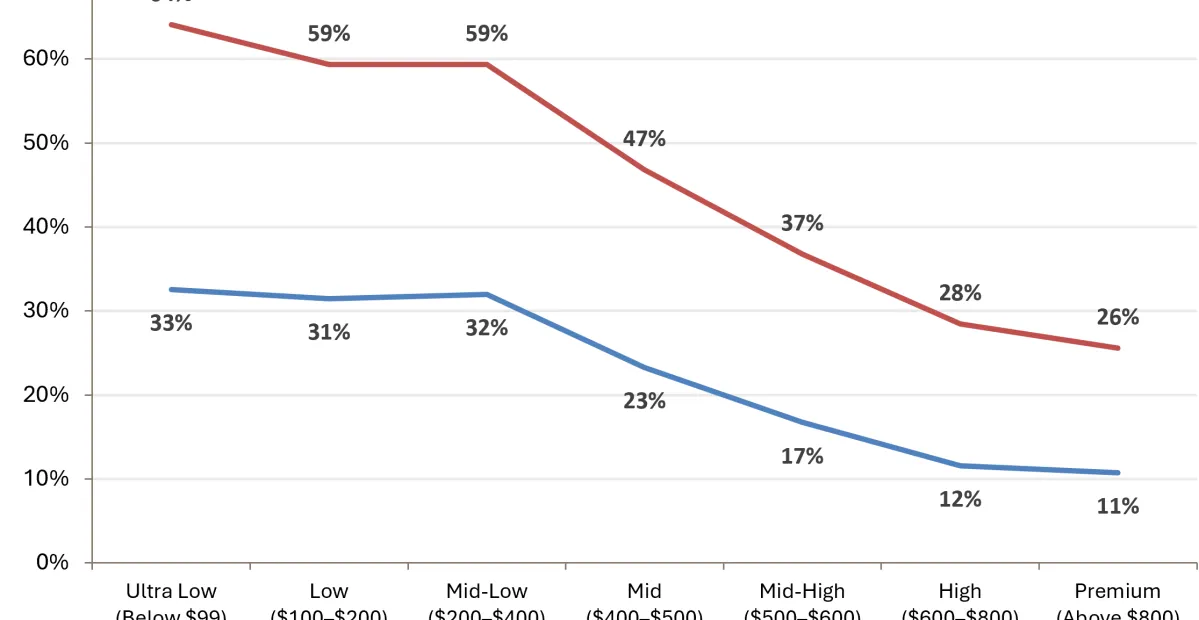
The cheap smartphone is being squeezed out of existence, and the reason sits inside the phone itself: the memory chips.New research from Omdia says the global market for smartphones priced below $400 — roughly Rs 34,000 — will shrink by more than 22 per cent in 2026, dragging the whole world smartphone market down 12 per cent for the year. The cause is a sharp, sustained rise in the price of the two kinds of memory every phone needs: DRAM, which runs the apps, and NAND, which stores the photos, videos and files. Both have climbed steeply over recent quarters, and Omdia expects them to keep climbing.The damage is uneven, and that is the real story. While the bottom of the market collapses, phones priced above $400 are set to grow 5.7 per cent this year. The same shock that is killing the budget phone is leaving the premium phone almost untouched. The memory crisis is splitting the smartphone market in two.This is the first of a two-part series from Omdia. The first, summarised here, explains how memory prices are rewriting the economics of the cheap phone. The second will look at how vendors are freezing or cutting memory in their low-end models while continuing to upgrade the expensive ones — a split the report calls memory polarisation.Memory Now Costs More Than Everything Else CombinedA budget phone's cost sheet works like a tight household budget. When one bill doubles, and that bill already takes most of the money, there is little left for anything else. Memory is now that bill.In the first quarter of 2026, memory accounted for close to 60 per cent of the total bill of materials — the combined cost of all the parts — in smartphones priced below $400. In phones priced below $99, it passed 64 per cent. Put plainly, in the cheapest phones on sale, the memory alone costs more than the screen, the processor, the cameras, the battery and the casing put together.The speed of the change is what makes it dangerous. Between the third quarter of 2025 and the first quarter of 2026, the share of the bill taken up by memory nearly doubled in the sub-$400 segment, and rose by more than 100 per cent in phones above $400. Omdia's own numbers put the price of the memory a phone maker could buy two quarters ago at half of today's cost — and even at today's higher price, the supply is thin.Why Memory Suddenly Costs So MuchThe root of the squeeze sits far from any phone factory. It is AI.The same memory chips a phone needs are the chips that AI data centres are buying in enormous volume. Building and running large AI models eats memory, and the three companies that make most of the world's supply — Samsung, SK Hynix and Micron — have moved their factories towards the high-margin memory that AI servers crave, chiefly high-bandwidth memory. Every wafer that goes to an AI customer is a wafer that leaves the ordinary DRAM and NAND used in phones. Supply tightens, demand holds, and the price climbs. For the memory makers, this is the best market in years; for a budget phone maker buying the leftovers, it is the worst.That single cause explains why the pain reaches well beyond the phone. The same shortage is lifting the price of laptops, desktop PCs and televisions, with television makers already warning of double-digit price rises over the coming months. A phone feels it first and hardest at the bottom, where memory is such a large share of a tiny bill.Omdia expects the pressure to stay. Standing up new memory capacity is slow work — a matter of many quarters, not weeks — so the imbalance between what AI wants and what phones can get looks set to run well into next year before supply and demand find a new level.Why Budget Phones Run Out Of RoomWhen one cost jumps, a phone maker's first instinct is to trim another. That works when there is slack in the design. In cheap phones, the slack is already gone.Vendors are doing what they can. They are cutting the cost of the parts where supply stays plentiful — display panels, sensors and the radio-frequency modules that handle mobile signal. But a budget phone is already built to the bone. It was cost-optimised long before this crisis began, which leaves almost no fat to cut. So the saving from a cheaper panel or a simpler sensor stays far short of covering a memory bill that has doubled.That leaves one lever: the price on the box. And pulling it starts a chain reaction the whole industry can see coming.The Retreat From The BottomZaker Li, principal analyst on Omdia's consumer team, is blunt about where this goes. Memory costs have become a serious burden for low-end smartphones, he noted, and the situation will worsen as memory prices keep rising over the coming quarters.His account of the vendor response is the heart of the report. Smartphone makers such as Transsion, OPPO, vivo, Honor and Xiaomi are raising the retail prices of their cheap phones sharply — and doing it only to hold on to a thin profit margin, rather than to grow one. Higher prices, though, meet a buyer who feels every rupee. Low-end customers are the most price-sensitive on earth; when the phone costs more, many hold on to their old one or step away from the purchase.So the maths turns against the cheap phone from both sides. Costs rise faster than prices can follow, and every price rise that does happen thins out the buyers. Low-end products are already becoming unprofitable, Omdia finds, and they face a growing risk of weakening demand as prices climb further. Faced with that, phone makers are doing the rational thing: they are gradually retreating from the low-end segment this year, and putting their effort where the money still works.The forecast captures the deepening pressure. Omdia's May outlook has the global smartphone market falling 12 per cent in 2026 — a sharp worsening from the 7 per cent decline the firm had projected only weeks earlier, in March. The whole of that extra damage traces back to the bottom of the market, where shipments of phones at $400 and below are set to drop by more than 22 per cent this year.The Premium End Holds FirmNow the other half of the split. While the cheap phone falls, the expensive one grows. Omdia expects shipments above $400 to rise 5.7 per cent in 2026, and three forces explain the gap.First, phone makers are steering their attention and their best components towards mid-range and premium models, where a sale still turns a profit. Second, the steady march of price rises is itself pushing more products up over the $400 line, so the premium band grows partly by absorbing phones that used to sit below it. Third, and simplest, the premium buyer barely blinks at a price rise. Someone spending Rs 90,000 on a flagship absorbs a few thousand rupees of extra memory cost and carries on; someone spending Rs 9,000 feels every rupee of it.There is one more advantage the premium phone enjoys, and it is the quiet key to the whole split: it has room to cut.Where Vendors Still Have Room To CutIn an expensive phone, memory is a smaller slice of a much bigger bill, and the other slices are large enough to trim. As the price of a phone rises, memory's share of its cost falls quickly, especially above $600, where the processor, display and cameras take up most of the budget. That gives vendors three places to find savings and soak up the memory shock:Display: Chinese vendors are moving some high-end models back from LTPO screens to slightly simpler LTPS OLED panels, keeping the top LTPO technology only for their most premium phones. The switch saves around $3 to $5 per device.Cameras: makers can mix and match sensors to suit each model, using smaller image sensors or fitting fewer cameras where the positioning allows.Processor: the chip is the single biggest cost in phones above $600, and vendors can slow the upgrade pace by carrying over the previous generation's platform — a move that can cut that cost by roughly 30 to 40 per cent.These levers vanish at the bottom of the market, because the cheap phone lacked the expensive parts to downgrade in the first place. That is the whole difference. The premium phone can give ground to protect its margin. The budget phone has run out of ground.Why India Sits At The Sharp EndNo major market is more exposed to this than India, because no major market leans harder on the cheap phone.India is a price-first market. The bulk of the phones sold here fall inside Omdia's danger zone, below that $400 line, and a large share sit far beneath it. The vendors Omdia names as raising prices — Transsion's itel, Infinix and Tecno brands, plus OPPO, vivo, Xiaomi and Honor — are the same names that fill the shelves of a mobile shop in any Indian town. When their entry phones get costlier, the effect lands on first-time buyers, on students, on the households upgrading from a feature phone, the exact customers with the least room in their own budgets.The early India data already matches the global warning. IDC's figures for the first quarter of 2026 show India's overall smartphone market down 4.1 per cent, with the entry-level tier — phones under roughly $100 — collapsing by close to 59 per cent year on year as rising component costs pushed those models out of reach. Across the industry, brands including Xiaomi, vivo, OPPO and Samsung have already raised prices on Indian models this year. The squeeze Omdia describes in a global report is, on the ground in India, already a lived reality on the shop counter.It also reshapes what winning looks like here. The brands betting on cheap, feature-rich phones are having to rethink how cheap they can stay. Some are pushing buyers gently upmarket; others are leaning on tie-ups and financing to keep a phone feeling affordable even as its sticker price climbs. The feature phone, cheap and memory-light, suddenly looks a little more durable than anyone expected, precisely because it sidesteps the DRAM and NAND that are breaking the smartphone's budget.What Happens NextThe uncomfortable truth in Omdia's numbers is that this is not a passing blip that clever cost-cutting will absorb. Memory demand from AI data centres is pulling supply and pricing in a direction that suits the expensive phone and punishes the cheap one. As long as that holds, the sub-$400 phone stays under pressure, and the market keeps splitting into a healthy top and a shrinking bottom.For the buyer at the value end, that means fewer choices and higher prices on the phones they can afford. For the vendors, it means a hard call between chasing a shrinking, unprofitable low-end and following the money upmarket into a more crowded premium fight. And for a market like India, built on the affordable smartphone, it raises a question the next few quarters will answer: what happens to the next hundred million first-time buyers when the cheapest good phone stops being cheap? Omdia's second blog, on how vendors are cutting memory in low-end models while upgrading the premium ones, takes up that thread next.FAQWhy are cheap smartphones getting more expensive in 2026?The prices of DRAM and NAND memory chips have roughly doubled over recent quarters, driven partly by AI data-centre demand. Memory now makes up close to 60 per cent of the parts cost of a sub-$400 phone, and budget phones have little slack to cut costs elsewhere, so prices rise.How much will the budget smartphone market shrink?Omdia forecasts that global shipments of smartphones priced below $400 will fall by more than 22 per cent in 2026, pulling the entire global smartphone market down 12 per cent for the year.Are premium phones affected too?Less so. Omdia expects shipments above $400 to grow 5.7 per cent in 2026, because vendors are focusing on premium models, price rises push more phones over the $400 line, and premium buyers are less sensitive to price. Expensive phones also have costly parts they can downgrade to absorb the memory hit.How much of a budget phone's cost is memory now?In the first quarter of 2026, memory reached nearly 60 per cent of the total bill of materials in phones below $400, and passed 64 per cent in phones below $99 — more than all other components combined.How does this affect India?India relies heavily on sub-$400 phones, so it is among the most exposed markets. IDC data shows India's entry-level segment (under about $100) fell close to 59 per cent year on year in Q1 2026, and brands including Xiaomi, vivo, OPPO and Samsung have raised prices on Indian models.Which vendors are raising prices?Omdia names Transsion, OPPO, vivo, Honor and Xiaomi as raising retail prices on low-end phones to protect thin margins — all major players in India's budget market.Who wrote the Omdia report?The research is by Zaker Li, principal analyst for mobile devices at Omdia. Based in China, he has over ten years of experience covering the smartphone industry, with earlier roles at TCL and IHS Markit.end of article
Omdia Warns Budget Phones Could Take A Big Hit From Memory Costs: Here's Why
The chips that store your photos and run your apps have doubled in price. For the cheap phone, that is turning into a death sentence — and India sits at the sharp end.
2,214 words~10 min read