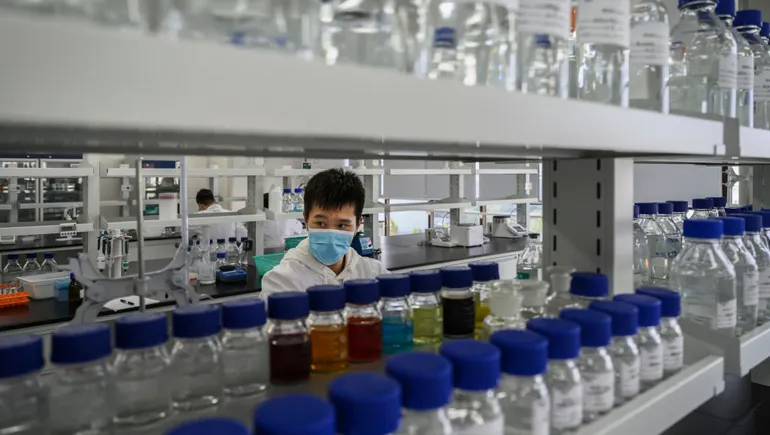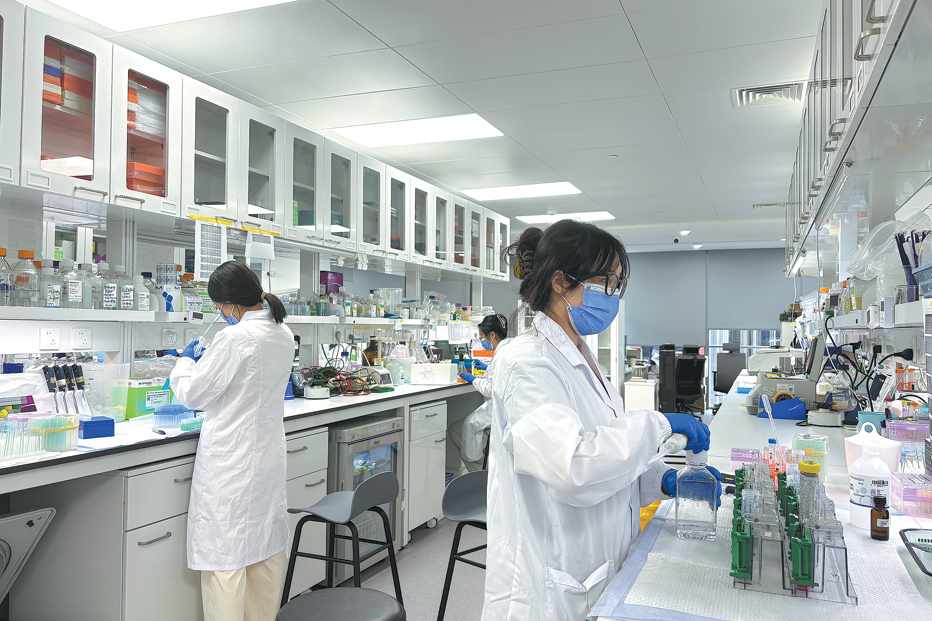
Researchers from Junying Yuan's team perform experiments at the cell biology laboratory of the Interdisciplinary Research Center on Biology and Chemistry, Chinese Academy of Sciences, in Shanghai on Monday. GUO YALI/CHINA DAILY
China is actively exploring innovative approaches to organizing biomedical research, betting that institutional reforms can help close one of the industry's most persistent gaps — turning laboratory discoveries into marketable medicines.
At the center of such efforts is the Interdisciplinary Research Center on Biology and Chemistry (IRCBC), affiliated with the Shanghai Institute of Organic Chemistry, the Chinese Academy of Sciences. The IRCBC has spent more than a decade building an interdisciplinary research model that links basic science, chemistry, structural biology, clinical medicine and drug development.
The model is designed to overcome what scientists call the "valley of death" — the long and uncertain path between fundamental scientific discoveries and clinical applications, where many promising findings fail to become viable therapies.
"China now produces a huge volume of basic research, but the real challenge is how to transform original scientific discoveries into original medicines," said Junying Yuan, director of the IRCBC, in an interview with China Daily. "That is where we believe institutional innovation matters."