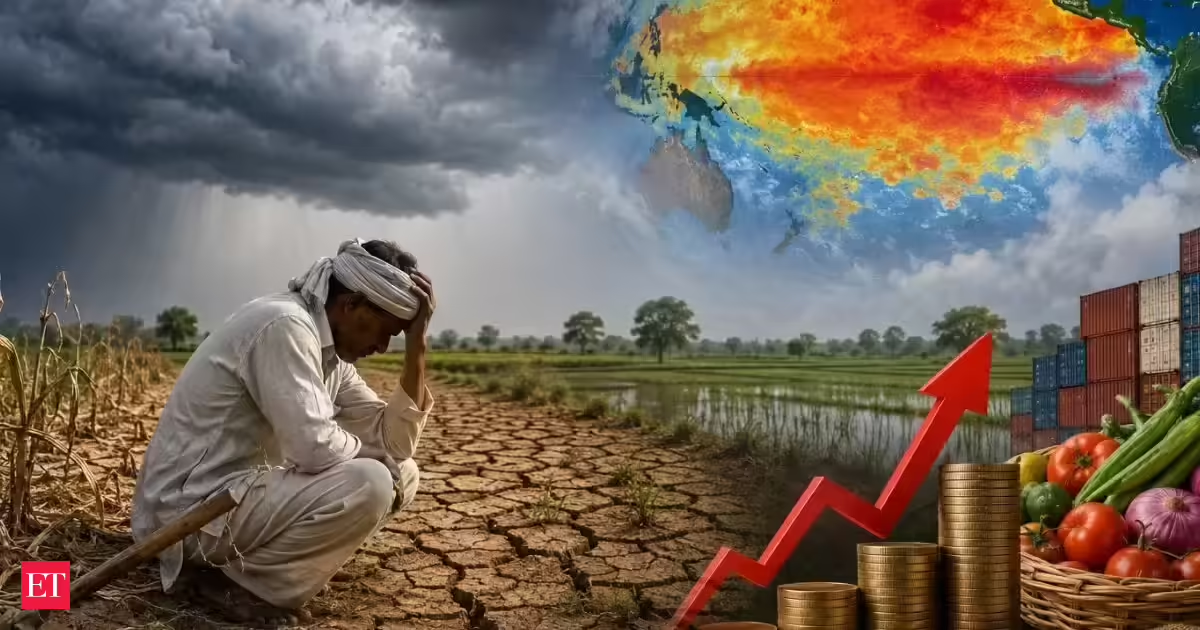
The recent alarm sounded by the India Meteorological Department (IMD) has cast a shadow of uncertainty over the rural heartland. With predictions suggesting the South-West Monsoon (SWM) will likely settle at just 92 per cent of the Long Period Average (LPA) due to the prevailing El Nino conditions, the vulnerability of the national economy is once again under the spotlight.In a country where rainfed agriculture is still practiced in about 45 per cent of the total cropped area, the prospect of a deficit monsoon is not merely a meteorological statistic but a significant economic threat. So does the ghost of the truant monsoon still haunt our agriculture?Monsoon metricsOne must first comprehend the sheer scale of the South-West Monsoon’s influence. India receives an average annual rainfall of approximately 118 cm, varying across the four major zones — North-Western, North-Eastern, Central India and the Southern Peninsula.Crucially, the SWM accounts for nearly 75 per cent of this total. Given this heavy concentration, a drop of more than 10 per cent from the LPA is expected to dent the the performance of the agricultural sector. While some believe that the dependency on rainfall is declining due to massive irrigation development, the empirical evidence from the last few decades tells a more complex story.Data shows that in the 1990-2024 period, India received below-normal rainfall in 18 years. This essentially means that every alternate year witnessed a monsoon deficit. Even more concerning is the district-level reality; more than 30 per cent of Indian districts received deficit SWM rainfall in 19 out of 35 years. When we look at year-on-year deviations, the rainfall deviated negatively by more than 10 per cent in six different years, while another five years saw deficits in the range of 5-10 per cent.Positive deviations were recorded in only 14 out of the 35 years, indicating that the Indian farmer is more often than not battling a deficit.Impact on cropped areaThe impact of these deficits is most visibly felt through three primary channels: irrigated area, cropped area and production volumes. There is a deeply entrenched relationship between rainfall levels and the area irrigated through surface sources such as canals and small water bodies.While minor fluctuations in the monsoon may not immediately dry up these sources, a large deficiency of around 10 per cent leads to a considerable reduction in surface irrigated area because the water flow into dams and reservoirs is directly tied to catchment rainfall.Time-series data from 1990 to 2024 confirms this nexus. In the years 2000, 2002, 2009, 2014 and 2015, where the SWM deficit was severe, the surface irrigated area declined sharply, suggesting that the expanded irrigation infrastructure is not an independent buffer but is itself hostage to the monsoon.Deficient rainfall fundamentally alters the landscape of the kharif season by shrinking the cropped area. Since nearly half of India’s cultivation remains rainfed, the SWM plays a decisive role in the farmer’s choice to sow. This is particularly true for nutri-cereals (jowar, bajra, ragi and maize), pulses, oilseeds and cotton, which are predominantly grown in rainfed areas with low coverage of irrigation (Chart).When a large number of districts receive deficient rainfall, the net and gross cropped areas witness a sharp decline. During the massive 19 per cent rainfall deficit in 2002, the area under paddy declined by 3.72 million hectares, while pulses, oilseeds and cotton saw declines of 1.96, 1.15 and 2.46 million hectares respectively. A similar trend was observed in 2009, which saw a 23-per-cent rainfall deficit. These numbers show what a crucial role monsoon plays in Indian agriculture.Output impactThe deficit monsoon also badly hits the harvest, reducing crop productivity due to diminished soil moisture and the subsequent poor adoption of yield-increasing inputs like fertilizers, which require adequate water. Consequently, when the area under cultivation drops and the yield per hectare simultaneously falls, the total production takes a substantial hit.This dip in kharif production due to deficit monsoon is brought out in the data from the 1990-2024 period. When the rainfall declines over 10 per cent, production of most kharif crops declines sharply from its previous year. The impact is even more devastating for rainfed crops such as nutri-cereals, pulses, oilseeds and cotton (Table).It is increasingly clear that the adverse consequences of deficient rainfall on our agricultural indicators have not come down appreciably over time. It is a misconception to assume that more dams and canals, have insulated us from deficient monsoon. If the clouds do not deliver on time, the dams do not fill and the canals run dry. With climate change now a being a constant, increased variability in rainfall is becoming the new normal.The 92 per cent rainfall prediction for this year is a call to action that cannot be ignored. We must shift our focus toward strategies that go beyond traditional irrigation. This includes the promotion of crops (other than paddy, wheat, sugarcane, banana, etc.) that consume less water. Shifting water-intensive paddy cultivation from conventional flood method to rice intensification method can reduce water stress.An aggressive adoption of modern technologies such as drip and sprinkler irrigation in all suitable crops can save water and boost productivity. There is an urgent need to address the pathetically poor water-use efficiency of our canal irrigation system which is estimated at a 35 per cent. As the El Nino impact looms over the current kharif season, data remind us that while we have made strides in irrigation infrastructure, the Indian farmer looks to the sky with the same anxiety as in the past. Contrary to what experts have observed, decoupling our dependence on monsoon remains one of the greatest challenges for Indian agriculture.The writer is an Economist and former full-time Member (Official), Commission for Agricultural Costs and Prices, New Delhi. Views are expressed personalPublished on July 9, 2026
Monsoon dependency remains
Expanded irrigation infrastructure is not an independent buffer, but is itself hostage to the monsoon
958 words~4 min read