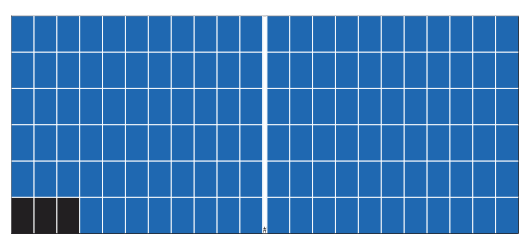
A TÜV NORD study found that back-contact (BC) modules outperform TOPCon modules under mild partial shading, particularly when three or fewer cells are shaded across different substrings within a string. However, once shading exceeds four cells, the performance advantage disappears, with both technologies experiencing similar power losses of around 50%.
Researchers from Germany-based technical inspection association TÜV NORD have conducted a series of simulations to compare the performance of back-contact (BC) solar modules with that of TOPCon counterparts under partial shading conditions and have found that BC outperforms TOPCon when shading occurs across different substrings within a single string.
“When shading affects different substrings within a single string, BC modules exhibit a performance advantage under mild shading conditions, corresponding author Cohen Chen told pv magazine. “However, as shading becomes more severe, this advantage diminishes, and the output power loss of the BC module approaches that of the TOPCon module.”
The scientists said their analysis considered realistic shading scenarios and complex patterns, including point, patch, linear, and symmetrical shading caused by environmental factors. Such conditions can lead to voltage and current losses, generate multi-peak P–V characteristics, and increase the complexity of maximum power point tracking (MPPT). The study also evaluated discrete shading patterns associated with common field conditions, such as bird droppings, fallen leaves, and shadows from vertical objects.