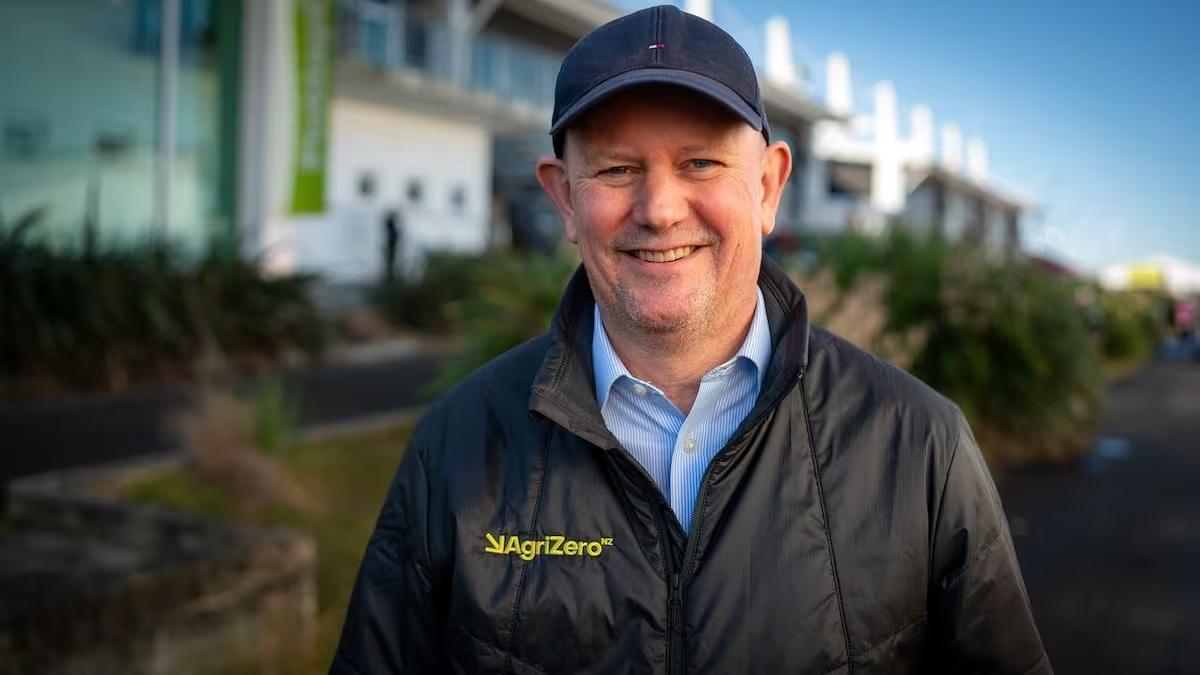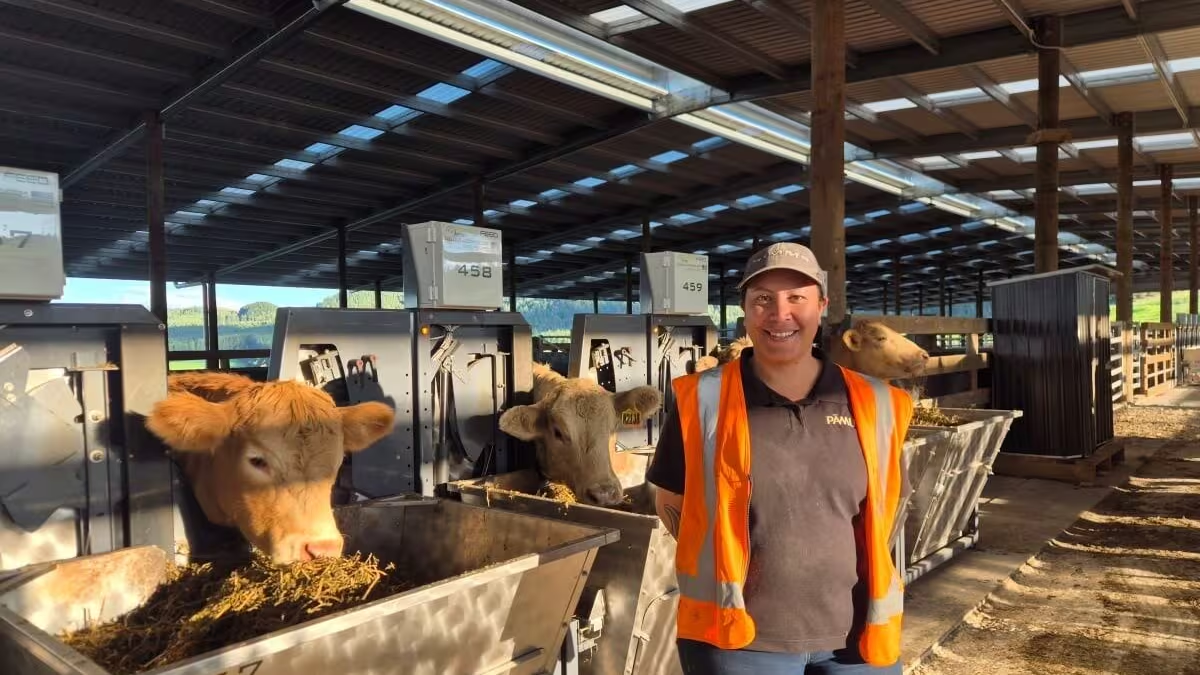
New Zealand’s farms are set to become a real-life laboratory for one of agriculture’s toughest climate challenges — reducing the methane cows and sheep belch. After years of research and investment, the country is on the cusp of giving farmers the first of a new generation of tools to curb the amount of the greenhouse gas livestock emit. Whether they can be deployed at the scale and speed needed to meaningfully reduce emissions and satisfy climate goals remains uncertain.Ruminant BioTech is awaiting registration from the Ministry for Primary Industries for a bolus, a capsule placed in an animal’s stomach that slowly releases a compound to suppress production of methane. Research shows it can reduce emissions per animal by as much as 70%. It may get approval as soon as next month.The Auckland-based company is one of a growing number of startups and researchers testing everything from methane-inhibiting compounds extracted from daffodils and probiotics known as Kowbucha — a nod to kombucha — to vaccines and selective breeding for lower-emitting livestock. Together, the technologies may reshape farming globally — if they can clear regulatory hurdles and gain widespread adoption.Reducing methane is a pressing challenge for New Zealand, one of the world’s highest per-capita emitters of the gas. Agriculture underpins the nation’s export economy, and methane produced by the digestive systems of cattle and sheep accounts for more than 40% of the nation’s total greenhouse gases. Reducing emissions is also important for the nation’s food exporters seeking to convince customers like Nestle SA and McDonald’s Corp. that New Zealand’s dairy and meat deserve premium prices.Helping drive the effort is AgriZeroNZ, a public-private partnership established in 2023 to fund technologies, which has committed around NZ$80 million ($45 million) across 18 companies, projects and trials. That includes NZ$5.8 million in Ruminant BioTech, which was its first investment.“All the companies we’re investing in are now doing animal trials,” AgriZeroNZ Chief Executive Wayne McNee said in an interview. “We need to be doing things and we are doing things. That’s why we exist, to enable farmers to take action as opposed to just talking about it.”‘No Additional Warming’The scientific push is unfolding against a political backdrop in New Zealand that has shifted in favor of farmers. Last year, the government set a less ambitious methane reduction target of 14% to 24% below 2017 levels by 2050, down from a previous aim of a 24% to 47% reduction. The revised ambition was based on a controversial “no-additional-warming” approach that seeks to prevent methane from contributing any further to global warming rather than to reduce its impact.That move was slammed by scientists, but hailed by farmers and was one of several the center-right coalition government has taken to support the agricultural sector, including ruling out any levy on farm emissions.Prime Minister Christopher Luxon sees agriculture as the engine of the economy and doesn’t want climate policy to impede it.“We are focused on growth and we ain’t shutting down any farms in this country,” he told reporters last month. “We feel very comfortable that agriculture’s on a good pathway. We’ve got genuinely outstanding innovation that actually can help us increase production and also deliver on sustainability commitments.”AgriZeroNZ effectively acts as a venture capital investor and has NZ$191 million to spend, funded equally from the government and ten industry players such as Fonterra Cooperative Group, a2 Milk Co and Silver Fern Farms. Its investments include companies such as Agroceutical Products, which is exploring extracting a methane-inhibiting compound from daffodils, and US-based vaccine developer ArkeaBio, which has a trial under way at Texas A&M University.McNee said the next step is to show the products work without impacting animal welfare or production, then getting them approved and offered to farmers.Farmers “mostly want to see other farmers in New Zealand using it and make sure it works,” he said. “Someone has to be paying, they’re not going to do it for free. Dairy customers like Mars Inc. and Nestle are already prepared to pay a premium for lower-emission dairy products sourced from Fonterra or Synlait Milk. Key trade agreements with the UK and the European Union also require efforts to reduce emissions.“In some cases, if you don’t do something, you won’t get market access,” said McNee. To help speed adoption of methane-cutting technology, the government last month announced a further funding program of NZ$51 million over three years, to be matched by private partners, to help deploy the new tools. Burping LessBreeding low-methane livestock is also under way. AgriZeroNZ is a co-investor alongside government research agencies and Beef + Lamb New Zealand in the Cool Sheep program, which is breeding low-methane rams. It is developing a similar program for beef cattle.“Genetics is a good way to do emissions reduction,” said Paul McGill, head of innovation and extension at Pamu Landcorp Farming, the state-owned farming company. “It’s baked in and then you just keep adding to it and you don’t have the cost each year” that vaccines and other inhibitors incur, he said.At a farm near Taupo, in the central North Island, Pamu has been monitoring cohorts of animals who spend eight weeks at a time in a specially designed barn. During that period each animal’s feed intake and weight is measured, while a unique system designed by South Dakota-based C-Lock Inc. takes a daily reading of how much methane they belch.The data feeds breeding programs designed to develop faster-growing animals that emit less methane.The Pamu facility is available to other developers testing their own solutions, ideally speeding their availability to all farmers, McGill said. That included Ruminant BioTech and Fonterra, which has been developing Kowbucha.Pamu, which is targeting a 30% reduction in emissions from 2019 levels by 2031, will watch those other results carefully.“Breeding will get us a certain way there along with farming efficiency and some offset forestry,” he said. “But there’s still quite a big chunk to achieve. So that’s why we need the vaccines, the ruminant inhibitors or other technologies to close that difference.”
How New Zealand became global laboratory for climate friendly cows
The government and industry are investing heavily to support these crucial climate initiatives. Widespread adoption of these technologies could reshape global agriculture practices.
994 words~5 min read