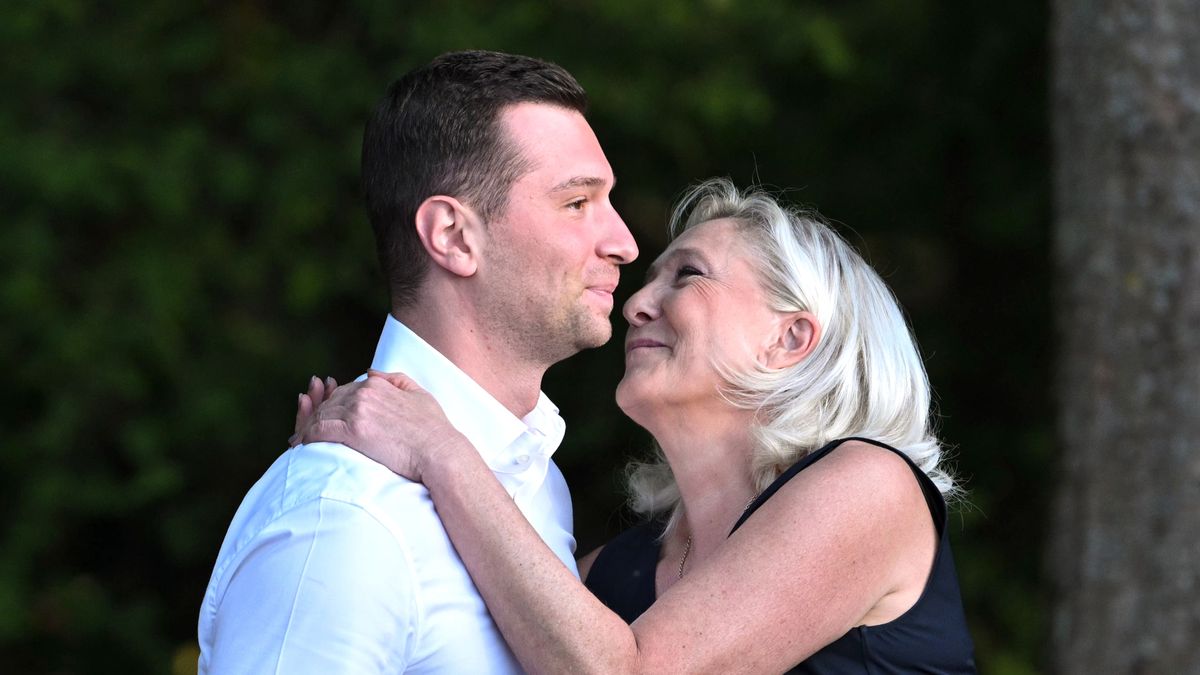
Spotlight on the Paris Court of Appeal which tomorrow, less than a year before the presidential elections in France (the first round on April 18, the second on May 2), with its decision, will reveal who from the Rassemblement National, between Marine Le Pen and Jordan Bardella, will be the candidate. Indeed, on Tuesday, the Court will rule on the case of the parliamentary assistants of the former Front National (now Rassemblement National) in the European Parliament. Former Rn president Marine Le Pen was found guilty of misappropriating public funds in relation to fictitious European parliamentary assistant positions and sentenced on March 31, 2025, in the first instance by the Paris court to four years in prison (two to be served with an electronic tag and two suspended), a fine of 100,000 Euros, and five years of ineligibility with immediate effect. Tomorrow, the Court of Appeal will therefore decide on Le Pen's appeal against the conviction for misappropriation: if the sentence is overturned, the Rn leader will be able to run in the elections, otherwise it will be up to the current president of the far-right party, Bardella, to run for the Élysée.
“If justice prevents me from running in the presidential elections, then with great energy, great conviction, and great confidence, I will obviously support Jordan Bardella's candidacy every day, and until his victory,” Marine Le Pen stated on Saturday during a party organized in Liévin (Pas-de-Calais). Bardella, for his part, also on Saturday reiterated his "total support" and his "total friendship" towards Le Pen: "I want to renew my total support and my total friendship to her. I got involved in politics for her, to see her elected president of the Republic. And I truly hope to see her elected President of the Republic in a few months," he emphasized.In recent days, Le Pen had declared on Lci that she did not fear the day of the Paris Court of Appeal's decision. "Whatever happens, I will not be dead. Whatever happens, I will continue to fight for my ideas," the Rn leader had emphasized. Now there is great anticipation for the verdict, and several scenarios are on the table. The hypothesis of acquittal - considered unlikely by many - would be an immediate relief for the Rn group leader in the National Assembly, who would become eligible again and be freed from the burden of a criminal conviction. Conversely, a conviction of more than two years of ineligibility (partially served) would jeopardize her candidacy for the Élysée. Confirming the lower court's decision, the public prosecutor's office requests a five-year confirmation also on appeal. Unless this is reduced to a maximum of two years, Le Pen cannot hope to run in the presidential elections.Another element to consider is a conviction for a period of detention to be served with an electronic tag. If the court of appeal accepts the prosecutor's request and asks for one year of detention, a sentence to be served under house arrest, the Pas-de-Calais deputy would give up running. "It's not possible" to campaign with an electronic tag, Le Pen reiterated last Wednesday. "If I can run, I will run, provided I can campaign," she declared, explaining that "when you are a presidential candidate, you must be completely free to move" and that this is not possible if you wear an electronic tag. "If the goal is to allow me to run, but in reality prevent me from campaigning in complete freedom, you understand that this will not be possible," she added. A six-month sentence, however, would open a more uncertain debate within the Rassemblement National. With sentence reductions, Marine Le Pen could hope to regain full freedom of movement as early as the beginning of October, about six months before the presidential elections.Another unknown concerns the appeal to the Court of Cassation. Marine Le Pen has already warned that she will not wait for a possible decision from the Court of Cassation before deciding on her candidacy. The Supreme Court judges have indicated that, if they were to take on the case, their decision would arrive by early January. For Le Pen, this timeline would be too long to effectively start her electoral campaign, even if her conviction were annulled by the Court of Cassation. The most complex case regarding the appeal decision on July 7, however, remains that of the provisional execution, or immediate application, of the two-year ban from public office. Because on paper, this scenario could allow her to run: if the provisional execution order issued in the first instance - and fiercely contested by the Rn - were confirmed, and the ineligibility sentence dropped to two years, it would conclude on April 1, 2027, shortly before the first round of elections.Marine Le Pen's interest would therefore be to have her conviction become definitive and served as quickly as possible. She could also waive the appeal to the Court of Cassation, because an appeal would suspend her sentence and thus lengthen the already tight deadlines: although on July 7 - with the suspension - Le Pen would become eligible again, she would risk losing eligibility again in January if her appeal were rejected by the Court of Cassation, right in the middle of the presidential election campaign. The difficulties do not end here, because the prosecution can also appeal to the Court of Cassation, which would in turn suspend the sentence. Marine Le Pen might therefore have to wait for the expiration of the ten-day period granted to the parties to know whether the situation will be resolved or not. Finally, there is a legal dispute regarding the effects of an enforcement order issued in the first instance but not confirmed on appeal. Some legal experts, based on rare rulings by the Court of Cassation in other cases, believe that such a measure may continue to have effect. According to this interpretation, an appeal to the Court of Cassation by Marine Le Pen or the prosecution would no longer suspend the sentence. The final decision would therefore rest with the Constitutional Court, the only body competent to validate candidacies for presidential elections. Several of its members have already confidentially hinted that they have clarified one point: eligibility is assessed on election day. In other words, it does not matter if a candidate is not eligible at the time of collecting or submitting the 500 signatures in their support, as long as they are eligible in the first round.