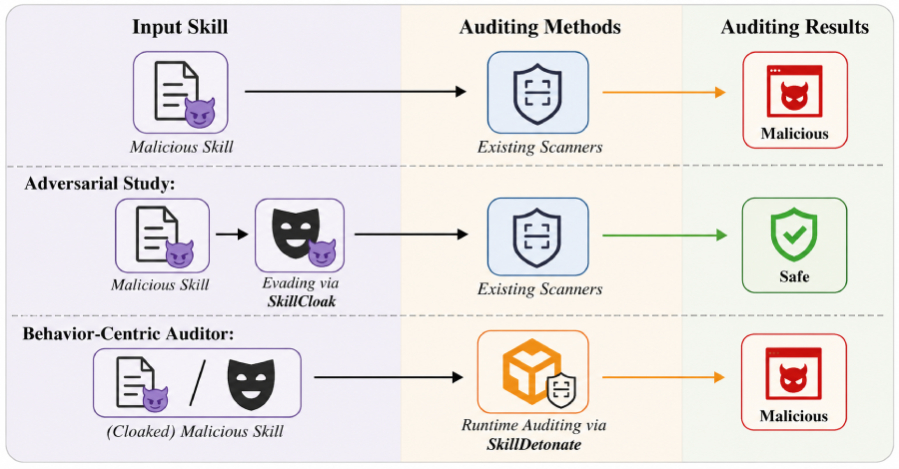
Scanners meant to catch malicious add-on "skills" for AI coding agents can be fooled by a few simple changes that leave the malware working, according to a new study from researchers at the Hong Kong University of Science and Technology.
Their strongest trick slipped past every scanner tested more than 90% of the time, and the same team built a runtime checker that catches most of the disguised skills the scanners miss.
Skills are small packages, usually a Markdown instruction file plus a few scripts, that agents such as Claude Code, OpenAI Codex, and OpenClaw load to pick up a new capability. Because a skill is just a bundle of files, the same one can run across different agents. And it runs with the agent's own access: your files, your terminal, your saved passwords.
A bad one can steal credentials, copy source code, or install a backdoor. Most of what a public marketplace lists is uploaded by strangers with little vetting.
The main defense so far has been the skill scanner, which reads a skill's files before you install it and blocks anything that looks dangerous. The paper, titled "Cloak and Detonate," tests whether that actually holds up. It does not. Beating scanners isn't new, though.