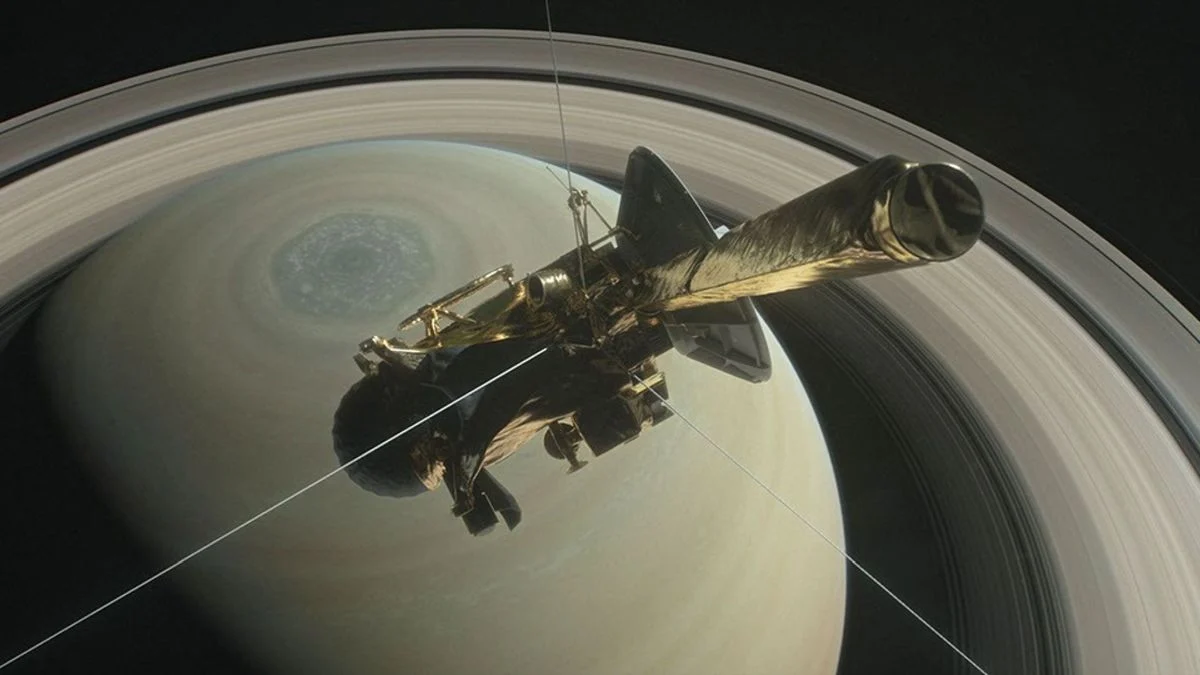
If we could hear the cosmos, our lives might be filled with endless unease.We can't, of course. Sound can only propagate through a medium with particles close enough to jostle one another.But when space observation data is translated into sound, we're given a small taste of a very different, very eerie Universe.From the deep booming of black holes to the disconcerting twang or whistling chorus of Earth's magnetic field, space could easily be a cacophony of the creeps. Saturn is among the worst offenders. With its giant system of rings and moons and its extremely orderly magnetic field, the space around Saturn generates activity that squeals and screams in ways that are difficult to forget.And, just before it plunged to its death in 2017, the Cassini probe orbiting Saturn recorded some truly unnerving behavior.
What you're hearing in the above video is not sound propagating through a medium but plasma waves rippling through the space around Saturn, two weeks before Cassini made its final dive into the planet's wild storms.It's not just a fun video, either. Two papers published in 2018 in Geophysical Research Letters revealed previously unknown interactions involving Saturn, its rings, and its moon Enceladus.One of the studies showed for the first time that plasma waves travel between Saturn and Enceladus along magnetic field lines connecting the two bodies.When Cassini drew ever closer to Saturn during the final stages of its Grand Finale mission, it took advantage of its unique proximity to take readings that would not have been possible from a greater distance.