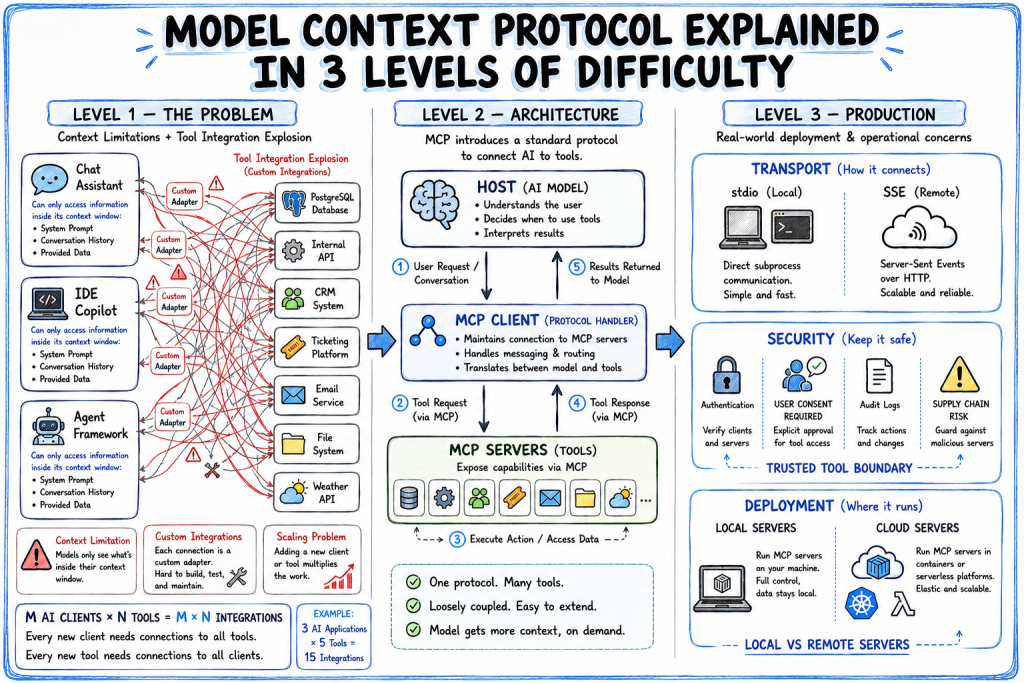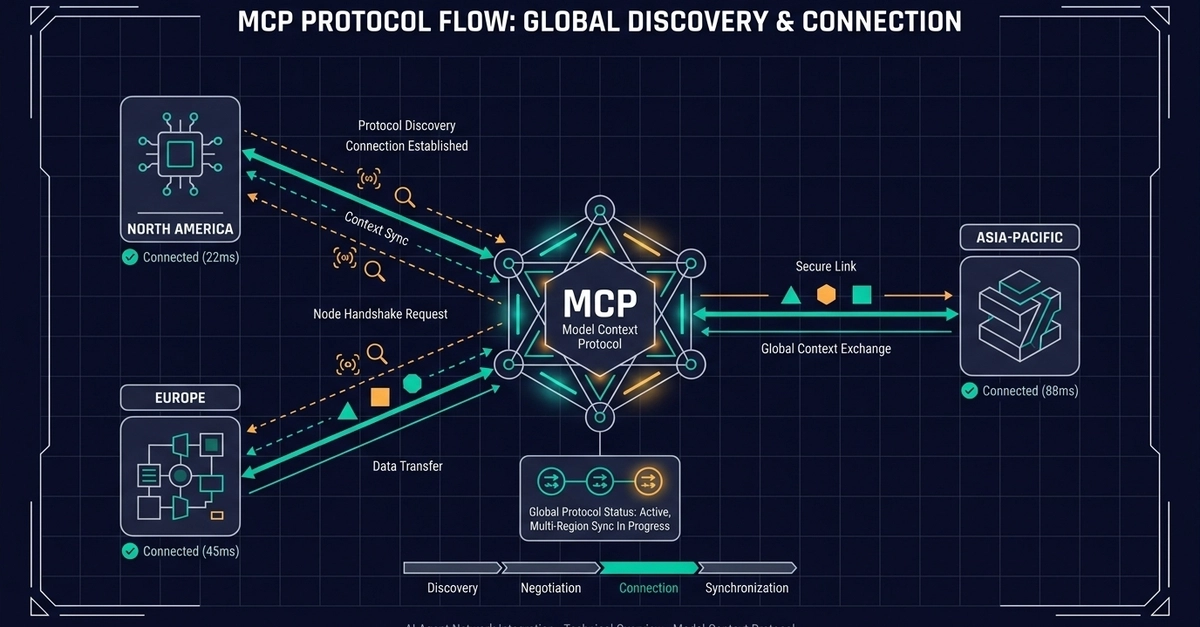
Most teams meet MCP as "a way to give your model tools" and stop there. That framing will cost you. Model Context Protocol is a small distributed system with three roles and three primitives, and once you see the architecture clearly, every later question — auth, scale, versioning, streaming — has an obvious home. This part draws the map.
This is Part 2 of a 15-part deep dive. In Part 1 we made the case for adopting MCP: it turns N×M integration glue into N+M (on Mattrx, our .NET/Azure SaaS, that meant 14 bespoke clients collapsing to 3 MCP servers). Now we open the box.
TL;DR
Concept
Ad-hoc agent (before)