Story audio is generated using AI
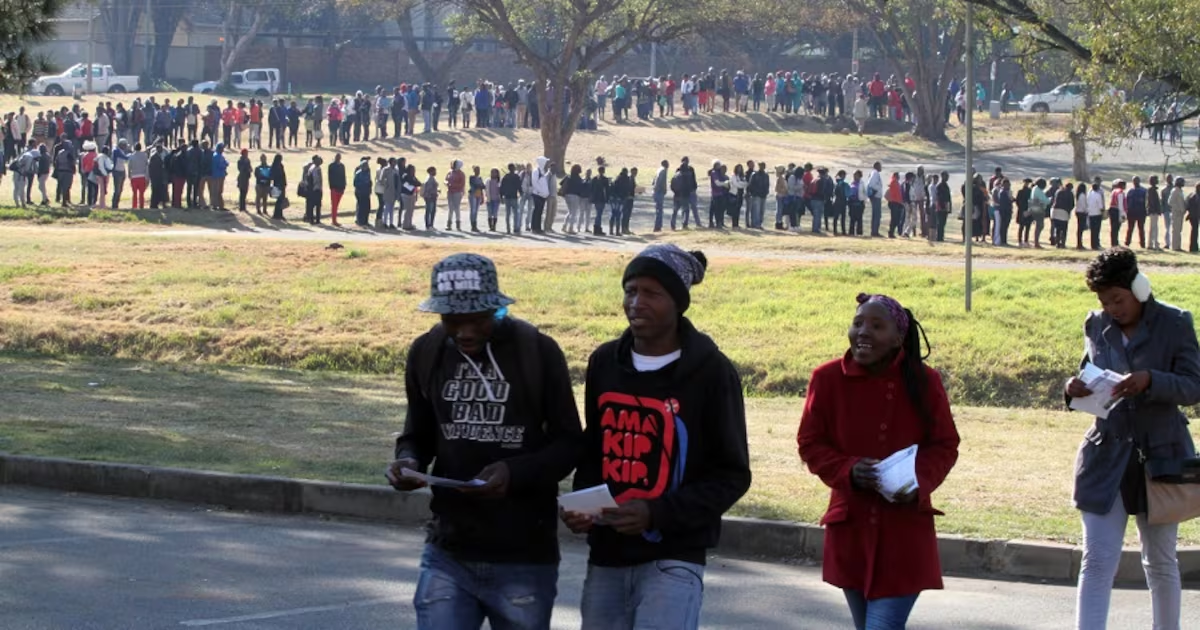
From Tuesday to Thursday, the National Treasury and the Government Technical Advisory Centre will host the 2026 Public Economics Conference under the theme “Counting the Crisis: Data, Evidence and Solutions for Youth Unemployment in South Africa”.Youth unemployment remains one of South Africa’s most urgent social and economic challenges, and the conference will explore how better data, stronger evidence and more effective implementation can help connect young people to real opportunities.The latest quarterly bulletin from Stats SA for the first quarter of 2026 puts the national unemployment rate at 32.7%, with joblessness among 15 to 24-year-olds sitting at 60.9%, while the rate for those aged 25 to 34 years was 40.6%. More than four in 10 young people aged 15–34 are not in employment, education or training.Discussions at the conference will focus on what the current data captures and misses, including informality and the lived experiences of young work-seekers; what can be learnt from existing employment interventions; and how technological change, digital transformation and artificial intelligence are reshaping the future of work.Read: Why policy uncertainty in SA has hit a new highFinance minister Enoch Godongwana will deliver an opening message, and the conference will also feature a discussion between National Treasury director-general Duncan Pieterse and South African Revenue Service commissioner Johnstone Makhubu. Leading economist Haroon Bhorat will deliver the keynote address.On Thursday, Stat SA will publish the manufacturing production numbers for May. This is after factory output shrank 2.9% year on year in April, suggesting that the contraction in the sector that weighed on GDP growth in the first quarter of the year persisted in the second.“The May data will provide one of the first hard indicators of how businesses responded to the recent oil-price shock and heightened geopolitical uncertainty,” Bureau for Economic Research economist Tracey-Lee Solomon said.“Survey evidence suggests that some firms may have accelerated purchases and inventory building earlier in the year in anticipation of higher costs and potential supply disruptions. If so, part of that demand may have been pulled forward from May and June, raising the possibility of a weaker manufacturing outcome.”The South African Reserve Bank’s (SARB) monetary policy committee (MPC) will weigh the key manufacturing numbers against other recent data showing that inflation pressure remains very much in evidence when it decides on interest rates next week.“The sharp decline in oil prices in recent weeks has generated some downside risk to our near-term CPI inflation forecasts. But the MPC has stressed that it will be more focused on containing any second-order effects and ensuring that inflation does not remain sticky over time,” banking group Absa said in a note.Stats SA will on Thursday also release the May export and import unit value indices, a measure of price changes for goods traded internationally, including commodities such as metals, minerals and agriculture products.Added to that, the agency will also publish its latest annual construction industry report for 2024, detailing total trading income — specifically from services like civil engineering, building construction and building installation — as well as employment statistics, including employment numbers, payroll expenses, and sector contributions to the national workforce. The report also outlines capital expenditure, which are investments in new assets, such as machinery, equipment and property. On Friday the CEO of the SARB’s Prudential Authority (PA), deputy governor Fundi Tshazibana, as well as the heads of the banking and insurance supervision, financial conglomerate supervision, risk support and policy and industry support departments, will brief the media on the release of the PA’s annual report.The briefing will also cover the PA’s work and key developments in the prudential supervision and regulation of South Africa’s financial sector.