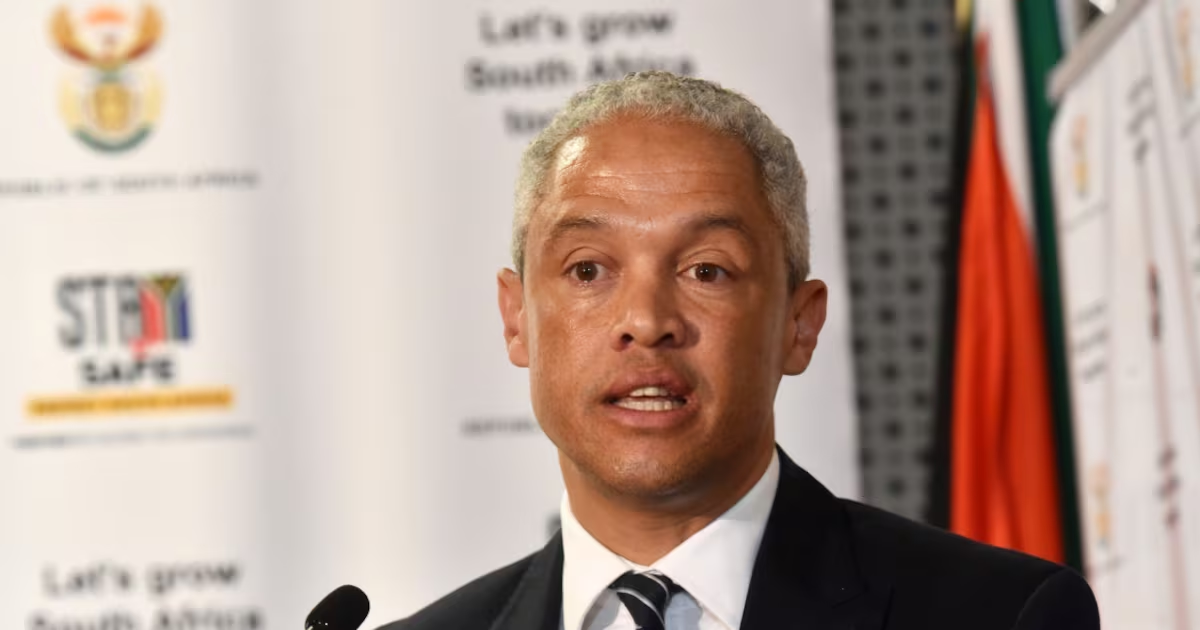
The dominant divisions in South Africa’s manufacturing industry are increasingly becoming less labour intensive, and the country must look to sectors such as tourism and construction to create jobs and solve its chronic unemployment, National Treasury director-general Duncan Pieterse said.At the annual public economics conference hosted by the Government Technical Advisory Centre, Pieterse reiterated that economic growth has for some years failed to match population expansion, meaning that on a per capita basis the income shared between South Africans has become smaller.“Our manufacturing sector in South Africa is dominated by four major sectors ― automotives, petrochemicals, food and beverages, and [basic iron & steel, metal products & machinery]― and the realities are that all of those sectors are increasingly becoming less and less labour intensive,” he said.“So, if you look at the research of [academics], they argue that manufacturing, because of China’s dominance and because of the role of technology in creating lower and lower employment intensity in manufacturing, doesn’t offer the kind of job reach growth opportunities for countries like South Africa that it may have done 10, 15 or 20 years ago.”Pieterse added, however, that the country’s economy has the advantage of sectors that offer opportunities for job-rich growth, such as tourism and construction.“So the ... policy question for South Africa is how should we calibrate our industrial and our economic policy in order to take advantage of those opportunities for job growth that we still have in this country,” Pieterse said.The three-day conference with the theme “Counting the Crisis: Data, Evidence and Solutions for Youth Unemployment in South Africa” is being held against the backdrop of data showing young people are still by far the majority of those struggling to find jobs.The latest quarterly bulletin from Statistics South Africa for the first quarter of 2026 puts the national unemployment rate at 32.7%, with joblessness among 15 to 24-year-olds sitting at 60.9%, while the rate for those aged 25 to 34 years was 40.6%. More than four in 10 young people aged 15 to 34 are not in employment, education or training.The conference will explore how better data, stronger evidence and more effective implementation can help connect young people to real job opportunities.“South Africa will not defeat youth unemployment at scale without faster, inclusive economic growth,” finance minister Enoch Godongwana said in a pre-recorded opening address.“But growth will not happen by itself. It requires reform. Reform requires implementation. Implementation requires capable institutions. And capable institutions require credible public finances, good data, accountability and discipline.”Sustainable public finances are the major necessary condition for economic growth to rise to the levels needed to meaningfully dent unemployment, Pieterse told delegates.“Without stable, sustainable public finances, your chances of growing are going to be very difficult and that’s because it’s very difficult for businesses to invest in an environment where the government is not managing its own finances sustainably,” he said.“We have had a primary surplus for the last three years, and the last time before that that the government had a primary surplus was in 2008/09. That tells you for how long we’ve been struggling to get public finances back into shape.”South Africa’s efforts at fiscal discipline have won it plaudits from rating agencies. In late May, S&P Global affirmed its long-term foreign currency rating at BB and local currency rating at BB+, keeping the outlook positive, a week after peer Moody’s lifted the country’s outlook to positive due to a strengthening fiscal performance and progress made on structural reforms.In June, Fitch upgraded the long-term sovereign rating by one notch to BB from BB minus, citing prudent fiscal management despite weak growth and economic shocks.The economy grew 0.5% in the first quarter of 2026, raising doubt that growth for the whole year will match the Treasury’s 1.6% forecast given in February. This was just before the US-Iran war triggered turmoil on global oil markets, hurting the overall global economy and net importers like South Africa in particular.Growth was a tepid 1.1% last year, weighed down largely by manufacturing and missing the National Treasury’s estimate of 1.4%.
Treasury chief: limited scope for manufacturing to create new jobs
Tourism and construction sectors will create more jobs, says Duncan Pieterse
674 words~3 min read