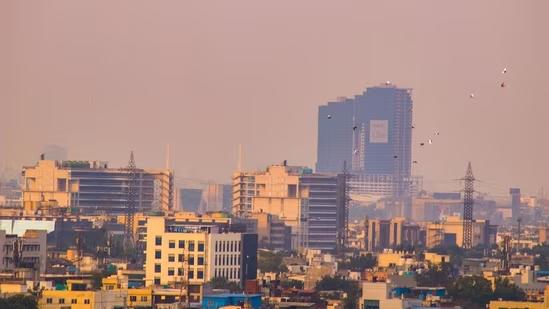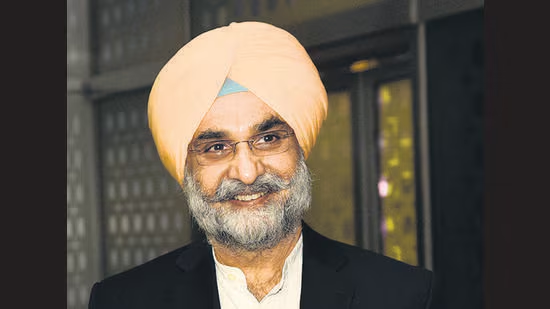
Lieutenant governor Taranjit Singh Sandhu on Friday chaired a meeting of the Delhi Development Authority’s (DDA) advisory council to review Delhi’s long-term urban blueprint, with officials zeroing in on housing shortages, unauthorised colonies, traffic congestion, water security, and climate resilience as key challenges requiring immediate and sustained intervention.Officials lagged gaps in affordable housing, the proliferation of slum and jhuggi-jhopri clusters, redevelopment of unauthorised colonies and rising pollution levels. (HT Archive)The meeting, held at the Raj Niwas, was attended by MPs Ramvir Singh Bidhuri and Sudhanshu Trivedi, besides representatives from the Delhi Metro Rail Corporation (DMRC), National Capital Region Transport Corporation (NCRTC), the Delhi government, and other central and state agencies.Council members flagged gaps in affordable housing, the proliferation of slum and jhuggi-jhopri clusters, redevelopment of unauthorised colonies, rising pollution levels, urban flooding, heat island effects, neglect of heritage structures, planned development in land pooling zones and low-density areas, and long-term water availability, officials privy to the deliberations said.Outlining a roadmap for the Capital, the LG proposed a four-pillar strategy pivoted on environmental sustainability, quality of life, economic growth, and inclusive urban development. The plan envisages expanding green cover, riverfront development, bolstering disaster resilience, securing water resources, building safer roads, redeveloping commercial hubs and logistics corridors, conserving heritage, and improving multi-modal transport with last-mile connectivity.“Delhi’s growth must be inclusive, sustainable, and future-ready,” Sandhu said, adding that the identified prescriptions would now guide actionable interventions across the city.Officials said the development framework spans over 1,400 square km, covering 207 sq km under Transit Oriented Development (TOD), 200 sq km of land pooling zones, 700 sq km of developed residential areas, 150 sq km of low-density pockets, 100 sq km of riverfront in Zone O, 24 sq km of the Walled City, 31 sq km of bungalow zones, and 20 sq km of high-density corridors.
LG flags housing, water security as urban priorities
Lt. Governor Taranjit Singh Sandhu reviewed Delhi's urban plan, addressing housing, traffic, and environmental issues, proposing a sustainable four-pillar strategy. | Latest News Delhi
302 words~1 min read