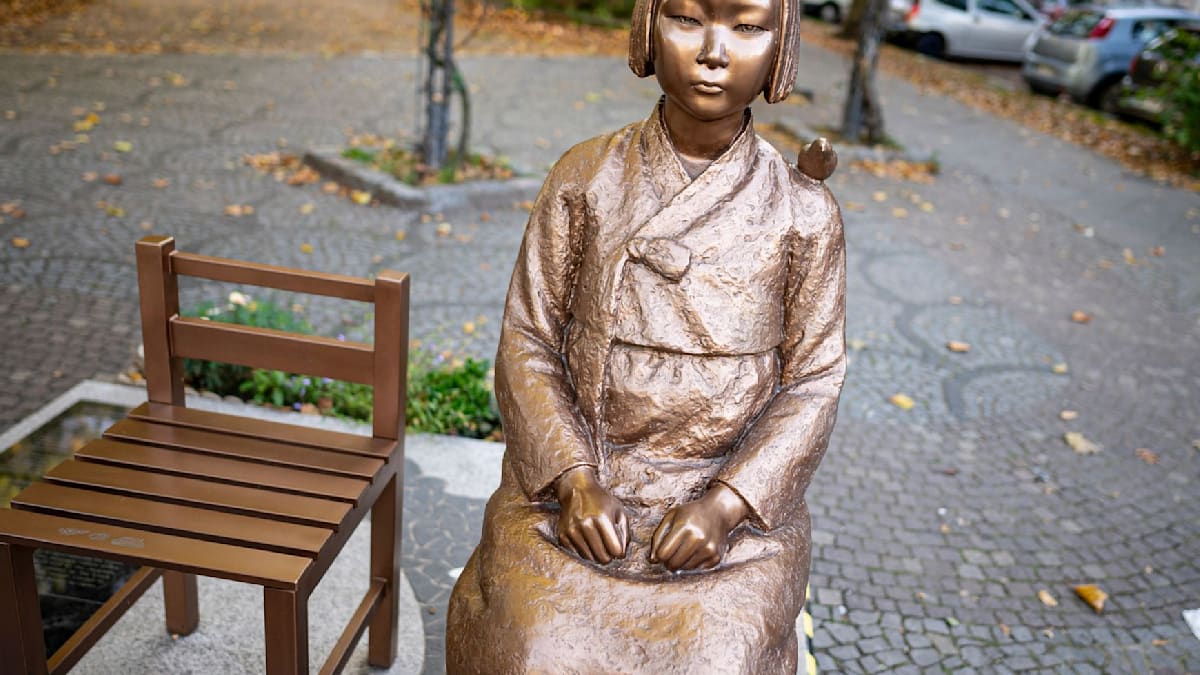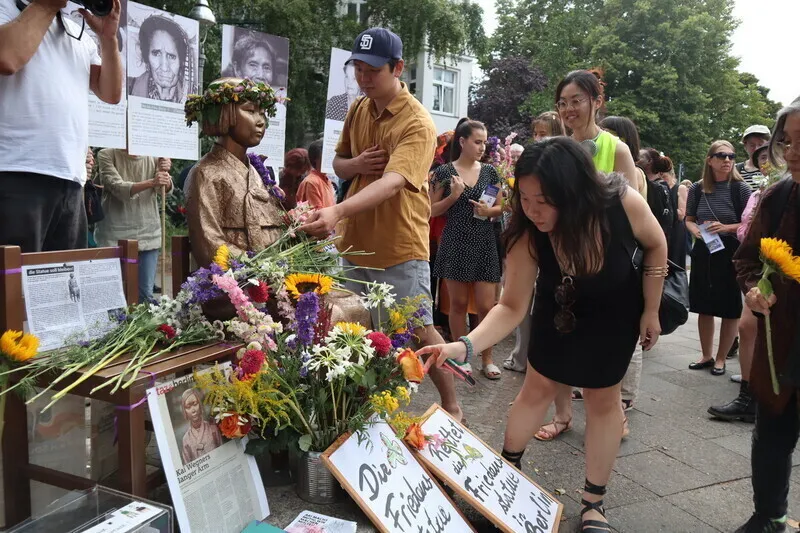
Participants in a rally for International Memorial Day for ‘Comfort Women’ on Aug. 14, 2024, lay flowers at the Statue of Peace in Berlin’s Mitte borough. (Jang Ye-ji/Hankyoreh)
After a period of uncertainty, the government of the Berlin borough where the Statue of Peace stands in Germany has ultimately ordered the memorial to be removed. Korea Verband, the local civic group that erected the statue, shared the removal order issued by the Mitte borough government on Friday. Failure to comply by Oct. 31, the order said, will result in a fine of 3,000 euros (US$3,277). The group has announced its intent to apply for a court injunction against the removal order and await the judicial decision. The Japanese government has pressured German authorities to remove the statue since its erection in September 2020; after standing strong for the past four years, the statue is now in danger of disappearing.The Mitte borough government sent a removal notice to Korea Verband on Sept. 30, rejecting the group’s application to extend the statue’s permit to remain on public property and to recognize the statue as a permanent installation. The government cited “customary practice” as the reason it could not permit the statue to remain. “Customary practice dictates that any piece of artwork erected on public grounds can remain standing for a maximum period of two years,” the notice stated. Regarding requests to have the statue immortalized into a public memorial, the borough government stated that any such endeavor would need to go through the designated public processes and receive approval for special use of public grounds. The notice argued that “granting the statue permanent status would constitute unfair special treatment.” Mitte borough stated that it had previously extended the statue’s permit for one year, until September 2021, and then granted an additional year until September 2022. After that, the statue was placed under “temporary approval,” or “duldung” (“exceptional leave to remain”) status, until a final decision was made. While the borough declared a customary standard of two years, such a standard is not absolute. According to a Sept. 19 report by German public broadcaster Rundfunk Berlin-Brandenburg (RBB), an artwork created to memorialize Bethlehem Church, which was destroyed during World War II, was given a 10-year permit, and the costs to erect the artwork were even provided by public funds. Stefanie Remlinger, the Mitte borough mayor, is a part of the same Green Party that the mayor of the Friedrichshain-Kreuzberg borough belongs to. The RBB reported that “despite the Mitte borough’s claims, there are no legal barriers to giving temporary artworks permanent status.” The RBB added that the Friedrichshain-Kreuzberg borough had reached a similar conclusion before. To see if any other artworks initially granted temporary status ended up becoming permanent installations in Mitte, the public broadcaster requested a list of the artworks and installations in the borough and the length of their respective permits, but said that the borough claimed that they did not have such records. The Berlin state government and Mitte borough have acknowledged that they had been concerned about diplomatic friction with Japan, leading some to criticize them for bending to the Japanese government’s will.The Mitte borough said that it was abiding by the German federal government’s stance that the comfort women issue between South Korea and Japan was resolved in a 2015 agreement between the two nations.“We are therefore seeking to avoid additional diplomatic conflicts between Germany and Japan as well as the danger of deteriorating cooperation between our two nations,” the borough added. “The Statue of Peace is directly tied to the conflict between South Korea and Japan, which bears no direct relation to Germany. The statue therefore does not directly correspond with memorializing the history or culture of the city of Berlin,” the borough concluded. The 2015 agreement mentioned in the borough’s statement refers to the agreement on the “comfort women” issue concluded during the Park Geun-hye administration.