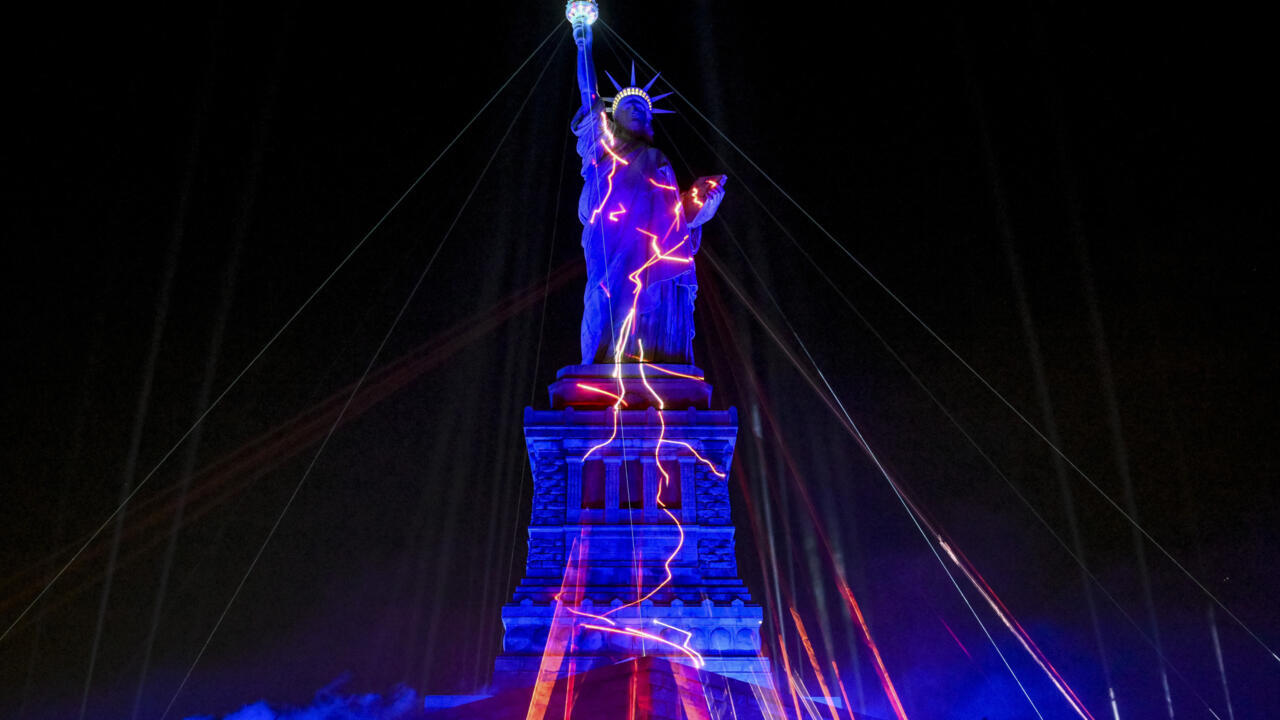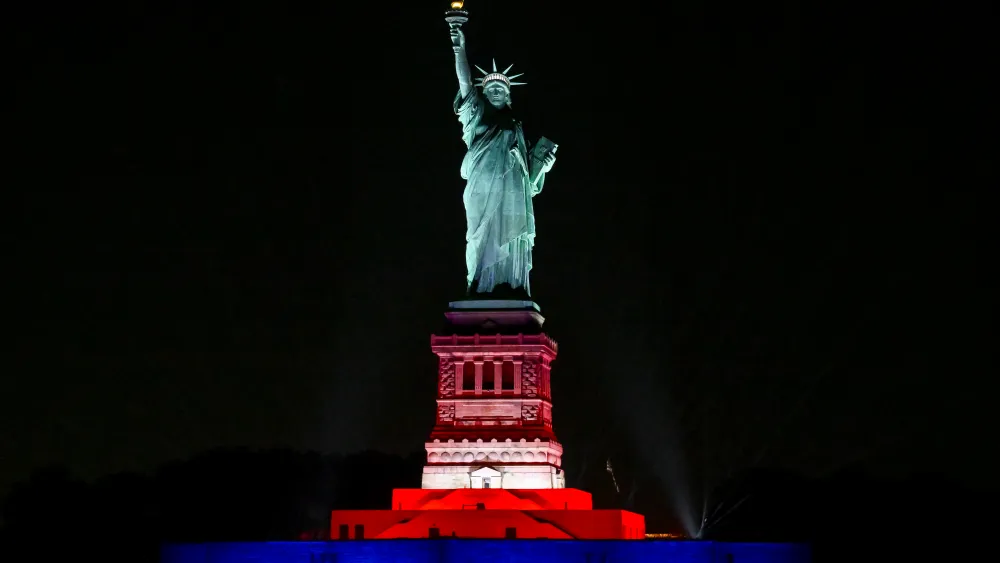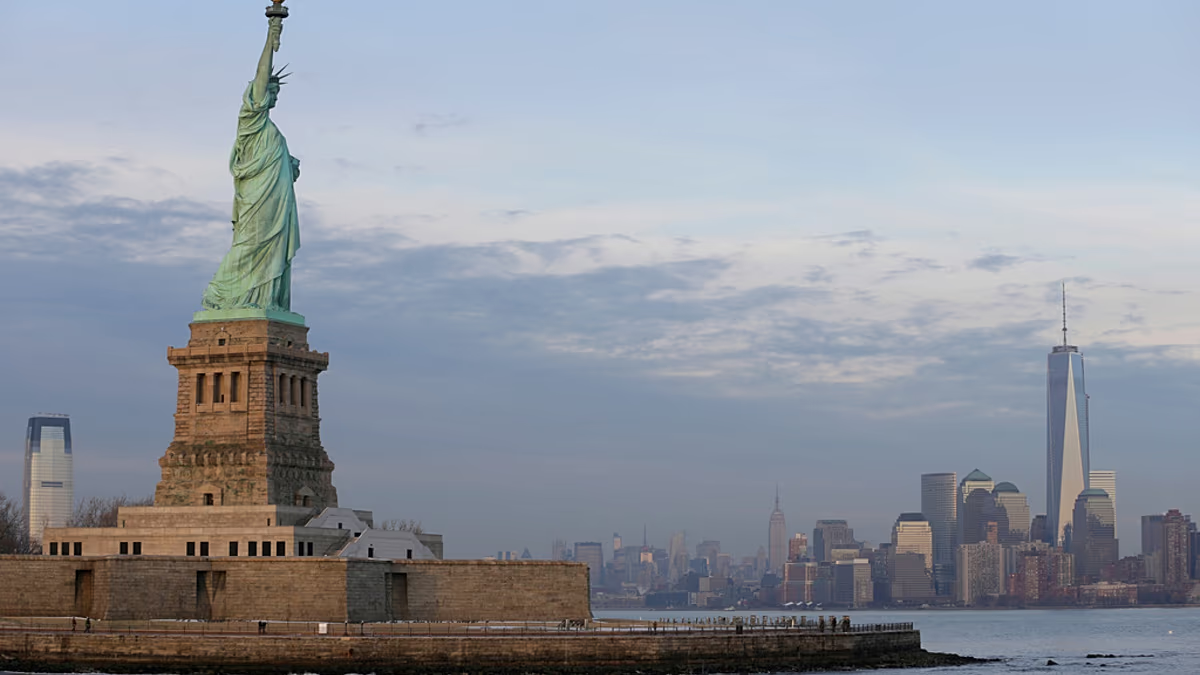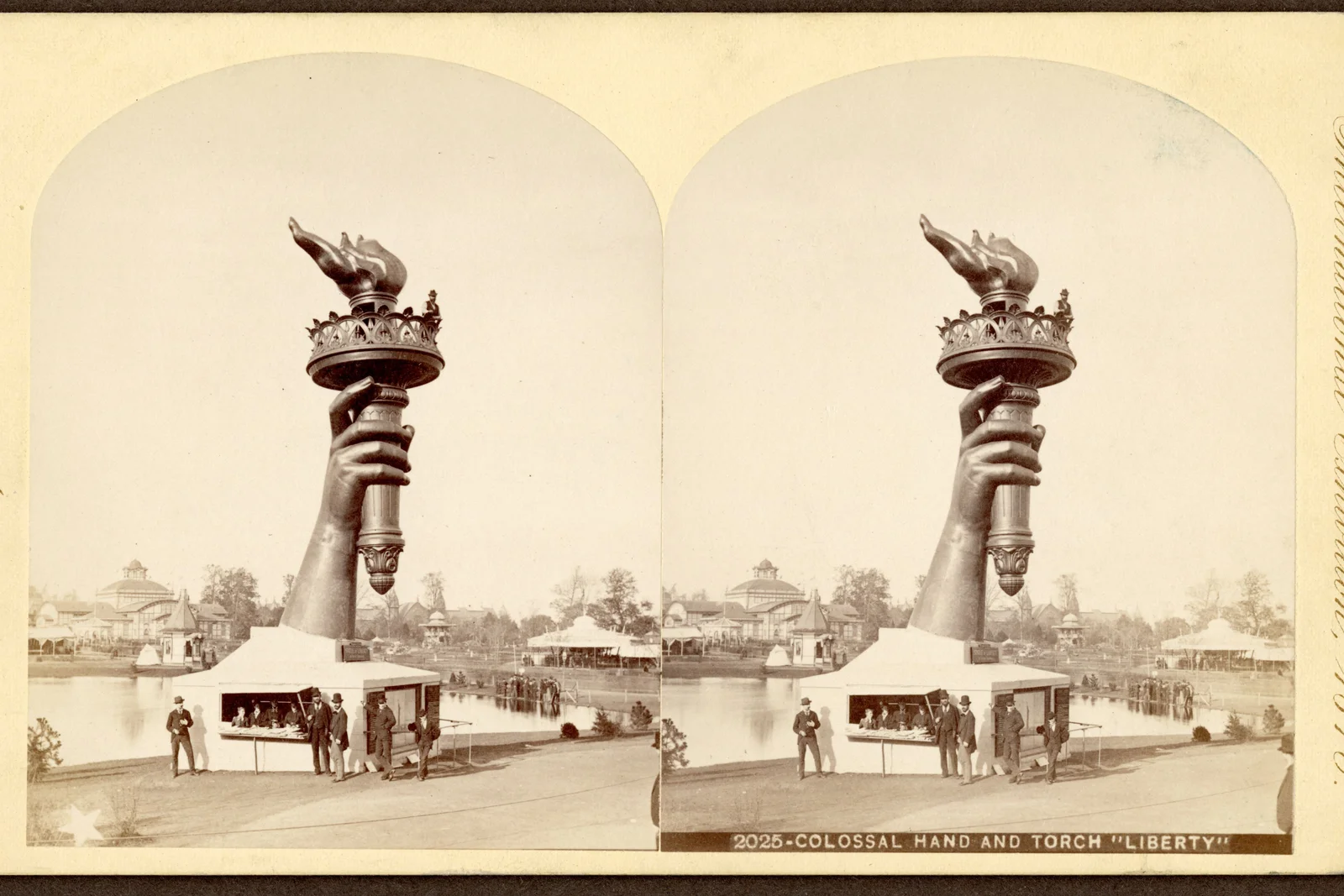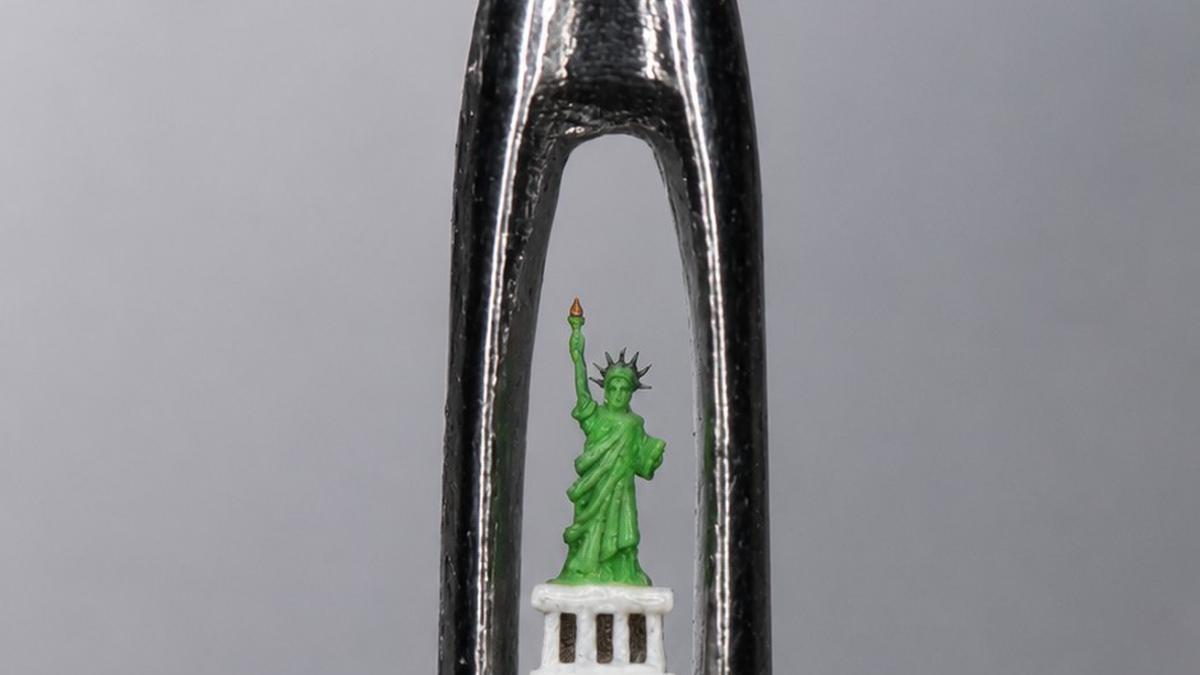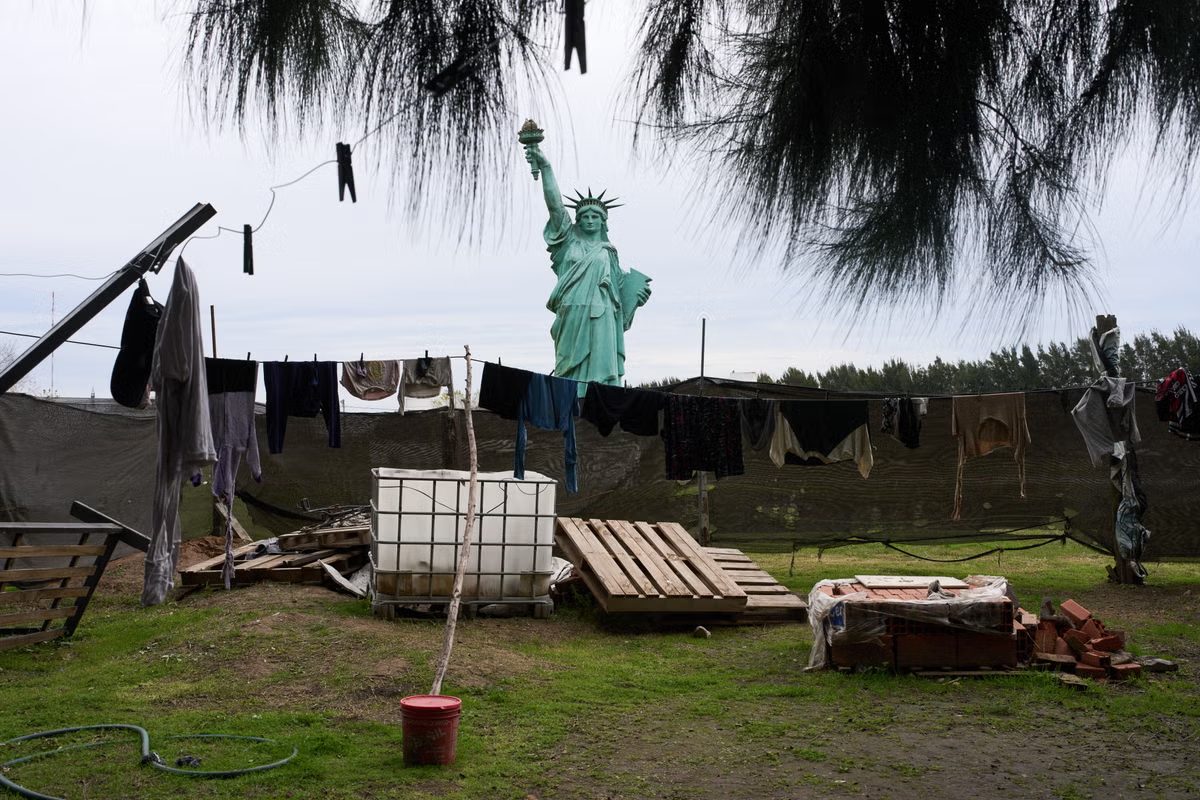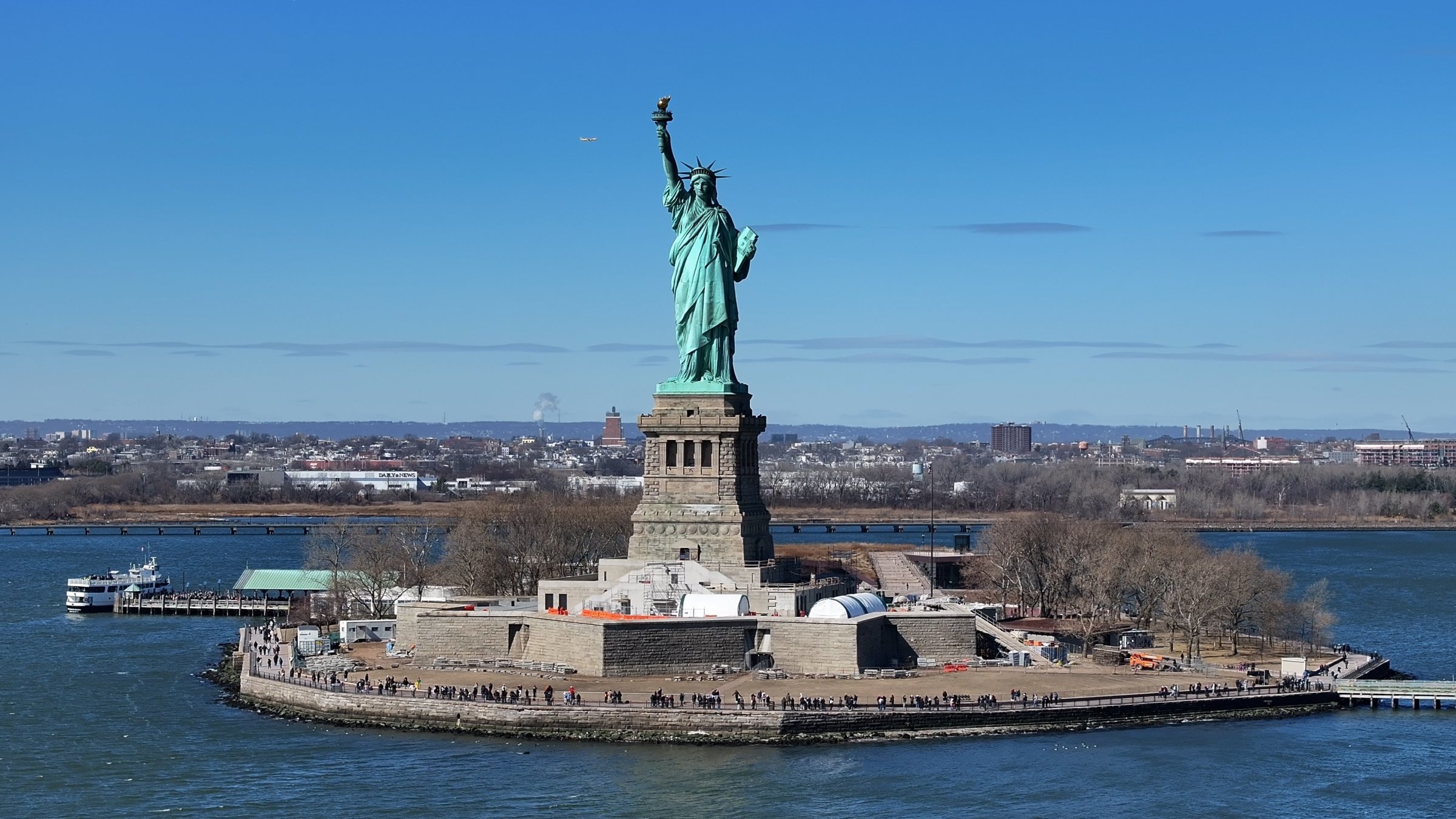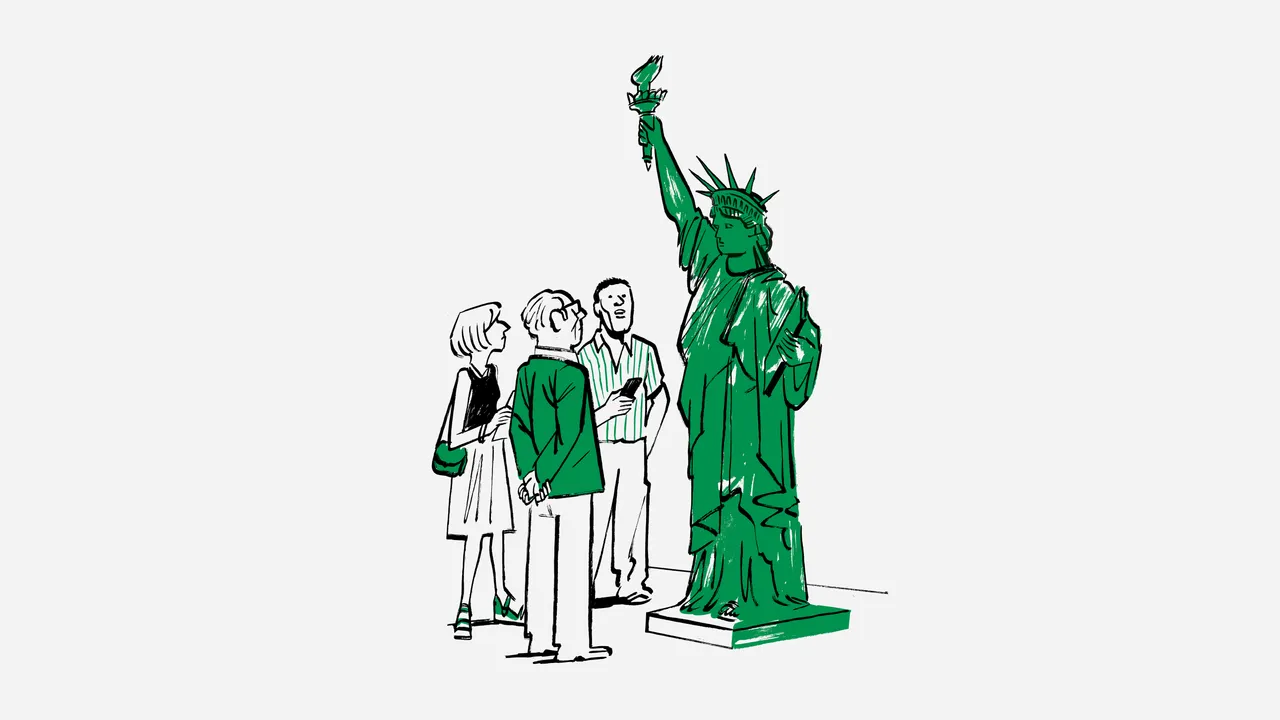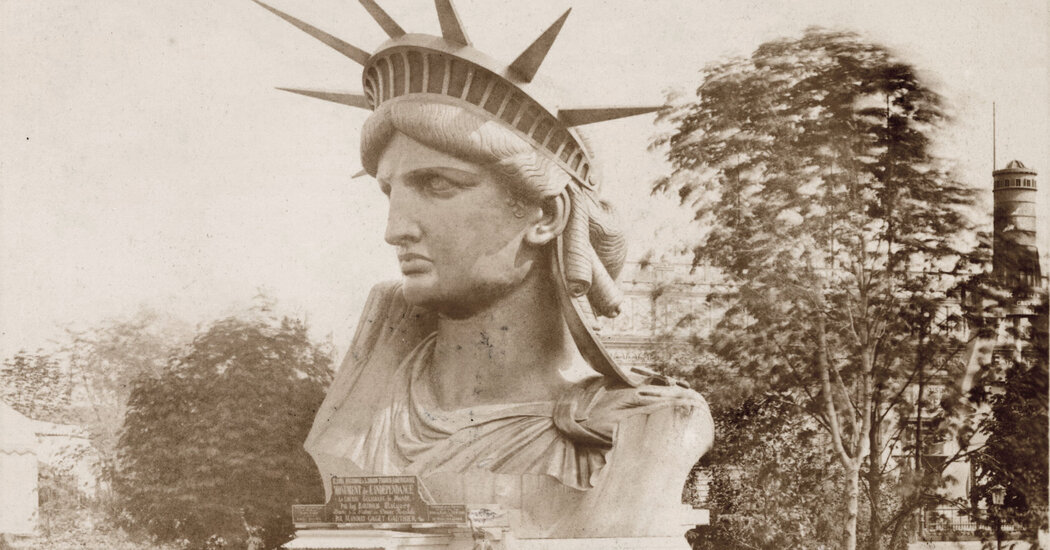
A close-up black-and-white photograph of the side of the Statue of Liberty’s face. There is scaffolding behind her, and a city skyline in the distance. She needs repair sometimes. The patina is thick. But she’s still standing.A close-up black-and-white photograph of the Statue of Liberty’s right ear and temple, with scaffolding in the background. What is the most iconic work of American art? A French sculpture, of course, assembled first in Paris, and then again in New York Harbor.A close-up black-and-white photograph of some ringlets of hair on the back of the Statue of Liberty’s head. The side of her crown is also visible, and she is surrounded by scaffolding. Financed by public subscription, powered by photography and P.R., the Statue of Liberty is now so identified with her adopted home that she has all but melted into symbol. A full-length black-and-white photograph of the Statue of Liberty standing, surrounded by scaffolding, in France — before she was broken down and shipped to the U.S. Soon after her dedication, in 1886, she was designated America’s Mother of Exiles. But she’s so much stranger as an object than an icon. She is monumental, but not weighty. She was not born in America, or even in France. And over the last year, I have rediscovered Liberty — or, really, discovered her for the first time — for what she is: a colossus quivering at the fault line of tradition and a new, modern age. A painting of a bare-chested woman holding a red, white and blue flag and a gun. She leads people who are carrying weapons and advancing over other people who have fallen, wounded or dead, amid smoke and rubble. La liberté. In French the noun is feminine. How do you give form to liberty? What does it, or she, look like? Is Liberty peaceable or vengeful? A nurturing presence, greeting all who come, or an unstoppable revolutionary?A painting of a woman in white holding a book and a long wire as she floats across a landscape. Behind her are a city, trains and farmers; ahead of her are mountains, buffalo, covered wagons and Indigenous people. Perhaps she is more of a conquistadora. Perhaps Liberty tramples you, or tramples other populations, as she spreads her gospel westward. A black-and-white photograph of the Statue of Liberty, seen from the knee down, surrounded by scaffolding on a pedestal. Three men stand near her right foot. In the second half of the 19th century, a volcanic era of imperialism and industrialization, French artists and engineers were fashioning new objects at immense scale, and debating abstract ideals of a parallel magnitude. One of them was this man on the left: Frédéric-Auguste Bartholdi, an Alsatian artist of the old school, who devoted his adult life to sculpting freedom as tall as a mountain. A painting of a giant looking and reaching skyward as orange and yellow light shines behind him. He holds an open book at his side, and smaller figures — people and horses — surround his legs. Nations. Industries. Fortunes. Empires. These things in the 19th century took on colossal scale, sometimes in the imagination, and sometimes in bronze and steel. What happened in the 19th century to make men dream so big? What did their dreams ignore?A close-up photograph of the Statue of Liberty’s left hand, which holds a tablet that reads July 4, 1776, in Roman numerals. There is scaffolding all around. A colossal monument is an ideal blown up to a scale nearly impossible to perceive as a whole. Which means that to really see the Statue of Liberty — not her given name — you have to think in parts.A close-up photograph of the side of the Statue of Liberty’s face, largely in shadow, with scaffolding in the background. You have to rivet together art and engineering. America and Europe. And at those junctions resides the truth of one of the weirdest sculptures I know. A black-and-white illustration of a colossal statue of the goddess Athena in grand, columned room where many people are gathered. In both France and the U.S., revolutionaries and reformers cast themselves as the inheritors of classical ideals. In antiquity, public virtues took the forms of gods and goddesses — often at staggering scale. At Olympia, a statue of Zeus towered as high as the temple. At the Parthenon, the sculptor Phidias raised a 40-foot Athena, crafted from wood, covered in gold and ivory. A black-and-white illustration of the Colossus of Rhodes: a large statue of a man draped in fabric and wearing a crown. He overlooks a harbor with a city in the distance, and his right arm is raised. At Rhodes, around 300 B.C., the Greeks who fended off an invasion melted down their enemy’s bronze weapons. They erected a timber framework, and a stone load-bearing core. They cast in their foundries the arms and abs of a god. When they were done the god Helios stood 100 feet tall. You could see the Colossus of Rhodes as you entered the harbor, or from miles away, crowned with a diadem: the rays of the sun. The brazen giant collapsed in an earthquake. All other Greek and Roman large statuary survives only in fragments. But there was one place in the Mediterranean world where the ancient colossi still stood. A black-and-white photograph of the Great Spinx of Giza, with pyramids in the background. One person stands on its head and another sits on its shoulder; a third person sits off to the side, in the Sphinx’s shadow. In 1798, Napoleon invaded Egypt in an ill-fated campaign. The French military corps had a scholarly attachment. Engineers and painters embedded with the army, and encountered an artistic heritage at pharaonic scale. In the desert they sketched the massive monuments. They measured them. Sometimes, they extracted them. A page showing black-and-white illustrations of a statue of an Egyptian pharaoh, seen from the side and the front. There are also some drawings of hieroglyphics. And over the 19th century, fueled in large part by this Egyptian encounter, European artists and writers embraced what the architectural critic Anthony Vidler once called a “monumental sublime.” You could buy lavish books illustrating giant statues, looking totally unlike the classical beauties of Greece. You could even travel, now, to Thebes — by packet boat across the Mediterranean, and wood-bottomed barge down the Nile.A black-and-white photograph of a pair of colossal pharaonic statues sitting in the desert. Two people stand at the base of one of the statues. Here, in a modernizing Egypt, Europeans indulged their Romantic pleasure in past civilizations’ ruins. They felt an aesthetic vertigo. The statues dwarfed human scale. Certainly that was the case for the guy who took this photograph … A black-and-white photograph of two men in Orientalist dress. The one on the left holds what appears to be a cane in his left hand. … none other than the young Auguste Bartholdi. He was the only sculptor on a French-funded artists’ junket to Egypt, and an early adopter of the still clumsy box camera. (That’s him on the left, alongside Jean-Léon Gérôme, who would become the kingpin of Orientalist art in France.) Bartholdi photographed the obelisks, the pharaohs’ tombs. In his sketchbook he idealized female peasants into silent, timeless witnesses. He was, like so many Frenchmen, channeling his ambitions into a monumental fantasy. A panoramic black-and-white photograph of a wide waterway filled with ships beside a sprawling town. A more modern project of pharaonic engineering soon began: the construction of the Suez Canal, built with French funds and Egyptian forced labor. It was one of the largest public works of the 19th century, and Bartholdi envisioned a monument to match. An illustration of a large statue of a human figure wearing a crown and raising a torch. The statue stands on a pedestal by the water. He proposed a commemoration to the leader of Egypt. A lighthouse at Port Said, at the entrance to the canal. She would have the form of a fellah, a peasant in flowing robes, like the ones he sketched on his grand tour. In her hand (her left one, though) was a torch to illuminate the harbor. She would stand 86 feet tall, a rival and successor to the colossi in Thebes. “Egypt Bringing the Light to Asia,” he ostentatiously called it in 1869. It didn’t work out: too expensive, too difficult. A black-and-white aerial photograph of the Statue of Liberty, seen from above and behind, surrounded by New York Harbor. By the time he undertakes his next great voyage, his world has changed profoundly. France has gone to war with Prussia, and lost. Napoleon III’s empire has collapsed. Alsace, Bartholdi’s native region, is no longer French at all. Out of the wreckage, he looks across the water. The U.S. has come through its own war, a civil war that ended slavery. A new birth of freedom. French liberals are envisioning a gift — a really big gift — for America’s centennial, one that will also rally their cause at home. A map of New York Harbor drawn by Bartholdi. Staten Island, Coney Island, Brooklyn, and other places are labeled. The map also shows a boat and its course up the Hudson River. And so this republican sculptor, backed by the jurist and abolitionist Édouard de Laboulaye, books his passage on a steamship from Le Havre in the summer of 1871. He practices his English onboard. He is awed, immediately, by the port of New York. From the Hudson the boats “move this way and that across the bay, full of people and covered with flags, emitting deep-toned blasts from their whistles; they sound like huge flies.” He takes note of a small island. A notebook page showing sketches of an American scene or scenes: a carriage, a bridge and some buildings. For five months, Bartholdi travels across the United States and Canada. He crosses the Great Plains and Rocky Mountains, reaches boomtown San Francisco. Of the country’s moral and cultural character he is dubious. He compares America to “an adorable woman chewing on tobacco.” What impresses him is the scale. “Everything is big here,” he writes to his mother. He begins to tease out a project of American dimensions.A detailed charcoal drawing of the Statue of Liberty in New York Harbor. Points of light radiate from her crown. It would be for the first place he saw, from the steamship. The island in the Upper New York Bay, with its 11-pointed fort. When he travels to the Jersey Shore to meet President Grant, he dreams of it. And, though he would later deny it, Bartholdi recycles the Suez lighthouse design for a new personification. “Liberty Enlightening the World,” to use her proper title, would guide not the pilots of an industrial waterway, but the collective destiny of man. Here, in the new world, the French Enlightenment would find its safe harbor. His Liberty, radiating from New York back over the Atlantic, would be the cosmic embodiment of universal freedom. A clay model of the Statue of Liberty, seen from the front. The Egyptian robes become a Roman peplum. The right arm comes forward, the left shoulder back.A clay model of the Statue of Liberty, seen from behind. The headscarf turns into a pointed crown, just like the sunbeams on the Colossus of Rhodes. A black-and-white photograph of Bartholdi sculpting in his studio. On the left side of the picture, a model of the Statue of Liberty is visible. In the studio, with clay, he was relying on formulas. The models of Liberty from the early 1870s embodied the stiff classicism of academic sculpture, which Degas had begun to crack apart and Rodin would soon sweep away. The innovation would come later, from others. Supersizing Liberty — to 151 feet, nearly twice the height of the Suez project — would require the know-how of an engineer.A black-and-white photograph of a workshop. The ceilings are high, with exposed rafters, and the floors are covered in debris. Numerous workers face the camera; in the background, a version of the Statue of Liberty’s left arm is visible. Like the Colossus of Rhodes, Liberty came together in pieces. From a clay model 4 feet tall, technicians used plumb lines to create a larger plaster version. They did that a second time, then a third, to finish with full-scale components.Another black-and-white photograph of a workshop. Several men stand on or around a wooden frame of the Statue of Liberty’s left hand. Carpenters then built wooden frames in the shape of the full-scale plasters. On paper, the enlargement was simple geometry. But it took thousands of measurements, and every time you scale up, you lose detail — so Bartholdi had to revise Liberty’s folds and features at each phase.Another black-and-white photograph of a workshop. On the left appears to be a plaster model of a piece of the Statue of Liberty’s robes; on the right, one of her hands. In Bartholdi’s day and ours, most metal sculptures are cast: Make a clay model, form a mold around it, then fill the mold with molten bronze. Liberty was too big for that — so Bartholdi’s team looked back. The foundrymen took thin sheets of copper, and hammered them around the wooden forms one by one. An additional lead sheet would be pressed into the plaster; then the copper would be fitted to the lead to get an exact match. Exact-ish. This hand-hammered technique, called repoussé, hadn’t been used much since ancient times. But at this scale exactitude wasn’t the point. What mattered was keeping the metal light to cross the Atlantic. A painting of a Parisian street scene, with the Statue of Liberty standing in scaffolding in the background. And by the early 1880s — the fulcrum of modernity, the years of Impressionism and electric light, of department stores and café-concerts — a flâneur walking through the 17th arrondissement would have come across a looming giantess.A black-and-white photograph of Paris street, with the Statue of Liberty standing in scaffolding in the background. Part by part, foot by foot, Liberty rose over the Paris of the Belle Époque.A 19th-century poster advertising a Statue of Liberty diorama at the Tuileries gardens, in Paris. A gift for a foreign country became a local spectacle. Liberty was only temporarily Parisian, but that was enough. She was a metallic incarnation of France’s own republican rebirth. A diagram showing two outlines of the Statue of Liberty and renderings of her interior support structure. It was one of the greatest engineering feats of the 19th century. But Bartholdi was never overly concerned with how to get Liberty to stand. He was really winging it at first. Eugène Viollet-le-Duc — better known for the spire that burned at Notre-Dame — originally proposed filling Liberty up with sand. When he died, Bartholdi found a new partner: a modern partner, a man of the ironworks.A black-and-white photograph of a tall iron pylon. On the ground beside it, the Statue of Liberty’s head is visible. Gustave Eiffel conceived of a central iron pylon, crossed with girders, affixed at the top with an extension for the right arm and torch.Another black-and-white photograph of a tall iron pylon, partially covered by the Statue of Liberty’s robes. On the ground beside it, the statue’s head and torch are visible. Attached to the core was a second, lighter system of bars. These would be Liberty’s skeleton, from which her copper gown would hang. Not solid, then, and not rigid. This colossus would sway slightly, supple in the wind and rain. More importantly — and here is where Liberty strides from antiquity into the modern age — she could be dismantled in Paris and reassembled in New York. A black-and-white photograph of the Statue of Liberty’s face, set in a wooden frame on grassy ground, with a man standing off to the side. A French warship laden with 214 crates arrived in New York in 1885. The Americans erected a pedestal, crowdfunded by the readers of The World, Joseph Pulitzer’s newspaper. Into the plinth they anchored Eiffel’s framework, the tallest iron structure ever at this time. A copy of Frank Leslie’s Illustrated Newspaper from 1886. A nearly full-page illustration shows workers inside the head of the Statue of Liberty. And then it began. Without scaffolding, the workers took the copper plates and riveted them together, 300,000 times. Each fold of the peplum, each finger and toe, was conjoined to the statue by hand. Liberty’s true modernity, argues the art historian Darcy Grimaldo Grigsby, was this part-by-part assembly around a void. “Empty statues,” she writes, “can be sent across the world in labeled crates, just as commodities circle the globe.” Liberty was a kit construction, like an Erector Set. Bartholdi was looking back, to Rhodes, to antiquity. Eiffel was looking ahead, to mobility and modularity. A black-and-white photograph showing the framework at the base of the Statue of Liberty. The copper of her gown and body, less than 1/10 of an inch thick, attaches to the iron skeleton via shaped metal bars that connect to the central core. Bartholdi’s sculpture became a shell. Liberty is only skin.A black-and-white photograph looking up at the interior of the Statue of Liberty. Like the curtain walls of 20th-century glass skyscrapers, the surface of the statue is not load-bearing. Her feet do not bear the cumulative weight of her body, as a marble sculpture’s would. In other words, you could detach any section of copper sheets and the remainder would stand up just fine — because the Statue of Liberty is, as literally as I can say this, an American Eiffel Tower. A black-and-white photograph of the base of the Eiffel tower, with a fountain and some people strolling past it in the foreground. Eiffel wouldn’t begin building his Parisian tower until the next year. It was another part-by-part construction, using the same riveting techniques. It had its own Egyptian inspiration; like Bartholdi, Eiffel had gone to witness the construction of Suez. But in Paris there would be no division between outward form and inner structure. The skeleton is unmasked. The latticework is all there is. A color photograph of a scaled-down reproduction of the Statue of Liberty, with the Eiffel Tower rising behind it. Yet Liberty and the Eiffel Tower are still connected. They are bookends, colossal ones, of the moment when everything changed. In all her reproductions and reconstitutions, something of this convulsive time remains. A black-and-white photograph of the Statue of Liberty, surrounded by steamboats and partially obscured by their steam. Numerous flags fly from the boats. It rained on the day when President Grover Cleveland inaugurated “Liberty Enlightening the World.” Bartholdi pulled down the French flag that veiled her face. It was October 28, 1886, and she was naturalized. Still, it would be a few more years before the U.S. set up a depot for other immigrants on the nearby Ellis Island. It was those arrivals, those huddled masses, who would recast Liberty as an allegory of world-wide welcome. A black-and-white illustration of people looking out at New York Harbor from the Statue of Liberty’s torch. The men wear hats; one woman carries a parasol. Liberty became Columbia: the personification of one country, in our passports, on our currency. She grew as a symbol — of that country’s merits and faults — and shrank as a sculpture. If we want to pull her back from American kitsch, we have to rediscover the improbability of Liberty. Her Orientalist pedigree. Her technological ingenuity. The outsized egos and anonymous hands that made her. A color photograph of the Statue of Liberty, seen from below, against a bright blue sky. Certainly I had my preconceptions. I was born in New York. But until this year I had never bothered to visit the largest work of French sculpture in town. A few weeks ago I took the ferry. I bought the foam hat. I went up through the pedestal. From the observation deck I craned to see the riveted panels, the abstractions of her lower robe, the torquing right leg.A black-and-white photograph of the interior of the Statue of Liberty’s crown, which is inset with windows looking out on New York Harbor. I went up to the crown, of course. Looked out at my birthplace. The day was fine, the harbor glistened. A young visitor took my picture. But it wasn’t that view that stayed with me.A black-and-white photograph looking up at a narrow staircase inside the Statue of Liberty. It was what was below the crown. The tight helical staircase, and the struts radiating from the core. The vertiginous sensation of a modern freedom, rising as she ripples and narrows.A black-and-white photograph showing one of the Statue of Liberty’s curved surfaces from the inside. From a little platform halfway up, and another halfway further, you can look out from the stair to the surface. Where Eiffel’s saddles meet Bartholdi’s skin. One’s thick, standardized braces hug the other’s thin, hand-hammered copper: reddish-brown in here, not green.A black-and-white photograph of the Statue of Liberty’s lips, seen from the inside. And that was where I saw it. The reverse of Liberty’s copper face, barely thicker than my own skin. And the precisely engineered curves bolted into her frown. French and American, vast and hollow, sculpture and building: All those contradictions, the torturous progress of culture and democracy, can be read right on her lips.A black-and-white aerial photograph of the Statue of Liberty, seen from the front. Life, liberty, the pursuit of happiness: The formula for democracy is a thing of multiple parts. At its core is nothing solid, just a framework, on which pieces brought across oceans can be conjoined. From many, one. It is all a matter of creative engineering. Of real and ideal. Of coming up with something meaningful, and then figuring out how to make it stand. More in this series
The Most Iconic American Artwork Is the Hardest to See
The Statue of Liberty is caught between the sublime and the souvenir, our critic Jason Farago explains. Look again: She’s much stranger than you think.
3,651 words~17 min read