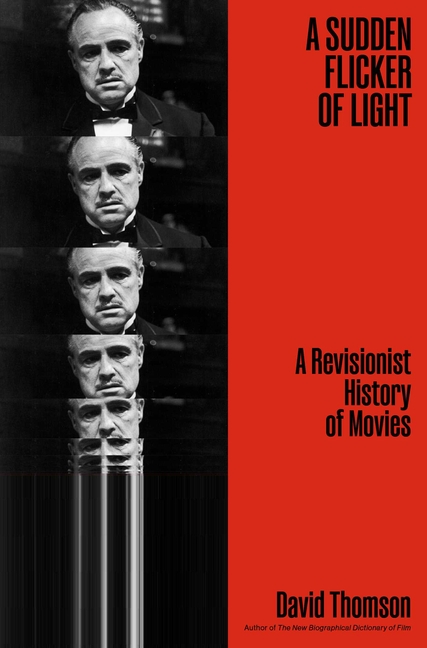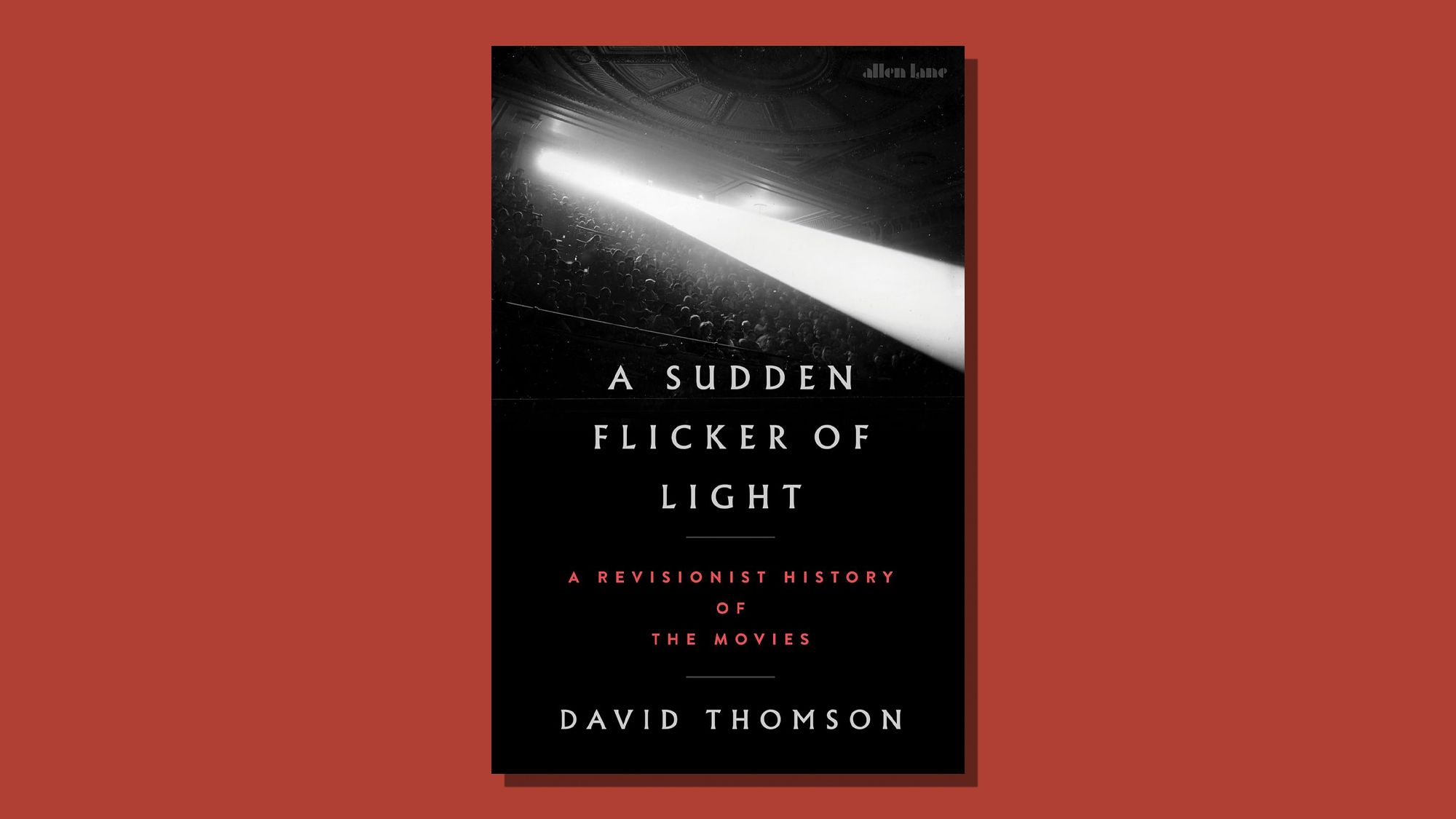
A Sudden Flicker of Light: A Revisionist History of the Movies Author: David Thomson ISBN-13: 978-0241843345Publisher: Allen LaneGuideline Price: £25How often do you imagine yourself on a movie screen? Soundtracked, dramatically lit, richly silent or uttering snappy dialogue? If you’re like me, it’s probably at least once a day. Daft confession, for a husband and father in his forties. If my life resembles anything in a movie, it’s that bit at the end of Goodfellas when Ray Liotta in his witness-protection dressing-gown picks up his daily newspaper. But there I go, imagining myself into a movie yet again. When Andy Warhol called his amateur actors “superstars,” he was being ironic, of course, but he was also telling a truth. In the age of movies, everyone thinks like a superstar, which is to say, everyone lives an inner life structured, to one degree or another, by the grammar of film. We know this. It’s a truism. But how often do we actually think about what it means? If we see ourselves at all, we see ourselves on screen – on the screens in our pockets, the screens in our heads. So what, under these conditions, are we actually seeing? The thing itself or the shadows cast by projected or pixelated light? An ancient question. Put it this way: “Humankind lingers unregenerately in Plato’s cave, still revelling, its age-old habit, in mere images of the truth.” That’s the first sentence of Susan Sontag’s On Photography (1977). “Habit,” here, might be wrong. A truer word might be “preference,” or “passion.” With us and screens, it was love at first sight. The Lumiere brothers famously described the movies as “an invention without a future.” Irony: their invention was the future. Plato’s cave is usually understood as an allegory about the nature of reality. We cannot see the ideal forms of things, only their images, as Plato’s imagined prisoners mistake the shadows on the cave walls for the objects that cast them. The intellectual usually understands him or herself as tasked in some way with escorting people out of the cave, forcing or cajoling a confrontation with the real. [ This man spent 15 years translating Plato’s dialogues. What he learned is vital for us allOpens in new window ]But this may be a fool’s errand. People love the cave. They rarely want to leave. They – we – sit on our sofas, with Netflix on one screen and the internet on another, and we go from one shadow-world to the next, and we are utterly at home. It’s what we’ve always wanted. But nobody feels good admitting this. We know from experience, and from what our parents told us, that anything we like this much has to be bad for us. We tell our kids, No screen time, as if their entire working lives won’t take place on screens, and most of their social lives, too. “Screen,” in common usage, once referred to those opaque screens or room-dividers behind which things like chamber pots could be hidden. It’s in this sense that Freud speaks of “screen memories,” those images that cover up troubling or unacceptable childhood feelings. Our screens are as opaque as ever, but now we think they show us everything. And in a sense they do. They show us everything we want to see. “There is really just a single screen,” writes the British film critic David Thomson, “and so many figures take their place on it.” Thomson knows that the original screen is the movie screen. He has now spent a long career – his first book on the movies appeared in 1967 – writing about the deep glamour, and the shallow fictions, of the movie business and the art of film. He is known to connoisseurs of film criticism as the author of six increasingly capacious editions of The Biographical Dictionary of Film (1975-2014), which is disguised as a reference book but is really David Thomson’s autobiography told via swift portraits of movie men and women, and which is absurdly prodigal with insights (on Gary Cooper: “Like so many of the great stars, he gave the impression of being caught unexpectedly in his own thoughts.”) Thomson’s great strength, as a critic, is that he takes our communal ambivalence about film to productive extremes. He loves the movies so much that he has spent his life in a completist fever, writing and rewriting a 1,000-page book about the people who make them. And this was while he plugged away at separate full-length biographies of Orson Welles, David O Selznick, Marlo Brando and Nicole Kidman, not to mention his other completist’s almanac, 2008’s Have You Seen…?, which is subtitled “A Personal Introduction to 1,000 Films,” not to mention The Whole Equation, his 2004 history of Hollywood, and so on and so on ... But Thomson also has the intellectual’s – that is to say, the Platonist’s – deep suspicions about the lure of the shadow-world. An early book, America in the Dark (1977), cautioned that Hollywood’s true gift to the United States was a luxurious detachment from reality that could end nowhere good. Now Thomson’s new book – a “revisionist” history of film, per the subtitle – has a chapter near the end called “Quiet, Piggy,” which is, you will alas recall, what Donald Trump said to the Bloomberg journalist Catherine Lucey on Air Force One in November 2025. Trump has always understood the image-world. He may not really understand anything else. But he may not need to. [ Was anyone surprised when Trump called a woman journalist ‘piggy’?Opens in new window ]A Sudden Flicker of Light does nothing so gauche as draw a direct line from the movies to Trump. Thomson isn’t in the business of advancing shallow cultural diagnoses. Late in the book he quotes the novelist and screenwriter Terry Southern on the difference between film and prose. Prose, Southern says, is “a gathering web of insinuations”. Thomson has devoted his writing life to film but any writing life is a life devoted to writing, whatever the subject addressed. Now he is ready to gather his web of insinuations once again. “[T]his medium has begun to diminish our nature.” To exalt the dream life, and then to spend our lives watching that exaltation – what has it done to us? (Incidentally, it is precisely the gathering web of insinuations that prose written by large language model lacks. To insinuate, it turns out, is human.) Other countries make films, but only America makes movies. Hence A Sudden Flicker of Light is a preponderantly American book. It hits the history’s high notes: The Jazz Singer, Birth of a Nation (two execrable films, actually), Citizen Kane, Bogart, Hitchcock, The Silence of the Lambs … We sit in the dark, or on our sofas, watching America’s lush romantic dreams about itself, and making them our own dreams. Why are we dubious about Irish films? British films? Even French or German films? They’re too damn close to reality. Nobody ever accused an American movie of being too damn close to reality. The American Empire played itself out on screens. (This was what the French intellectual Jean Baudrillard meant when, in the early 1990s, he wrote that “the Gulf War did not take place”.) The fraying of the empire has meant a diminishment in the scale of the screened dream: Donald Trump is a creature of television, not movies, and it is streaming content that now delivers us our daily visions of a flattened and futureless, but still ineffably glamorous, fantasy USA. (Melania, nostalgist that she is, made a movie about herself. But Eva Braun, too, was interested in movies, and filmed happy days at the Berghof as the camp ovens burned off screen.) Revision by small revision, Thomson insinuates his case against movies. Georges Méliès, the great French innovator, “had long appreciated that photography was a tricked reality, a medium begging for subterfuge, ‘effects,’ and bare-faced lies.” But Méliès’s early film entertainments are, Thomson says, “monotonous and childish if set beside the work Picasso was doing in those same years – the moment of cubism and Les Demoiselles d’Avignon (1907).” A childish art, an art of daydream: for more than a century we have been in thrall to a machine for “making lustrous images that confuse our footing in reality”.“Reading,” Thomson suggests, “is a habit in which the shape of sentences is a primer in logic and reasoning. It is also a mechanism that trains one in imagining other people, their feelings, their facts, and their possibility […] And this capacity is being undermined by the attachment to screens and their insinuation that we are no more than helpless outsiders to what is happening.” Movies show us everything, or seem to. But they failed to record the worst catastrophes of the 20th century. As Thomson points out, no film exists of the bombing of Hiroshima, or of the Nazi gas chambers in operation. When movies show us history, they lie. The battle on the Odesa steps, in Eisenstein’s Battleship Potemkin (1925), never happened, nor anything like it. But they are everyone’s remembered image of the Russian Revolution – even though the film is set (another triumph of the remembered image over the facts of history) during the failed revolution of 1905. “For a century,” Thomson suggests, “the fallacy had reigned that watching would make us better. Instead of just indifferent.” In Plato’s allegory, the cave can be escaped. Does the image world have an exit? Or are we getting closer, day by day, to creating a world in which the shadows on the wall are all that matter, and all that ever did?Kevin Power is a writer and an assistant professor at Trinity College DublinFurther readingFlicker by Theodore Roszak (1992)This hugely involving thriller about a malign and ancient conspiracy to influence people using a subliminal “flicker”, now perfected in movies, is a cult book among cinephiles, and deservedly so. A Year in the Dark by Renata Adler (1969)Adler spent a year writing film reviews and movie journalism for The New York Times, and collected her entire year’s work in this bracing volume, a sly series of suggestions that the movies aren’t everything they’re cracked up to be, and neither is the culture that worships them. From Caligari to Hitler by Siegfried Kracauer (1947)A refugee from Nazi Germany, Kracauer wound up in New York in the 1940s, writing this book about how the psychological underpinnings of nazism were clearly visible in the strange expressionist films of the Weimar period.
A Sudden Flicker of Light: A Revisionist History of the Movies – big screen questions
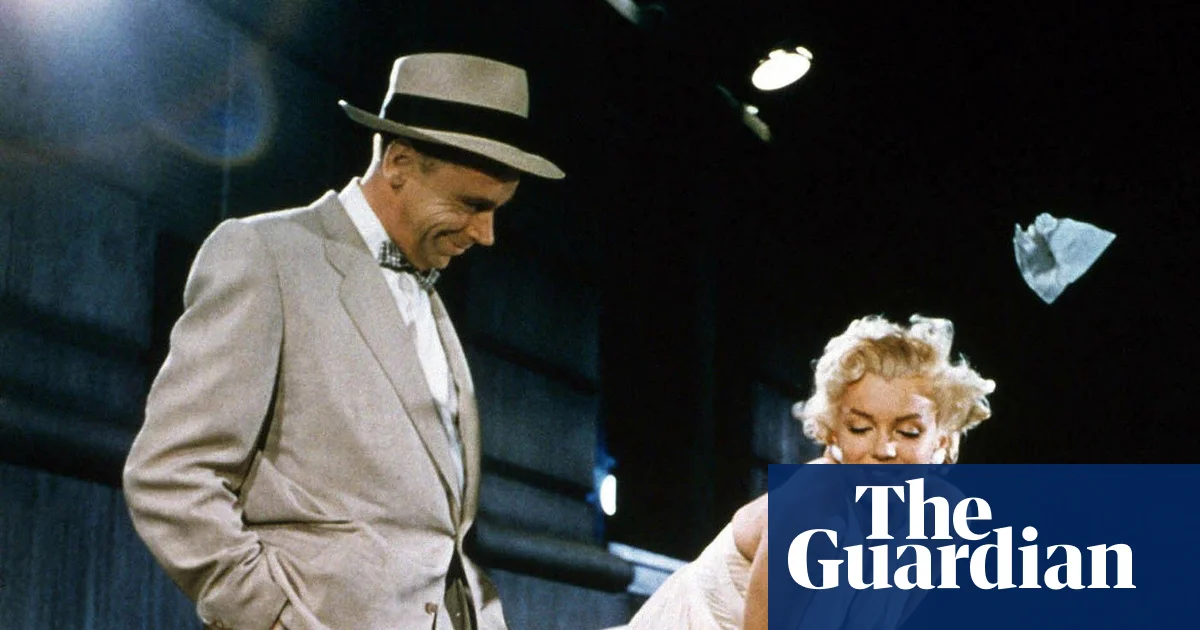
David Thompson, having devoted his life to writing about film, suggests the medium has begun to diminish our very nature
1,753 words~8 min read