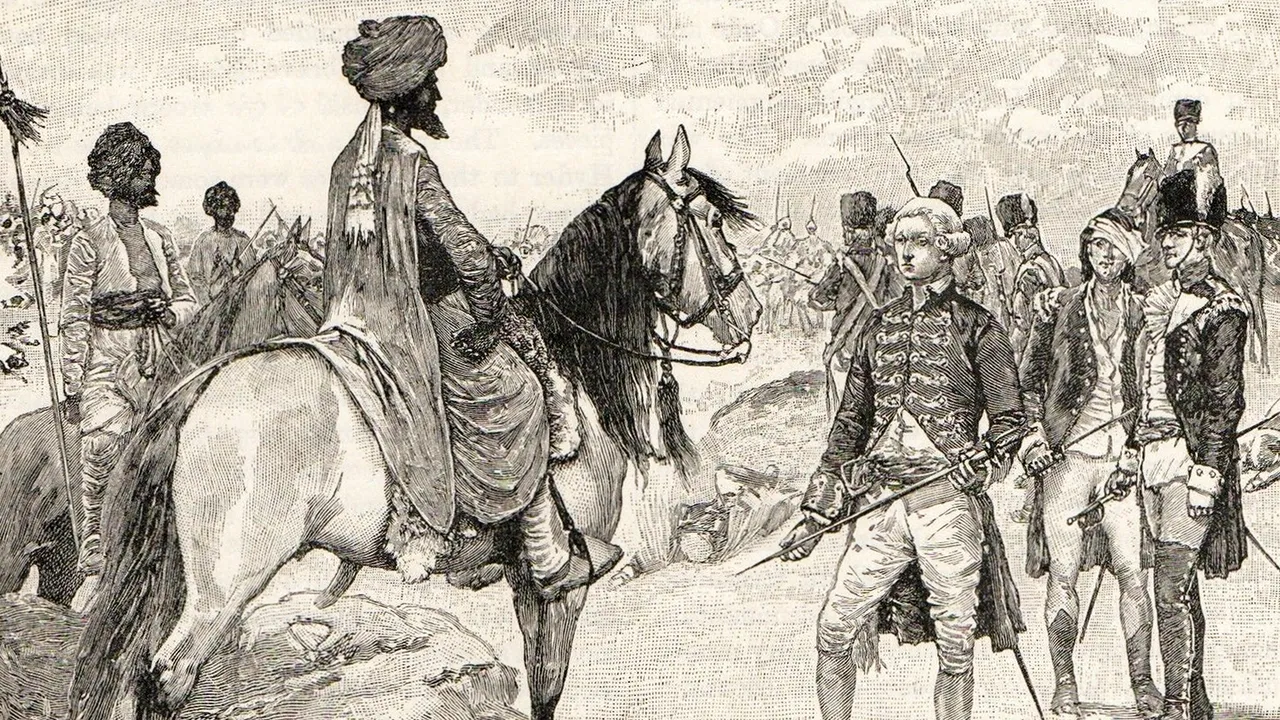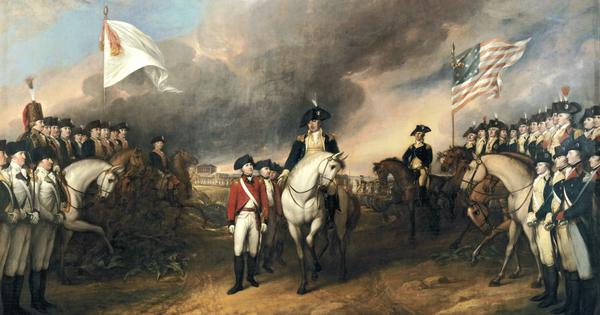
July 4 marks the 250th anniversary of the day America’s colonists issued a declaration stating their desire to be free of British rule. The anniversary is an occasion to revisit two questions that are fundamental to US history: what motivated the American colonies to turn against their overlords across the Atlantic? And how did an outmanned colonial military defeat a superior British fighting force?An unlikely country – India – factors into both answers. Let’s review them, in reverse chronological order.In April 1775, war broke out between the American colonies and the British. The colonists won that first battle of what became known as the Revolutionary War. While the British had more experience, more troops, and more money, they could never conquer the colonists. For several years, the two sides battled to a stalemate. But the tide turned in 1781. What changed? To answer that, let’s look at a battle fought the previous year – in India.Soldiers from the East India Company – a de facto arm of the British government – were enmeshed in what became known as the Second Anglo-Mysore War. The battle stemmed from Britain’s seizure of a port controlled by the French government in Mahé, on the Malabar coast, in 1779. Portions of India were under French rule at the time.The port was closely aligned with Mysore’s ruler, Haidar Ali, and he responded to its seizure the following July by mounting a massive invasion of the Carnatic region, deploying 80,000 troops. Two months of warfare followed, with the decisive battle fought on September 10 in the town of Pollilur. The use of what was then cutting-edge rocket technology helped Ali and his troops prevail. The East India Company suffered 3,000 fatalities and lost nearly half its officers. It was “the severest blow that the English ever sustained in India,” according to a leading British military official of the era, Sir Hector Munro.A map of Mahé from 1726. Credit: Anonymous Unknown author, Public domain, via Wikimedia CommonsThe outcome was wake-up call to the British, who feared French encroachment. Soon afterwards, the British doubled the number of troops they had in India, which meant reducing their presence in the Revolutionary War. It was a critical decision – and one that would have far-reaching consequences.The reallocation helped the British achieve military parity with India in what become known as the Second Anglo-Mysore War, which concluded in 1784 with the Treaty of Mangalore. But this came at the expense of the fighting forces in the American colonies.The British were henceforth short staffed, and unable to keep up with the colonists, who in January 1781 won a key battle in South Carolina. Nine months later, the two sides squared off in Yorktown, a city in Virginia. But the British, with 8,000 troops, could not compete with the nearly 20,000 troops representing the Americans and the French.On October 19, Britain’s military leader in the American colonies, Lieutenant General Charles Cornwallis, surrendered, effectively ending the Revolutionary War (though battles would continue for another two years). Soon thereafter, America’s political leaders gathered to celebrate the American victory. At the event, they toasted Haidar Ali – “May he continue to be a scourge to the British!” The duke of Manchester later declared, “The neglect of not having a proper naval force in America was the cause of the calamity.”That sentiment is amplified in a forthcoming book by the University of Chicago’s Steven Pincus: “In many ways the defeat . . . at Pollilur led ineluctably to Cornwallis’s surrender at Yorktown.” Pincus adds, “No explanation for the emergence of the American state can be complete without consideration of developments on the Indian subcontinent.”Hyder Spanks the EnglishTo show that the English did not have sole rights on myth making, here is a cartoon by Antoine Borel, showing Hyder Ali of Mysore giving a British officer a thorough spanking while a French soldier smirks and supplies the twigs. pic.twitter.com/6sAVrbRKYv— Folkloristan (@folkloristan) May 22, 2025
How India influenced the US rebellion against the British 250 years ago
Hyder Ali’s military campaign against the East India Company and fears that a famine in Bengal could be replicated in America left their mark far away.
1,525 words~7 min read