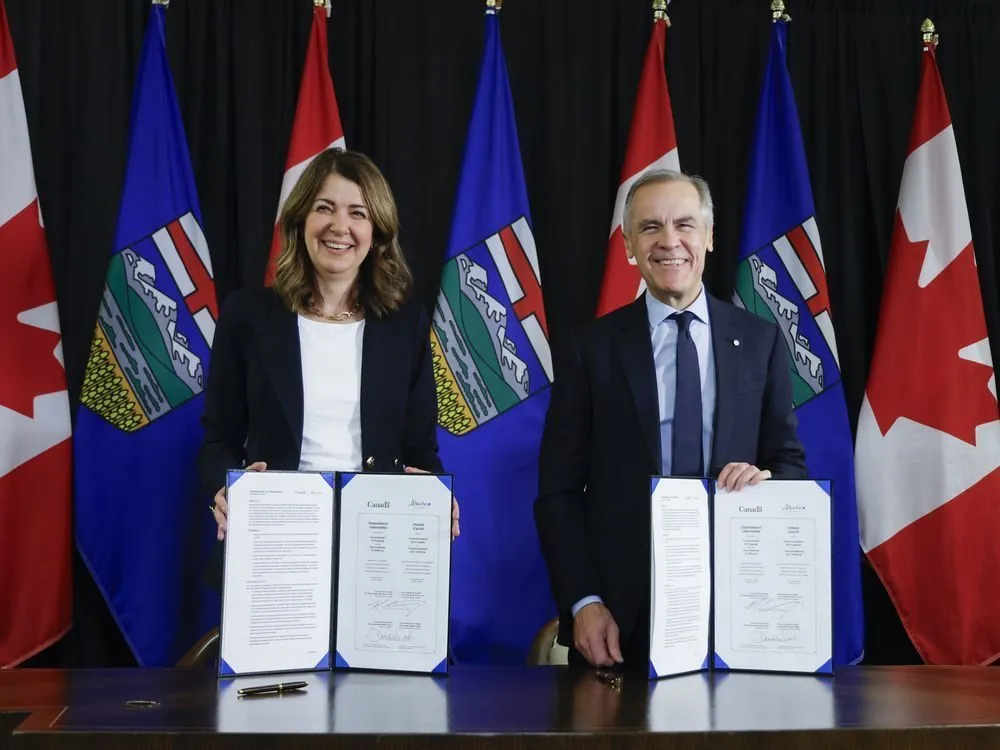
Skip to Content News Archives Economy Energy Oil & Gas Renewables Electric Vehicles Mining Commodities Agriculture Real Estate Mortgages Mortgage Rates Finance Banking Insurance Fintech Cryptocurrency Work Wealth Smart Money Wealth Management Investor Personal Finance Family Finance Retirement Taxes High Net Worth FP Comment Executive Women Puzzmo Newsletters Financial Times Business Essentials More Innovation Information Technology FP500 Podcasts Small Business Lives Told Tails Told Shopping Financial Post Store Obituaries Place a Notice Advertising Advertising With Us Advertising Solutions Postmedia Ad Manager Sponsorship Requests Classifieds Place a Classifieds ad Working Profile Settings My Subscriptions Saved Articles My Offers Newsletters Customer Service FAQ News Economy Energy Mining Real Estate Finance Work Wealth Investor FP Comment Executive Women Puzzmo Newsletters Financial Times Business Essentials HomeEnergyVarcoe: 'Investments are riding on this' — great expectations as Alberta pursues West Coast pipeline proposalThe message from the federal government surrounding oil and gas has shifted “like night and day" You can save this article by registering for free here. Or sign-in if you have an account.Prime Minister Mark Carney, right, signs a memorandum of understanding with Alberta Premier Danielle Smith in Calgary, Alta., Nov. 27. Photo by Jeff McIntosh/The Canadian PressDuring the Calgary Stampede one year ago, Prime Minister Mark Carney said it was “highly, highly likely” his government would consider a proposed oil pipeline to the Pacific Coast to become a project of national interest.Subscribe now to read the latest news in your city and across Canada.Exclusive articles from Barbara Shecter, Joe O'Connor, Gabriel Friedman, and others.Daily content from Financial Times, the world's leading global business publication.Unlimited online access to read articles from Financial Post, National Post and 15 news sites across Canada with one account.National Post ePaper, an electronic replica of the print edition to view on any device, share and comment on.Daily puzzles, including the New York Times Crossword.Subscribe now to read the latest news in your city and across Canada.Exclusive articles from Barbara Shecter, Joe O'Connor, Gabriel Friedman and others.Daily content from Financial Times, the world's leading global business publication.Unlimited online access to read articles from Financial Post, National Post and 15 news sites across Canada with one account.National Post ePaper, an electronic replica of the print edition to view on any device, share and comment on.Daily puzzles, including the New York Times Crossword.Create an account or sign in to continue with your reading experience.Access articles from across Canada with one account.Share your thoughts and join the conversation in the comments.Enjoy additional articles per month.Get email updates from your favourite authors.Create an account or sign in to continue with your reading experience.Access articles from across Canada with one accountShare your thoughts and join the conversation in the commentsEnjoy additional articles per monthGet email updates from your favourite authorsSign In or Create an AccountorThat initial optimism could take a step forward Thursday, marking another key moment for the Alberta-Ottawa energy accord and the province’s pipeline ambitions.Alberta had pledged to send its proposal to the federal Major Projects Office by Canada Day, allowing it to be considered for expedited approval as a nationally significant development.Get the latest headlines, breaking news and columns.By signing up you consent to receive the above newsletter from Postmedia Network Inc.A welcome email is on its way. If you don't see it, please check your junk folder.The next issue of Top Stories will soon be in your inbox.We encountered an issue signing you up. Please try againEarlier this week, the province said an announcement was expected on Thursday to provide long-awaited specifics about the initiative that aims to transport one million barrels per day of Alberta bitumen to the British Columbia Coast for export.“I would say investments are riding on this, jobs, job certainty . . . We can’t just keep talking about energy being (Canada’s) superpower and not do something about it,” said Gurpreet Lail, CEO of Enserva, an industry group that represents energy services, supply and manufacturing firms.“We still need to see tangible changes to make that happen.”Industry leaders are watching several key issues tied to the energy accord including whether the proposed oil line would be built from Alberta to the northwest Pacific Coast, or south to the Port of Vancouver, and if private sector proponents take a stake in the venture.Will it also come with an understanding between both levels of governments and the Oil Sands Alliance to build the Pathways carbon capture network in northern Alberta, despite the sector’s concerns about the province’s industrial carbon levy going up?Industry players are looking for signs of progress, including whether the country’s largest oilsands operators agree to the Pathway project and to ramp up production to fill a new pipeline. Mark Little, former Suncor Energy CEO, during a tour of the Fort Hills oilsands project on Monday, Sept. 10, 2018. Vincent McDermott/Postmedia file“Does it look like the industry is in on (the deal) or is their resistance growing? I think it’s pretty clear that the province and the feds are trying to actually make something happen here,” said former Suncor Energy CEO Mark Little, who was involved in the formation of the alliance in 2021.“Every month that goes by, the tension keeps building.”The idea of building a new West Coast oil pipeline was initially pitched by Premier Danielle Smith to the Carney government last year. It would see a new line approved under Ottawa’s Bill C-5, along with industry advancing the multibillion-dollar carbon capture project to help decarbonize oilsands production.In an interview with the Herald last July, Carney seemed to open the door to both the pipeline proposal and the Pathways initiative.“I am confident that my government will do everything we can so that those projects can be built,” he said.By November, the pipeline and Pathways project were part of the energy memorandum of understanding (MOU) signed by both governments.The pact also removed several divisive energy and environment policies announced by the former Trudeau government, such as the Clean Electricity Regulations and an emissions cap on Canada’s oil and gas industry.In a video posted Tuesday, Carney detailed the rationale for changing Canada’s approach to conventional energy development, noting issues such as energy security are shifting. Since mid-2024, the Trans Mountain expansion has also proven there is strong demand for Canadian heavy crude in Asia.“We’re developing options for a second oil pipeline to the West Coast,” Carney said in the video.The message from the federal government surrounding oil and gas has shifted “like night and day,” in the past year, said Lail.As part of a follow-up agreement between the governments in May, Smith pledged Alberta would submit its pipeline application by the end of June. The two sides also reached an agreement on industrial carbon pricing.At the time, Ottawa said it would make its “best efforts” to provide a path that would enable necessary approvals needed to start building the pipeline by September 2027.While a route has not yet been revealed, Smith previously voiced support for a northern line that would ship oil to the Port of Prince Rupert area, but told the Herald last December that a southern route to Roberts Bank in Delta, south of Vancouver, was also being studied.Richard Masson, former CEO of the Alberta Petroleum Marketing Commission (APMC), believes a southern pipeline is more likely to advance than a northern one, given opposition from some coastal First Nations.“In my mind, the northern route doesn’t have the Indigenous support it needs to succeed,” said Masson, adding additional production will also be needed to support the proposal.“To have any kind of pipeline, you have to have shippers, and I don’t see them.” Richard Masson, chair of the World Petroleum Council Canada poses at the BMO Centre in Calgary on Friday, September 15, 2023. Jim Wells/PostmediaTalks between the two governments and the Oil Sands Alliance — a group of five large producers, including Cenovus Energy and Canadian Natural Resources — to build the carbon capture network, and increase oil production to fill a new pipeline, have continued in recent weeks.Industry leaders recently criticized Alberta’s industrial carbon tax, which will climb to an effective rate of $130 per tonne of emissions by 2040 under the MOU.However, there could be room for a deal with the oilsands producers, one that could potentially see the two governments take steps to incentivize more output.“I think the province is going to light a bonfire under this pipeline (proposal) and work hard to put it forward,” said Little.Oilsands production is expected to grow by about 500,000 bpd by the end of this decade, mainly coming from optimizing existing developments, said BMO Capital Markets analyst Randy Ollenberger.Future growth projects could theoretically add another half-a-million bpd of output by 2035, although those developments haven’t been sanctioned yet, he said.There are already about 1.2 million bpd of identified pipeline expansion plans in the works in Canada, excluding the province’s West Coast proposal.Former Alberta energy minister Sonya Savage said this week she will be looking for specifics about the pipeline proposal, but anticipates it will take time to sort out all the details required for the major development.“I don’t know how far advanced it’s going to be,” she said. “If it takes longer, that’s OK. These things take time.”Chris Varcoe is a Calgary Herald columnist.cvarcoe@postmedia.com Join the Conversation This website uses cookies to personalize your content (including ads), and allows us to analyze our traffic. Read more about cookies here. By continuing to use our site, you agree to our Terms of Use and Privacy Policy.
Varcoe: 'Investments are riding on this' — great expectations as Alberta pursues West Coast pipeline proposal
Optimism could take a step forward Thursday, marking another key moment for the Alberta-Ottawa energy accord and the province’s pipeline ambitions.
1,567 words~7 min read