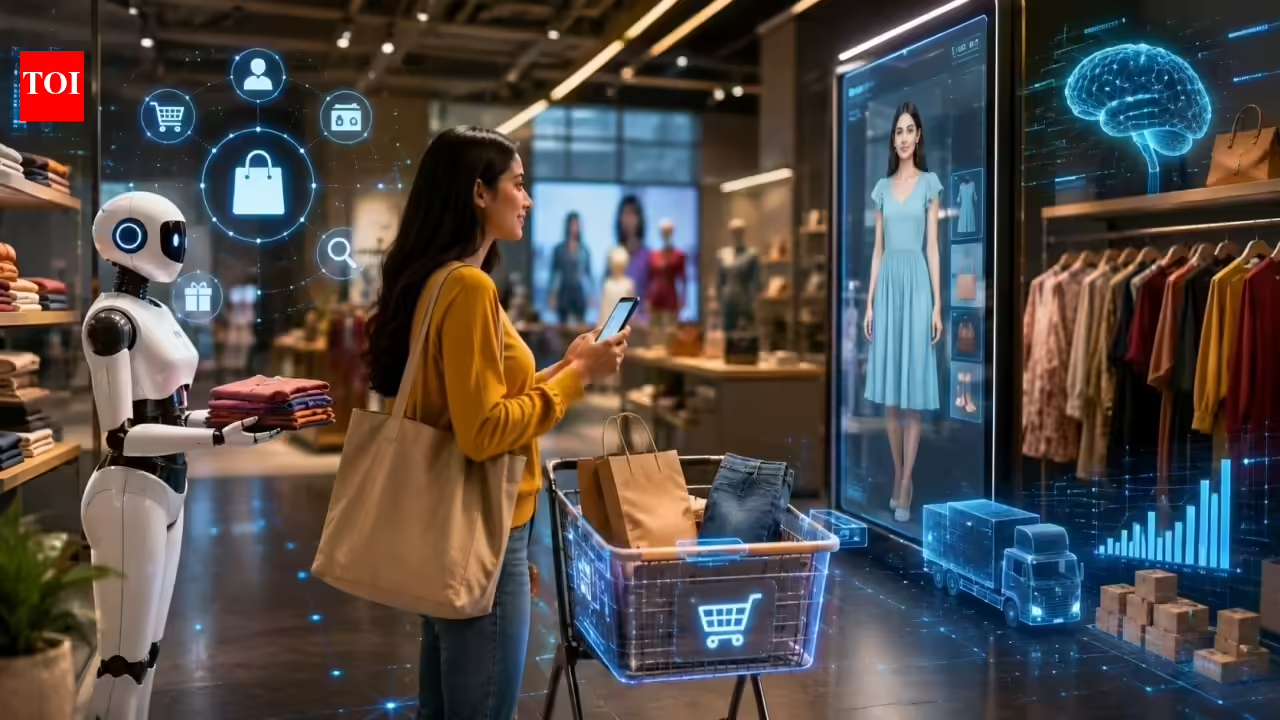
Akhilesh Sharma, Founder & CEO, A3logics—20+ years in digital transformation, AI & EDI. Firsthand insight into AI-augmented workplaces.gettyRetail has spent the better part of the last decade competing on intelligence at the customer edge. This included smarter recommendations, faster checkout, dynamic pricing and omnichannel experiences designed to reduce friction.As AI expands across forecasting, pricing, fraud detection and customer engagement, retail enterprises have become more sophisticated—and more fragile.Today's retail business is no longer simply a collection of stores, warehouses and payment terminals. It is a tightly coupled digital ecosystem of APIs, AI decision engines, cloud-native workflows, embedded payment platforms, logistics providers, loyalty systems and third-party marketplaces, all expected to function in synchronized real time.While that interconnectedness has delivered extraordinary speed, it also creates a new category of systemic risk. A checkout issue is no longer merely a checkout issue. A corrupted inventory feed can trigger fulfillment delays across multiple regions. A payment orchestration failure can erode customer trust in minutes. A compromised vendor integration can disrupt far more than the originally affected environment.Retail's challenge is no longer simply digital transformation. It is digital survivability.Why Traditional Resilience Thinking Is No Longer EnoughFor years, enterprise resilience strategies were built around prevention: strengthen perimeter security, improve patch discipline, monitor endpoints and reduce downtime. These remain necessary disciplines, but hyperconnected systems do not fail in isolated ways. They fail systemically.The cyber incidents affecting major U.K. retailers, alongside visible customer-facing disruption, offered a reminder of how tightly coupled modern retail ecosystems have become. In several cases, disruptions extended beyond websites and payments into fulfillment, customer service and supply-chain operations, showing how a single failure can ripple across the retail value chain.The issue is not that prevention has become irrelevant but that prevention assumes disruption can always be stopped before it spreads. I believe that assumption becomes increasingly fragile in ecosystems where AI models, payment networks, APIs, cloud platforms and third-party vendors continuously interact.Against a backdrop of broader cyber threat trends, the more relevant leadership question may no longer be "How do we prevent failure entirely?" but "How do we ensure failure does not spread faster than we can contain it?"Thinking Less Like Engineers And More Like BiologistsIn this context, I believe biological systems offer a useful model. A healthy immune system detects anomalies, isolates threats, activates defenses, learns from exposure and adapts.Digital enterprises may need to evolve similarly. The concept of a digital immune system, which has since gained broader attention across enterprise architecture and software engineering communities, points toward this broader enterprise direction, combining observability, automated testing, engineering discipline and adaptive recovery.Applied to retail, the implications become particularly compelling. Imagine infrastructure that behaves less like static software and more like adaptive biological defense. Not merely monitoring for failure but also responding to it, containing it and learning from it, recovering autonomously where possible.What A Self-Healing Retail Infrastructure Could Look LikeThe underlying technologies already exist. What remains underdeveloped is the architectural intent to connect them.Checkout ResilienceIf a payment gateway begins to fail during a peak transaction window, traditional systems escalate alerts and depend on operational teams to intervene. A more adaptive architecture could automatically reroute transactions across alternate payment rails, preserve customer continuity and reduce cart abandonment without waiting for human escalation.Inventory IntegrityRetail inventory synchronization remains vulnerable to delayed API responses, mismatched data states and fragmented fulfillment logic. A self-healing system could reconcile inventory signals, detect anomalies before they become customer-facing failures and redirect fulfillment accordingly.Modern cloud resilience engineering principles already support much of this architectural thinking. Concepts such as fault isolation, failover, redundancy and observability are already embedded within cloud-native architectures. Self-healing retail infrastructure extends these principles beyond availability and uptime, enabling systems to identify anomalies, contain their impact and restore trusted operations with minimal human intervention.When Intelligence Becomes A Risk MultiplierAI introduces another layer of both opportunity and amplification risk. As AI-led retail transformation accelerates, operational intelligence increasingly becomes both a competitive advantage and a potential failure multiplier.Many retail systems now rely on AI for demand forecasting, fraud detection, pricing decisions and recommendation engines. When those models drift or their assumptions fail, errors can scale rapidly.Adaptive infrastructure could detect abnormal model behavior, quarantine suspicious outputs, revert to validated decision states and prevent flawed automation from cascading across the enterprise.Cybersecurity may be the most urgent application. According to IBM's "Cost of a Data Breach Report 2025," organizations using AI-driven security automation reduce both containment time and breach-related costs.Broader work framing cyber resilience as a business discipline reinforces the same strategic logic. A compromised POS cluster should not necessarily trigger enterprise-wide disruption. Infrastructure designed with containment logic could isolate affected nodes, preserve operations elsewhere and dynamically reroute critical services while remediation continues.This is not speculative futurism. It is an architectural decision.The KPI Retail Leadership May Be MissingRetail has traditionally measured resilience through uptime, but that metric increasingly feels incomplete since a system may be technically available while operationally compromised. The more meaningful strategic metric may be recoverability. • How quickly can the enterprise detect abnormal behavior?• How effectively can it isolate disruption?• How intelligently can it preserve continuity?• How safely can it restore trusted operations?These are increasingly business strategy questions, because trust is often lost faster than systems recover.From Optimization To SurvivabilityRetail's first digital era focused on digitization. Its second focused on optimization. The next may belong to survivability.This does not mean slowing innovation. Instead, I think it means designing innovation with resilience at its core. The reality is that personalization will continue to matter, AI will become even more deeply embedded and speed will remain essential. But retail has become too interconnected to think in isolated technology layers. The enterprises that lead the next decade may be those that stop asking whether disruption can be eliminated entirely and start designing systems capable of absorbing, containing and recovering from it intelligently. Because in modern commerce, resilience can no longer be viewed as operational insurance.Forbes Technology Council is an invitation-only community for world-class CIOs, CTOs and technology executives. Do I qualify?
Retail’s Next Competitive Edge Is Recoverability
Retail's challenge is no longer simply digital transformation. It is digital survivability.
994 words~5 min read