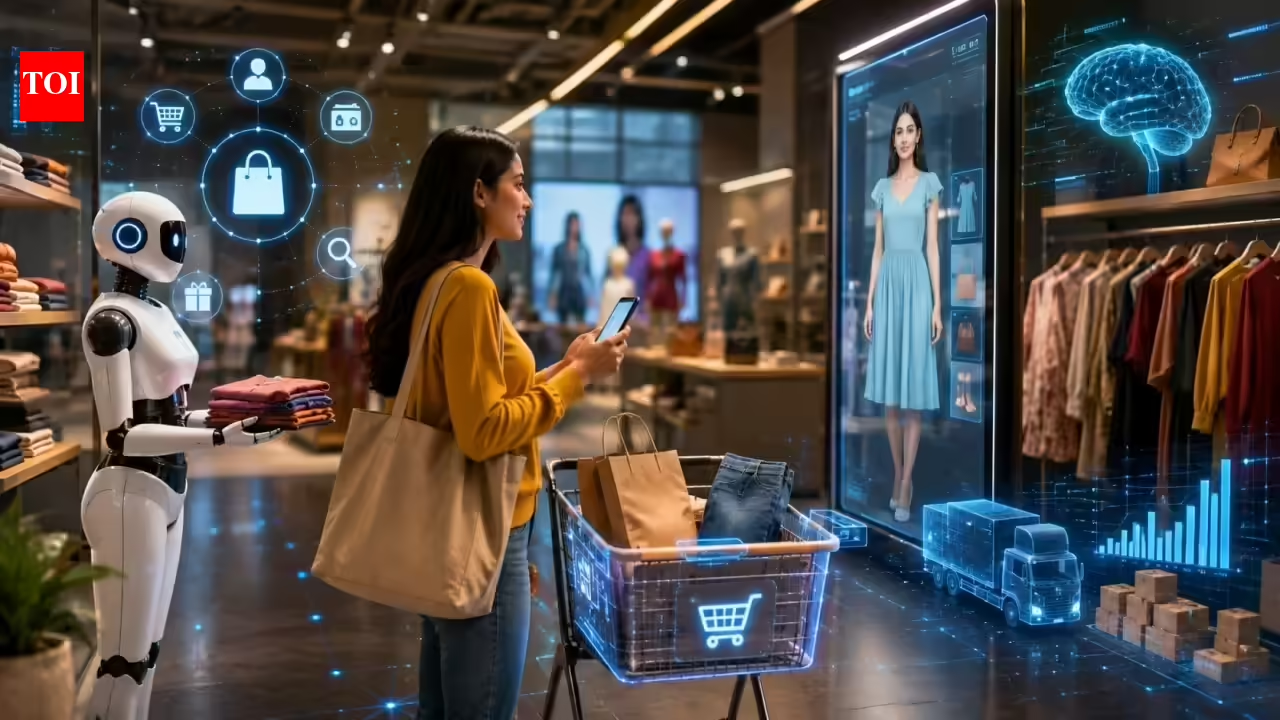
A high-AIQ retail organisation has moved beyond using AI as a tool for operational efficiency and built it as the foundation of its customer relationship. (AI image)Consider what a customer interaction looks like for a high-AIQ Indian retailer today. A consumer opens an app and is presented with a homepage configured in real time based on their purchase history, browsing behaviour, time of day, location, and current inventory availability. The product they are most likely to buy surfaced first. The price they are offered reflects their price sensitivity, their loyalty profile, and competitive pricing intelligence. The delivery promise they receive is generated by an AI system that has assessed current logistics capacity, their location, and historical delivery performance in their pin code.This is not science fiction. It is the operational reality for India’s most advanced retail organisations. And for those that have not built this capability, the gap is widening every quarter.The Data Behind Retail AI’s Business ImpactThe evidence for AI’s impact on retail business performance is compelling and consistent across geographies. Sales professionals using AI are 47 per cent more productive, saving an average of 12 hours per week. Eighty-three per cent of sales teams with AI reported revenue growth in 2024, compared to 66 per cent of those without. Deal cycles for sales professionals using AI weekly are 78 per cent shorter.Customer experience improvements are equally documented. A Salesforce survey found that 63 per cent of service professionals believe generative AI helps them work faster. McKinsey data identifies customer operations as one of the four highest-value AI application areas, with AI-powered customer operations delivering 82 per cent faster response times. For India’s retail sector, where customer service quality has historically been a differentiator, this represents a structural competitive advantage for early movers.Demand Forecasting and Inventory IntelligenceOverstocking and understocking are the twin pathologies of retail inventory management. The cost of carrying excess inventory in Indian retail is substantial, while the cost of a stockout — lost sale, customer disappointment, potential permanent churn — is higher still. AI-driven demand forecasting systems, trained on historical sales data, real-time market signals, seasonal patterns, promotional calendars, and macroeconomic indicators, are delivering forecast accuracy improvements that translate directly to margin.The India AI in Supply Chain market, which encompasses retail logistics and inventory management, is projected to grow at a CAGR of 37.8 per cent through 2032. The e-commerce sector is among the primary drivers, with companies leveraging AI to manage high order volumes, optimise last-mile delivery, and improve customer satisfaction.Personalisation at Scale: The End of Mass MarketingThe traditional retail marketing model — mass communication, broad targeting, standard promotions — is being replaced by AI-powered personalisation that treats every customer as a segment of one. McKinsey’s analysis of AI’s impact on marketing found that AI-powered personalised messaging and pipeline management are among the highest-return AI applications in the marketing function.For Indian retailers operating in a market of 1.4 billion people with extraordinary demographic, linguistic, and cultural diversity, personalisation at scale represents both the greatest challenge and the greatest opportunity. A high-AIQ retailer does not communicate with its customers in Hindi or English or Tamil. It communicates with each customer in the language of their individual preferences, purchase history, and life context.The Omnichannel Intelligence ImperativeIndia’s retail landscape is uniquely complex: a massive and growing e-commerce sector coexists with 12 million traditional kirana stores, modern trade formats, and a rapidly expanding quick-commerce segment. The consumer moves fluidly between these channels, expecting a seamless experience in each. AI is the only technology capable of creating and managing this seamlessness at scale — unifying the data from every customer touchpoint into a single intelligence layer that informs every subsequent interaction.Fifty-three per cent of small business owners across sectors report noticeable improvements in customer experience after implementing AI solutions. For India’s large retail organisations, which can deploy more sophisticated AI systems and generate more data to train them, the potential impact is correspondingly greater.What AIQ Means for Indian RetailersA high-AIQ retail organisation has moved beyond using AI as a tool for operational efficiency and built it as the foundation of its customer relationship. It knows its customers better than any competitor. It serves them faster and more relevantly. It manages its inventory and supply chain with a level of precision that manual processes cannot match. And it does all of this at a scale and cost that creates structural advantage.The TOI AI Quotient Awards invites India’s retail leaders — from the country’s largest e-commerce platforms to the most innovative traditional retailers and D2C brands — to demonstrate the AI Quotient they have built. The award is for organisations that have made the customer relationship, through AI, genuinely smarter.
AI is rewriting the rules of Indian retail - the winners are playing a different game
Consider what a customer interaction looks like for a high-AIQ Indian retailer today. A consumer opens an app and is presented with a homepage configured in real time based on their purchase history, browsing behaviour, time of day, location, and current inventory availability.
778 words~4 min read