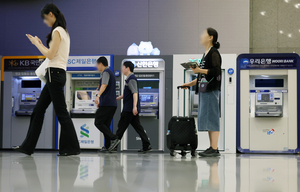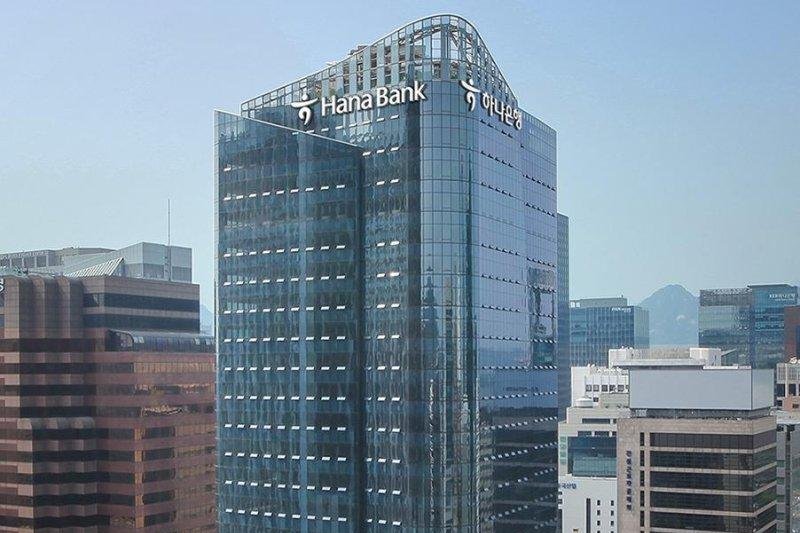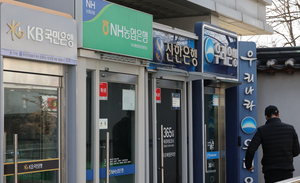
From left are the headquarters of Shinhan, Woori, KB and Hana financial groups. Courtesy of each company Korea’s four major financial holding companies are on track to deliver another record-breaking performance in the first half of the year, driven by robust interest income and a booming domestic stock market, industry officials said Thursday.However, the outlook for the remainder of the year is expected to be less upbeat as a persistently weak Korean won, the prospect of interest rate hikes by the Bank of Korea and tighter regulatory pressure weigh on profitability.The combined net profit of KB, Shinhan, Hana and Woori financial groups is projected to reach an all-time high of 11.05 trillion won ($7.1 billion), up 5.7 percent from 10.46 trillion won a year earlier, according to market tracker FnGuide.All four groups are expected to post higher net income compared with a year earlier, with KB Financial Group projected to lead with about 3.68 trillion won.Strong first-half earnings were largely driven by steady net interest income amid higher market interest rates, as well as rising noninterest income supported by gains from securities subsidiaries.However, whether this momentum can be sustained in the second half of the year remains uncertain.One of the key risks is a prolonged weak won, which has traded above the psychologically important 1,500 level against the U.S. dollar for more than a month.The elevated exchange rate inflates risk-weighted assets (RWA) and puts pressure on banks’ common equity tier 1 ratios, a key gauge of financial health, as it increases the value of foreign currency-denominated loans when converted into won.As of the end of the first quarter, the total RWA of the four major banks already stood at 886.46 trillion won, up 2.9 percent from the end of last year.Potential central bank rate hikes amid persistent inflation and efforts to defend the weak currency are another key concern.While higher rates typically support lending margins, banks’ funding costs are also likely to rise. However, government pressure for inclusive finance leaves lenders with limited room to pass on those costs to customers.Compounding the margin squeeze, a revised banking law that took effect this month bars lenders from incorporating administrative expenses into loan pricing spreads.These factors are fueling expectations that the banks’ net interest margins will inevitably narrow in the second half.Furthermore, banks have expanded corporate lending as household loan growth has been more tightly controlled under regulatory pressure.This raises concerns that more financially weak companies could emerge in the second half of the year as the prolonged economic slowdown, coupled with high exchange rates, inflation and interest rates, adds strain on vulnerable borrowers.“Our business strategy, formulated at the end of last year, already included scenarios assuming the won-dollar exchange rate could reach the 1,600 level,” an official from one of the financial holding groups said. “We are focusing on strengthening nonbanking income to maintain a stable earnings structure even if the period of a persistently weak won continues.”The official added that most financial institutions are expected to rely on the solid earnings base built in the first half to maintain financial soundness in the second half.
KB, Shinhan, Hana, Woori face mounting headwinds despite solid profits - The Korea Times
Korea’s four major financial holding companies are on track to deliver another record-breaking performance in the first half of the year, driven by...
515 words~2 min read