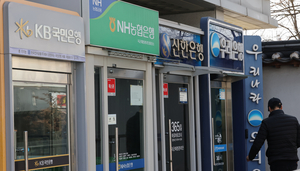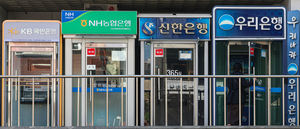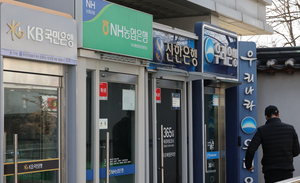
ATMs of Korea's major banks line a street in Seoul in March. (Yonhap) KB Financial Group, Shinhan Financial Group and Woori Financial Group have warned US investors that government pressure to expand policy finance and support vulnerable borrowers could weigh on profitability and asset quality, highlighting risks that were not disclosed in their Korean filings.The banking groups, all listed on the New York Stock Exchange, included the disclosures in annual reports for fiscal 2025 filed with the US Securities and Exchange Commission.In the April 28 filing, KB Financial said the Korean government in 2025 had advanced “inclusive finance initiatives” aimed at improving access to credit for low-income and financially vulnerable borrowers by encouraging banks to provide preferential lending.The group warned that complying with such policy initiatives “could require adjustments to its business practices that may increase the risk of defaults by its customers,” potentially leading to higher delinquency ratios and weaker asset quality.Shinhan Financial used nearly identical wording in its April 22 filing.Woori Financial took a more explicit approach, referring to the government’s push for so-called “productive finance,” under which banks are encouraged to expand lending and investment into strategic industries while diversifying beyond traditional household lending.The group said such policies could force it to support sectors it might not otherwise finance, citing its recently announced plan to invest up to 7 trillion won ($4.7 billion) over the next five years in inclusive finance programs for vulnerable borrowers.Woori warned that the policy direction could pressure its net interest margin and potentially result in “unintended costs or losses.” It also echoed peers in flagging risks of higher customer defaults, rising delinquency ratios and deteriorating asset quality.The disclosures drew attention because policy finance-related risks were absent from the groups’ domestic regulatory filings in Korea.An official at one major banking group said the difference reflects stricter disclosure standards in the US.“US filings are designed to provide detailed disclosure of possible risk factors, even when the actual likelihood is low, because failing to disclose potential risks can create significant regulatory liabilities,” the official said.“The disclosure of inclusive finance-related risks should be understood as notice of a potential risk rather than an indication that actual losses are expected.”The Korea Institute of Finance also recently warned about growing pressure from policy finance in a report on risks facing the banking industry in 2026.“As demands for productive finance and inclusive finance grow, downward pressure on banks’ earnings structures and financial soundness is increasing,” the report said.The institute added that an aggressive expansion of productive finance could create imbalances between corporate lending growth and financial stability.“If large-scale losses occur from these loans, there is a high risk that the impact could spread beyond banks’ soundness and profitability to broader financial-system instability,” it said.
Korean banks flag policy finance risks in US filings
KB Financial Group, Shinhan Financial Group and Woori Financial Group have warned US investors that government pressure to expand policy finance and support vul
456 words~2 min read