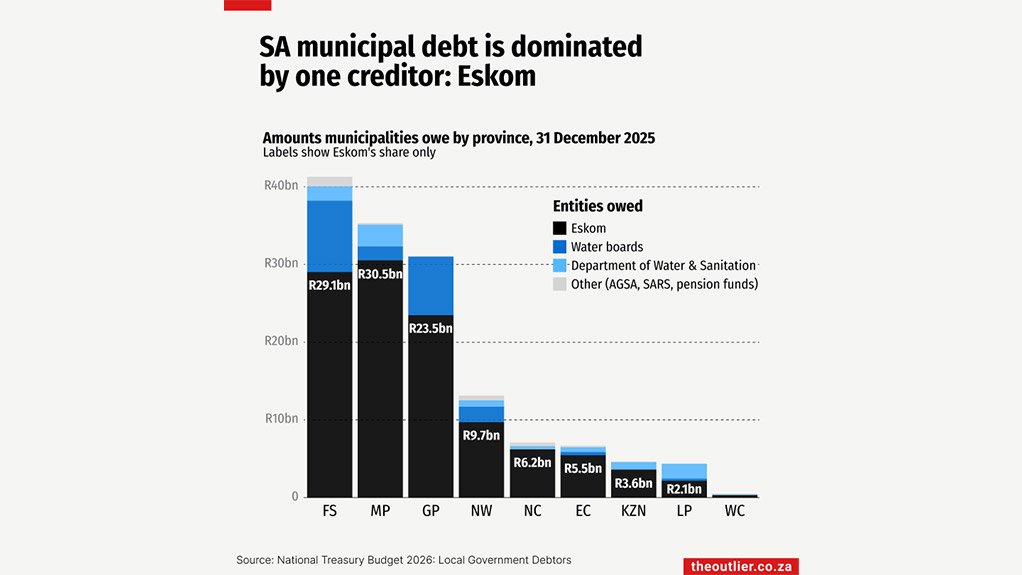
South Africa is good at announcing major reforms for local government. We professionalise it. We pass amendment bills. We design “utility models” to run water and electricity like businesses. We rework the division of revenue. These are serious efforts, and most are headed in the right direction. We assume that a municipality can measure, bill and collect the money it is owed.The auditor-general tabled the 2024/25 local government audit outcomes last week. Under the audit opinions lies the crucial finding that revenue and receivables are the most misstated items across the entire municipal system. The auditor-general reported that 76% submitted financial statements with material misstatements and 39% received modified opinions. Put plainly, most South African municipalities cannot produce reliable figures for their financial statements.What is even more alarming is that in a single year, municipalities wrote off R62bn in consumer debt as irrecoverable and lost a further R36bn to water and electricity distribution losses, essentially water that leaked from broken pipes and power that disappeared from the grid before either could be billed. That is close to R98bn of municipal revenue lost or forgone in one year, simply never counted, never collected and never kept.This picture warrants reframing the debate. At the root is a collection failure. In 2024/25, municipalities took an average of 129 days to collect the money owed to them. The R96bn owed by municipalities to Eskom and the water boards, and the 45% of councils adopting unfunded budgets, are not separate problems. They are downstream symptoms of one upstream failure. A municipality that cannot collect cannot pay. The ongoing debate is premised on treating recurring symptoms because the main cause remains unresolved. Fragmented billing The problem is rarely a lack of legislation or policy. Municipalities often struggle with incomplete customer databases, ageing meters, inaccurate property valuations, illegal connections, weak credit control, fragmented billing systems and chronic shortages of technical and financial skills. These operational failures accumulate over time, rendering financial statements unreliable, causing bills to be disputed or issued incorrectly, and leading to a collapse in cash collections. Every municipality ultimately depends on a simple financial chain: services generate bills, bills generate cash and cash funds maintenance, infrastructure renewal and future service delivery. When that chain breaks, every downstream obligation, from paying Eskom and water boards to repairing infrastructure and maintaining basic services, begins to fail.The fix is profoundly unglamorous. There is no ground-breaking ceremony for a cleaned-up billing system. No politician is carried shoulder-high to sort out a receivables ledger or fix an impairment methodology. No minister announces, to applause, that a municipality has finally started reading its water meters correctly. The work of measuring, billing, collecting and protecting revenue is tedious, technical, invisible and slow. It is thus neglected in favour of grand reform announcements that photograph better. Revenue management is not only an administrative discipline; it also demands political courage. Accurate billing is only the first step. Councils must also be willing to enforce payment consistently, tackle illegal connections and apply credit-control policies fairly, even when doing so is unpopular.Collection failureThe truth is that the grand reforms sit downstream. A business model that cannot meter or bill its customers is not a business; it is a charity with a balance sheet. The Municipal Finance Management Act Amendment Bill’s funded-budget requirement is a noble idea that means nothing if the municipality cannot produce a credible revenue figure to underpin the budget. The equitable share, however generous, cannot be asked to subsidise a collection failure forever. At some point, that is no longer a transfer; it is a permanent bailout of an institution that has stopped trying to bill.In the end, we cannot escape the uncomfortable conclusion. The most consequential local government reform available to South Africa right now is helping municipalities do the boring thing well — that is, to count what they are owed, bill it correctly, collect it and stop it leaking away. Get that right and the glamorous reforms suddenly have a foundation to be built on. Leave it broken, and they are houses built on sand, however elegant the architecture.The reform path requires sequencing and honesty. Fixing the billing system, the meter and customer data, and the receivables ledger before anything else. Rebuilding credit control so that billed revenue is collected. Rooting out distribution losses and building in-house capacity, with real skills transfer, rather than renting it in perpetuity from consultants at R1.6bn a year. None of it will trend. None of it will win an election. It is plumbing, not architecture. But a country that has spent a decade redesigning the house while the pipes rot should, by now, be ready to hear that the plumbing is the reform that matters most.• Ngozo is an independent economist and fiscal policy specialist and founder of Eoza Consultancy.
THANDO NGOZO | Fix municipal revenue collection first
Solution to huge Eskom and water board debts and auditor-general’s negative findings is for local governments to measure, bill, collect and protect revenue
797 words~4 min read