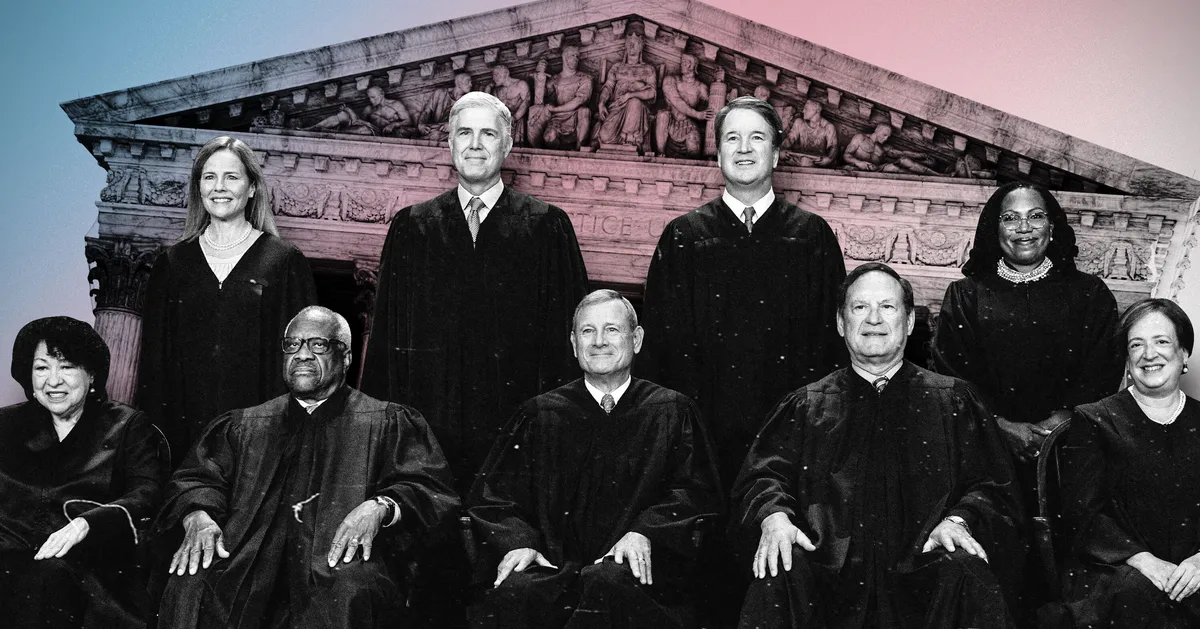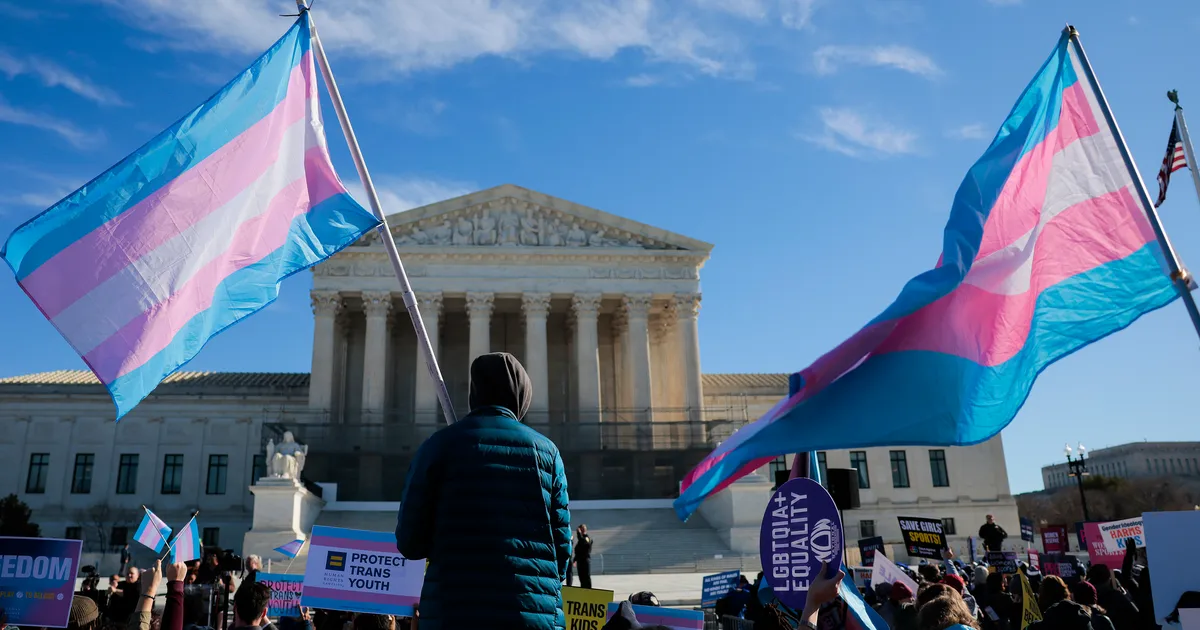
In January, during oral arguments in the Supreme Court, in a case about whether states may exclude transgender female athletes from girls’ sports teams, the lawyer for Becky Pepper-Jackson, a transgender teen-ager, made a point of emphasizing her athletic mediocrity. Competing on her school’s track-and-field and cross-country teams, “where nobody was cut,” her lawyer said, “she came in near the back.” Becky (known in the case as B.P.J.) hadn’t gone through male puberty, and didn’t have male testosterone levels, because she had taken puberty blockers and was on female hormones. The other transgender plaintiff, an Idaho college student named Lindsay Hecox, had gone through male puberty, but, her brief said, she “was not fast enough” to make her university’s N.C.A.A. cross-country and track teams, so she played club sports instead. The plaintiffs’ strategy—to convince the Court that the fact that a girl is transgender doesn’t mean she is bound to be a champion—was understandable. The concern about transgender girls competing on girls’ teams stems from a belief that they have an inherent sex-related athletic advantage over other girls. If the advantage goes away, the plaintiffs’ reasoning went, the concern should go away, too.Twenty-seven states have laws—including the ones at issue in this case, West Virginia and Idaho—that separate sports teams based on sex identified at birth, or “biological sex,” thereby excluding transgender girls from girls’ and women’s teams. (The N.C.A.A. and the International Olympic Committee have adopted similar rules.) On Tuesday, the Court unanimously decided that such policies do not violate Title IX, the federal law that prohibits federally funded schools from discriminating “on the basis of sex.” All nine Justices agreed that it is consistent with Title IX’s meaning for schools to define “sex” as “biological sex” for the purpose of separating athletic teams by sex—that schools may exclude transgender girls, or “biological males,” from girls’ and women’s sports teams.But the Court split 6–3 on whether these bans violate the Fourteenth Amendment’s equal-protection clause. The distance between the majority of six conservatives and the dissent from three liberals was simultaneously narrow and vast. A policy that limits participation on girls’ and women’s sports teams to “biological females” is plainly a sex-based classification; under the Court’s equal-protection doctrine, it is valid only if it satisfies “intermediate scrutiny,” meaning that it is substantially related to an important state interest. Justice Brett Kavanaugh, writing for the Court’s six conservative Justices, started with the “undisputed proposition that biological males generally possess inherent physical advantages in sports”—which was indeed a premise for both sides. He concluded that the policy of excluding transgender girls from girls’ teams is substantially related to the important interest of promoting equal athletic opportunities for females by protecting the safety and competitive fairness of girls’ and women’s sports.The plaintiffs in this case didn’t assert that all transgender girls should be allowed to compete on girls’ teams. They argued only that some transgender girls, who have taken puberty blockers and hormones, do not possess the athletic advantages that biological males generally have and that it is unconstitutional to exclude those particular athletes from girls’ teams. In other words, the state’s interests in safety and competitive fairness are not furthered by sweeping up for exclusion that subset of trans girls, along with all biological males. It was on these lines that Justice Sonia Sotomayor, joined by the two other liberal Justices, dissented in part. She thought the Court should have sent the case back to the district court, to determine whether transgender girls like Becky, who have not experienced male puberty and who receive hormone treatment, in fact have an inherent athletic advantage. But, she also wrote, “None of this is to suggest what the eventual outcome of this litigation would have been, or even should have been,” had the case proceeded that way. She stated that “West Virginia may well have satisfied its burden and seen its ban upheld.” That is, if it were established that, despite receiving gender-affirming treatments, a transgender girl still retained an athletic advantage because of her sex assigned at birth, it was clear that Sotomayor would affirm a ruling against her.The disagreement boiled down to a perennial question in constitutional cases: How much overinclusion or underinclusion in a law is acceptable? Nobody in this case was challenging the practice of separating sports teams into male and female categories. The division of people into these two groups for athletic purposes is accepted as, roughly, good enough, even though some male and female individuals have inborn physical attributes that make them outliers for their sex. And people don’t generally find it unfair that Michael Phelps’s extraordinary wing span, or Serena Williams’s unusual muscle mass, provides an advantage over competitors. The Court understood a state’s decision to divide sports into “biological male” and “biological female” teams as similarly good enough to satisfy intermediate scrutiny. “Not every biological male athlete is bigger, stronger, faster, or otherwise more athletically able than every biological female athlete,” Kavanaugh wrote. The fact that some transgender girls may, through gender-affirming medical treatment, eliminate the athletic advantages typical of biological males and have athletic capabilities typical of biological females did not, in the Court’s view, make it unconstitutional to exclude all transgender girls from girls’ teams.Kavanaugh described the alternative world—the one the dissenters were after—in which a court’s conclusion must depend on whether a particular transgender girl actually poses a risk to safety and competitive fairness, as a “judicial quagmire.” “Individuals come in all shapes and sizes, with different height, weight, muscle mass, heart capacity, lung capacity, strength, speed, endurance, jumping ability, and so on,” he wrote. Kavanaugh balked at the prospect of courts “determining the effects of the puberty blockers and hormones taken by transgender athletes—and then comparing each of those transgender athletes’ abilities to those of other individual biological males and individual biological females in the relevant sport.” He said it would be “almost impossible” for a judge to do it equitably. It is, however, the kind of complicated factual inquiry that trial courts are routinely asked to undertake.Courts also commonly sort through medical science presented by opposing sides. In this case, neither side could confidently trumpet the science, even though their arguments circled around it. Last year, in United States v. Skrmetti, the Court declined to invalidate a state ban on the use of puberty blockers and hormones to treat minors’ gender dysphoria, in part because it didn’t wish to “second-guess” the legislature’s decision in the face of medical uncertainty on the long-term outcomes of those treatments. The medical science regarding the effect of gender-affirming treatments on athletic advantage is unsettled; the International Olympic Committee stated, in March, that “there is no current evidence that testosterone suppression or gender-affirming hormone treatment eliminates this advantage.” Following Skrmetti’s lead in the face of uncertain science on the question, the Court declined to find that states were wrong to believe that “at least some biological males who have taken puberty blockers or hormones still retain physical advantages over females.”Kavanaugh’s opinion left the strong impression of a Justice who has skin in the game, so to speak. It is well known that Kavanaugh has been a coach of his daughters’ youth-sports teams. His paean to female athletics read like a proud sports dad speaking up for his daughters—or a cross between a Nike ad and a tampon commercial: “They spend extraordinary time and effort to train in the heat and in the cold, to work out early in the morning and late at night, to get a little faster, to become a little stronger, to jump a little higher, to shoot a little better, to watch a little more video, to make the lonely journey back from an A.C.L. tear, to scrap for playing time, to start, to win the game, to win a championship, to hang a banner, to bring home a medal, to be all-tournament, all-county, all-State, or all-American. They put a championship trophy or all-league award on their bedroom shelf—and it stays there forever as a reminder of their love of the game and pride in their achievements.”Kavanaugh emphasized that “sports are generally zero sum”—meaning that an athlete who makes a team, gets playing time, wins a match, or earns an athletic scholarship “deprives another athlete” of that opportunity. There are winners and losers. Justice Kavanaugh’s heart bleeds for girls participating in “the human drama of athletic competition, to overcome the agony of defeat and know the thrill of victory.” He seems to have a clear sense that a loss for transgender girls in this case is a win for other girls. And, as if to model the lesson of sportsmanship, he made a point of stating that “we greatly admire the desire of all students, including transgender students, such as B.P.J., who want to participate in sports.” As if to display the opposite, Justice Clarence Thomas wrote in a concurrence that “Men and boys with gender dysphoria are not women or girls, even if they believe that they are.”A pair of realities cast a pall over the case in the months leading to the decision. Last September, Lindsay informed the Court that she had made the “extremely difficult decision to cease playing women’s sports.” It was an unsuccessful attempt to moot her case so that the Court would dismiss it, which would have left in place her win in the Ninth Circuit. She had sued to vindicate the right of transgender girls and women to compete, but by then it was clear that her Supreme Court case would likely bring about the opposite result. And, awkwardly, after Becky’s lawyer had attempted to assure the Justices of her inability to dominate her sport, this spring she became the state champion in shot put. Did she defeat her competitors to win a title because of the time and effort she put into training, or because of sex-related biological athletic advantages, or because of an athletic prowess detachable from sex? Those are the sorts of questions that the dissenting Justices would have wanted answered before deciding that the Constitution permits the state to ban her from competing as a girl. But, for the Court, a general rule of exclusion was good enough for government work. ♦
Behind the Supreme Court’s Ruling on Transgender Athletes
A 6–3 Supreme Court decision, split along ideological lines, upheld bans in 27 states that exclude transgender girls from girls’ and women’s sports teams.
1,700 words~8 min read