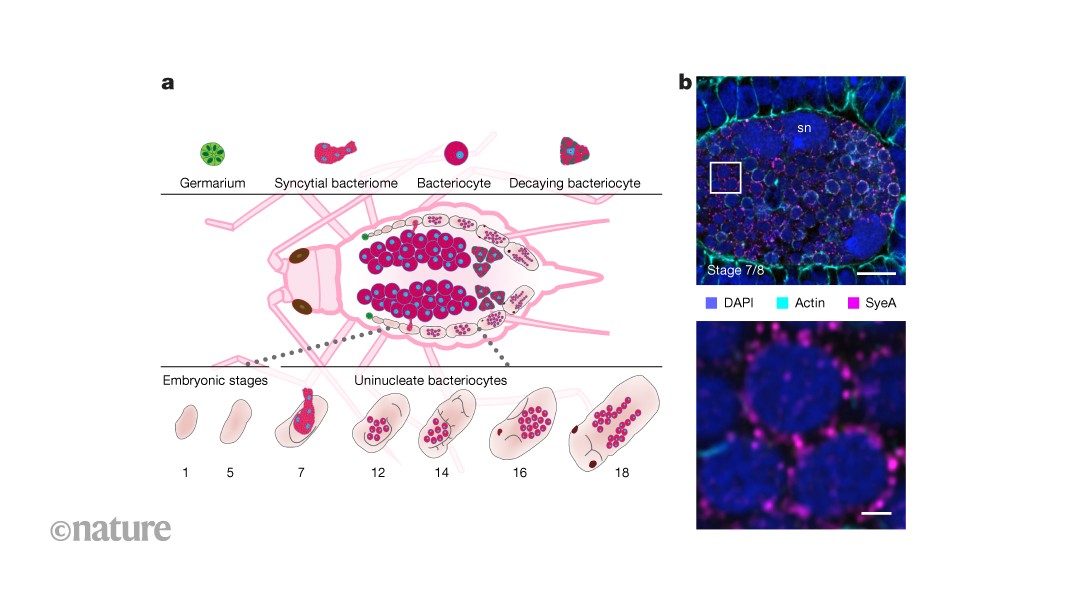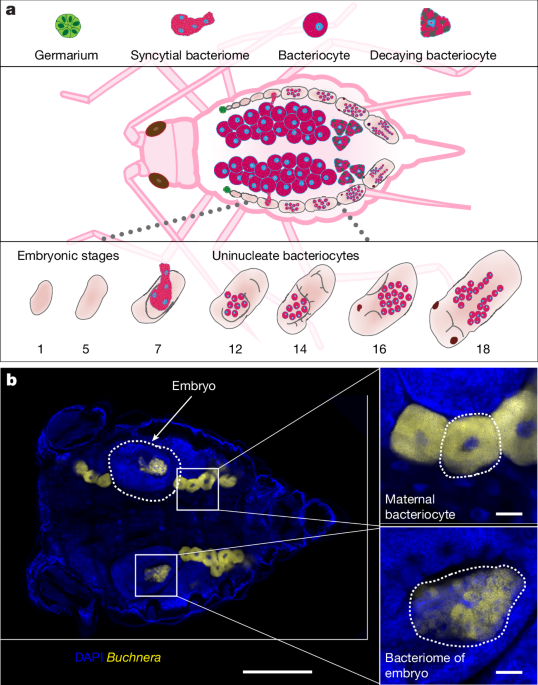
MainAs with many obligate endosymbionts, Buchnera benefits hosts by provisioning essential nutrients, and aphids require Buchnera for successful embryonic development7. Despite its reduced genome, Buchnera retains pathways for producing amino acids that are needed by hosts3. Buchnera cells densely populate the cytoplasm of bacteriocytes, which are specialized host cells formed during embryogenesis8,9. Each Buchnera cell is housed in a cytoplasmic compartment, the symbiosome, enclosed within a host-derived membrane. Transmission occurs when Buchnera cells are exocytosed from maternal bacteriocytes and endocytosed by a large multinucleate embryonic cell, which develops into mature bacteriocytes5 (Fig. 1). In older aphids, symbiosomes fuse with lysosomes, resulting in death of the resident Buchnera, hypervacuolation of the cytoplasm, death of the bacteriocyte itself and recycling of the released nutrients6,10.Fig. 1: The Buchnera life cycle within A. pisum.a, Stage 7 embryos are colonized by Buchnera from maternal bacteriocytes, forming a syncytial bacteriome8,9. Cellularization occurs at stage 10, resulting in uninucleate bacteriocytes. In older aphids, mature bacteriocytes and resident Buchnera deteriorate when symbiosomal compartments fuse with lysosomes6. b, The whole body of a 5-day-old aphid was stained with DAPI and with a Buchnera-specific fluorescent probe, showing the positions of maternal bacteriocytes and embryonic bacteriomes. Scale bars, 0.5 mm (left) and 50 μm (right).To find clues as to how Buchnera achieves its intracellular existence, we sought to identify endosymbiont molecules that interface directly with hosts, such as outer membrane proteins or secreted proteins. Despite genome reduction, Buchnera of the pea aphid Acyrthosiphon pisum (hereafter, Buchnera-Ap) retains an apparent secretion system, as it possesses 26 genes encoding components of the flagellar basal body, although not the flagellar filament itself3. The basal body is homologous to, and can function as, a type 3 secretion system (T3SS) that delivers proteins across the bacterial cell wall and into host cells11. In Buchnera-Ap, the basal body components are highly expressed12,13,14 and number in the hundreds on the Buchnera cell surface15 (Extended Data Fig. 1).Secreted effectors are candidates for Buchnera molecules that interact with host cells and enable the intracellular lifestyle, but their identities have remained unclear. We searched Buchnera proteomes for candidate effectors, leading us to focus on an uncharacterized gene encoding a hypothetical protein with few homologues outside Buchnera. We therefore undertook efforts to better characterize this protein and its role (or roles) in the symbiosis.A secreted protein in diverse Buchnera
A secreted endosymbiont protein essential for colonizing host cells - Nature
SyeA was present in the Buchnera ancestor, is secreted into the host cytoplasm, is homologous to secreted effectors of bacterial pathogens and is essential for Buchnera transmission.
11,633 words~53 min read