view more
For millennia, farming in Switzerland did not reduce plant diversity but helped increase it, University of Basel researchers have shown in a detailed reconstruction covering the past 7000 years. Only recent decades paint a different picture.
The fall of the Roman Empire and major plague outbreaks: These events not only affected people but also reduced plant diversity on the Swiss Plateau, as human land use temporarily declined. Researchers led by Dr. Fabian Rey and Professor Oliver Heiri at the University of Basel report this surprising finding in the journal Nature Communications.
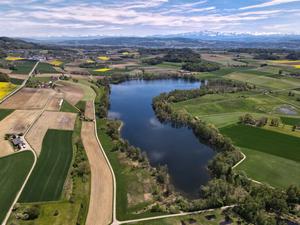
Their analyses are based on sediment deposits in three Swiss lakes: Moossee near Bern, Burgäschisee near Herzogenbuchsee, and Hüttwilersee in Thurgau. The researchers extracted sediment cores from these lakes and then analyzed the material deposited in the sediments over the course of millennia. This allowed them to infer and date variations in both plant diversity and agricultural land use in the areas surrounding the lakes.
“This is an exceptionally comprehensive and precisely dated dataset,” says Oliver Heiri. “It allows us to reconstruct changes in plant diversity around the lakes over the past 7000 years at a time resolution comparable to long-term ecosystem studies in modern ecology – and for a period long before modern ecology existed.”