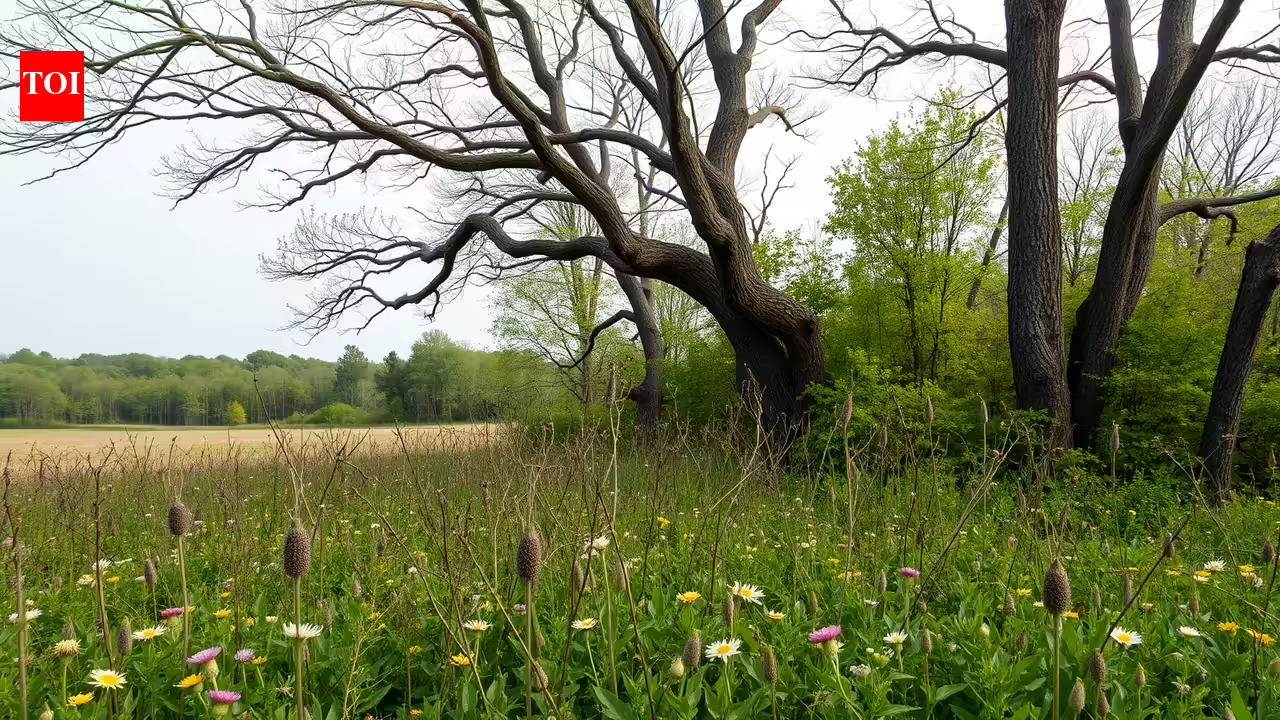
Young Black Locust saplings aggressively push through native wildflowers, while mature trees dominate the invaded forest. Image Credit: TIL CreativesPlants can help solve environmental problems, but one species planted in parts of Switzerland for environmental reasons has created another ecological problem there.Robinia pseudoacacia, or the Black Locust, a plant native to the North American continent, has been extensively grown in parts of Switzerland since the middle of the 18th century for erosion control, strengthening railway embankments, and producing durable wood. More than 250 years later, ecologists say the plant is spreading beyond its planting sites, replacing species-rich grasslands and altering soil chemistry in ways that can crowd out native species.According to researchers, the problem represents an emerging conservation paradox in which a plant useful at one time turns out to be one of Europe’s worst invasive tree species.A tree brought about by necessityThe Black Locust was first introduced into Europe in the early 1600s but came to be cultivated in many other countries over time. As indicated by the European and Mediterranean Plant Protection Organization (EPPO), the tree species has been cultivated intentionally due to its fast growth rate and tolerance to poor soils.Black locust was introduced to Europe in the early 17th century and was later planted extensively in Switzerland to stabilise unstable slopes and railway embankments. The strong root system helped stabilize loose soil, and the tree became popular. Nevertheless, researchers indicate that these attributes have enabled the tree to grow far outside cultivated areas.Landscapes change, and grasslands vanishThe problem is not just that black locust is invading; it is invading the wrong habitats.According to the Swiss Federal Office for the Environment (FOEN), black locust increasingly invades dry grasslands, open woodland edges and other habitats that support exceptionally high biodiversity. Many of these grasslands contain rare wildflowers, orchids, and insects that have evolved under nutrient-poor conditions. Once black locust settles in an area, it forms dense stands that shade out plants below. Native plants that need sunlight may disappear from the area because of the lack of light.This leads to a reduction in plant variety in the forest canopy and eventually impacts wildlife such as insects and birds that rely on those native plants.There are also changes in the soilThe difficulty of managing black locust lies in the fact that it does not only compete for space.Unlike most tree species, black locust is a leguminous plant that forms a partnership with nitrogen-fixing bacteria. These bacteria can transform atmospheric nitrogen into a soil-enriching form. Even though richer soil sounds like an improvement, ecologists state that it might completely change ecosystems adapted to life in nutrient-deficient soil.As reported by a research project carried out by Technische Universität Berlin and the National Museum of Natural History Luxembourg, the invasion of black locust trees can lead to the enrichment of soil with nitrogen and alteration in the species composition of the understory plants, thus providing favorable conditions for other alien plant species. The research also examines how urban and rural woodlands respond differently to black locust invasion and how European ecosystems change in diversity.Similar observations are made by the Centre for Agriculture and Bioscience International (CABI).Image Credit: Black locust tree. Image Credit: Wikipedia CommonsAn invasive species in EuropeExperts argue that the effects of the black locust are not always bad; the plant could be beneficial in managed forests or urban areas, where it produces timber, nectar for honeybees, and helps prevent soil erosion. The problem emerges once the species becomes established in nature reserves.Black locust is listed among Europe’s invasive alien species by the International Union for Conservation of Nature (IUCN), and EPPO classifies it as an invasive species that should be controlled because of its negative effects on biodiversity and habitat conservation. Invasive alien species are considered to be one of the main reasons for biodiversity decline in Europe, along with habitat destruction, pollution, climate change, and over-exploitation, according to the European Commission.Balancing history and conservation effortsBlack locust elimination is a complex process.In addition to seed production, this tree reproduces via suckering from roots. That is why conservation specialists must apply long-term methods by conducting repeated removals and restoring the natural habitat to allow native vegetation to regrow. It is said that conservationists are no longer trying to remove all black locust trees. Instead, their goal is to prevent additional invasion of valuable ecosystems while taking into account the species' contribution to forestry and land management.In the case of Switzerland, as well as other European countries, the story of black locust demonstrates how different the priorities in ecology can be. The tree, which was planted for erosion control, has become a subject of debate for conservationists weighing its practical uses against its ecological impacts. By affecting soil and biodiversity, black locust illustrates how environmental interventions can have long-term consequences.
Switzerland began planting black locust trees around 1750 to stabilise eroded hillsides and railway embankments, but today scientists say the invasive trees are replacing species-rich grasslands and changing their soil chemistry
Plants can help solve environmental problems, but one species planted in parts of Switzerland for environmental reasons has created another ecological problem there.
798 words~4 min read