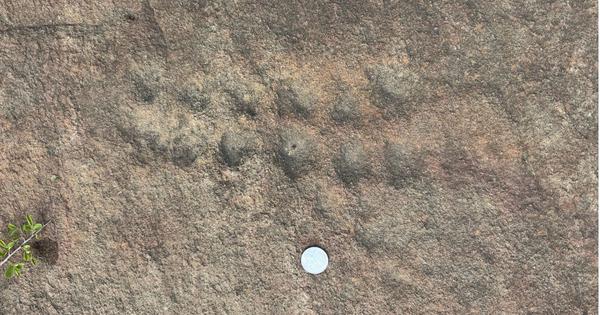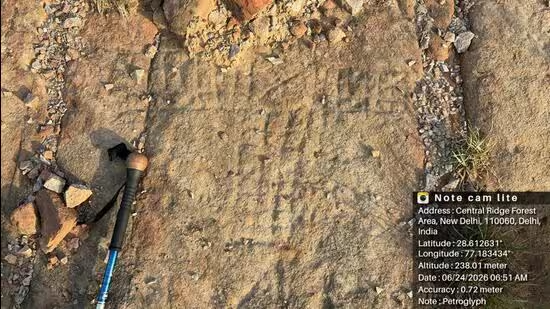
New DelhiThe image shared by environmentalists who made the discovery during a walk on June 24. (Courtesy: Chetan Agarwal)Presumed ancient carvings dotting the quartzite rocks of Delhi’s Central Ridge, not too far from the Delhi Polo Club, were discovered over the past week and mark the first likely record of a petroglyph in the Central Ridge, environmentalists who made the discovery said.Such rock carvings have previously been discovered around the Jawaharlal Nehru University (JNU) campus, while prehistoric stone tools have also been documented around the Kamla Nehru Ridge in north Delhi. Neighbouring Bhondsi, Surajkund, Mohabatabad, Dhauj, Kot, and Alwar were found to host multiple such rocks, tools and engravings, experts said.Environmentalist Pradip Krishen, who made the discovery alongside environmentalist Chetan Agarwal, said he discovered the carvings last week during a walk. “We (Chetan and I) happened to notice this large rock which was not too far from the polo grounds. Although I’ve walked this path many times, the rock is easy to miss. We so happened to notice it this time around,” said Krishen, stating the carvings appear significantly old, as confirmed by researchers.At JNU, in the late 1970s, stone-age tools were discovered in the rocky terrain of the campus, while more recently, around 2007, etchings, including cup marks, geometric representations and other pre-historic rock markings, were found. These were later shared with the Archaeological Survey of India (ASI). Engravings recorded across the Aravallis, documented in recent years, include ancient cupules (cup-shaped depressions), geometric grids and foot-shaped markings.Agarwal said this is likely the first such record of petroglyphs in the Central Ridge. “Previously, they have been found in JNU and around the northern Ridge. We have also seen ample evidence on the Haryana side, around Anangpur, Mangar and Bhondsi, including caves where such carvings exist,” he said, adding that a proper study of the area will shed more light.HT also showed these photographs to a historian specialising in rock engravings who confirmed these to be petroglyphs, but did not wish to be quoted.Experts confirmed that the images, a copy of which was accessed by HT, looked like petroglyphs, including a cupule art.Archaeologist Banani Bhattacharyya, former deputy director of the department of archaeology in Haryana, said the linear petroglyph engraved on the quartzite rock comprises intersecting vertical and horizontal incised grooves, forming a ladder-like geometric design. It is likely thousands of years old, but added confirmation will require scientific dating.“Similar petroglyphs, often associated with multiple cupmarks, have been documented at Mangar in the Aravalli region, suggesting possible cultural continuity from the prehistoric period. Although comparable engravings have occasionally been interpreted as symbolic motifs or rock-incised gaming boards, the function and chronology of the Central Ridge petroglyphs remain uncertain and require detailed archaeological investigation and scientific dating,” she said.She emphasised an urgent need for systematic documentation, high-resolution recording (excavation where appropriate), and scientific dating to establish the chronology and cultural context of these rock engravings within the broader prehistoric landscape of the Aravallis.Dr Mohd Zakir Khan, who has a PhD in prehistoric archaeology, said while the cupules appeared to be Mesolithic or from the Chalcolithic period, the other carvings could possibly be from the historic period.“The faint linear and geometric markings form a grid-like pattern. It bears some resemblance to traditional board game carvings, such as chausath kothi or ashtapad grids, found at various sites across India, though this remains speculative, given the panel’s weathering,” he said.
Delhi’s Central Ridge hides historic carvings in plain sight
Ancient petroglyphs were discovered in Delhi’s Central Ridge, marking a first. Experts suggest they could date back thousands of years, needing further study. | Latest News Delhi
565 words~3 min read