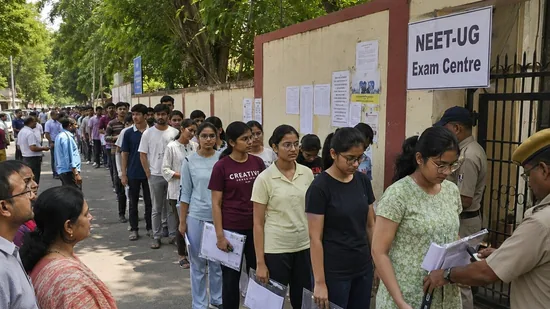
India is often described as the world’s largest democracy. Less frequently acknowledged is another reality: it is also the world’s largest examination republic. Every year, around six crore students and job aspirants appear for high-stakes examinations across the country ranging from board exams in schools and entrance tests for university admissions to recruitment exams for various government services.TET paper leak case: Maharashtra Education Minister must resign, says Youth Congress; holds protestIn a nation where upward mobility is closely tied to educational and employment opportunities, the exam system functions as a powerful instrument of social justice. For millions of families, a single examination can determine the trajectory of a lifetime. This is why the integrity of the exam ecosystem is not merely an administrative concern but a matter of national trust.India’s exam ecosystem is massive in size and impact: over three-crore students appear for Class 10 and 12 board exams each year; more than 25 lakh aspirants sit for the Joint Entrance Examination annually; the National Eligibility-cum-Entrance Test sees over 23 lakh candidates in a single cycle; and recruitment exams conducted by agencies such as SSC, RRBs, and various state commissions collectively involve crores of applicants every year. Any breach in such a system is not an isolated administrative failure but a national-scale disruption of trust.Deeper damageWhen a paper leak or impersonation racket is exposed, the immediate reaction is outrage. But the real damage is deeper and often lasts longer. First is the psychological impact on honest students. A candidate who has prepared for two or three years for a competitive exam suddenly begins to question the system itself. Effort appears uncertain, while shortcuts seem to be rewarded.Second is the financial and social burden. Many aspirants spend significant sums on coaching, relocate to exam hubs, and delay employment opportunities in pursuit of success. A cancelled or compromised exam is not just an inconvenience. It is an economic and emotional setback.Third is the long-term impact on professional quality. If entry-level exams are compromised, the ripple effects become visible years later in the form of under-qualified professionals entering sensitive sectors, a decline in service standards, and increased governance risks.No country can aspire for global leadership if its talent pipeline is weakened at the point of entry. India’s exam ecosystem today faces a growing trust deficit. The problem is not only the occurrence of malpractice, but also the perception that the system may be vulnerable. In the age of instant communication, rumours often travel faster than official clarifications. Even unverified claims can create panic among millions of candidates.This perception gap has three consequences: Erosion of institutional credibility, rise of litigation and administrative delays, and normalisation of cynicism among youth. A country where young citizens begin to lose faith in meritocracy risks weakening its own developmental foundations.Enter technologyOver the past decade, significant AI-led technological safeguards such as computer-based testing platforms, biometric authentication, encrypted digital question paper delivery, and enhanced identity verification mechanisms have been introduced into the exam process. While these have reduced certain types of malpractice, especially impersonation and large-scale copying, technology alone cannot eliminate cheating. Every secure system eventually faces attempts at breach. Fraud evolves, and systems must evolve faster.Therefore, exam integrity must rest on three interlinked pillars: Technology to reduce vulnerabilities; governance to ensure accountability; and ethics to build a culture that respects merit. Without the third pillar, the first two will always remain incomplete.What needs to be doneIndia’s response to exam irregularities has often followed a familiar pattern of public outrage, investigation, cancellation or re-examination, and a temporary tightening of processes. But what is required is a comprehensive policy architecture for examination integrity. Periodic system audits, standardised protocols for high-stakes exams, swift and transparent investigations, and stronger coordination between examination agencies are essential components of such an approach. Equally important is the need to ensure that innocent candidates are not subjected to avoidable hardship due to systemic failures. Justice in such matters must be both swift and fair.No exam system in the world is completely immune to malpractice. The real measure of a system is not whether breaches occur, but how effectively and transparently it responds. India’s exam ecosystem must evolve continuously through periodic review of processes, upgradation of technology, strengthening of governance frameworks, and promotion of ethical conduct across stakeholders.Paper leaks are not merely administrative lapses. They are signals that systems must be strengthened, not merely repaired. The journey from paper leaks to policy reforms is, therefore, not just about fixing exams. It is about rebuilding trust among students, parents, institutions, and the nation at large.The writer is the Vice-Chairman of the Indian Centre for Academic Rankings and Excellence (ICARE)
Rebuilding trust in India’s exam ecosystem
Rebuilding trust in India’s exam ecosystem
770 words~4 min read