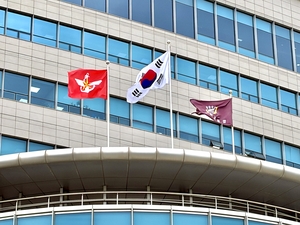
The Defense Ministry headquarters in Seoul (The Korea Herald DB) South Korea's military investigative agency has commissioned a policy study on democratic oversight as it prepares to assume broader investigative powers following the breakup of the Defense Counterintelligence Command, officials said Monday.According to military sources, the Criminal Investigation Command, an agency under the Defense Ministry, recently launched a research project to examine control mechanisms after it absorbs the DDC's security investigation unit.The move comes as the Criminal Investigation Command prepares to take over the DCC's security investigation function, raising concerns that investigative authority within the military could become overly concentrated in a single agency.The agency said in a research outline that the reform is aimed at restoring public trust by unifying military investigation functions and clarifying responsibility. But it also acknowledged that the concentration of investigative powers in one agency has become a central issue requiring institutional safeguards.“The need for a control system over the concentration of authority in the Criminal Investigation Command is emerging as a central issue,” the agency said in the document.The ministry decided to dismantle the DCC after it came under scrutiny for helping execute former President Yoon Suk Yeol's Dec. 3, 2024, martial law declaration by deploying troops to detain politicians and election officials.The Defense Ministry plans to transfer the DCC’s security investigation unit to the Criminal Investigation Command, while also moving some existing personnel from the command to the new security investigation department.The agency recently received applications from personnel hoping to move to the security investigation unit and provide related training.But the planned shift has also raised questions over whether the Criminal Investigation Command can maintain the required expertise after taking over the DCC’s role, given its limited experience in counterintelligence and security investigations.Some in military and legal circles have also pointed to delays in cases transferred from the special counsel investigation into insurrection allegations as a sign of the challenges ahead.Although the Criminal Investigation Command was given authority to investigate insurrection and foreign aggression crimes after revisions to the Military Court Act, critics say the agency has yet to show clear results in politically sensitive and complex cases.In the research project, the agency asked outside experts to assess structural changes expected from the transfer of security investigation functions and the integration of military police investigation authorities. It also requested an analysis of potential risks stemming from the concentration of investigative powers.The study is expected to examine oversight models involving the National Assembly, the Board of Audit and Inspection and civilian institutions.Internally, the agency is seeking ways to reinforce inspection functions, introduce clearer accountability rules and improve checks within the organization. The Defense Ministry has already moved to revise the presidential decree governing the Criminal Investigation Command.Under the proposed revision, the current structure of a chief and deputy chief would be replaced by a system consisting of a chief, chief of staff and inspector general.Still, officials and experts say internal oversight alone may not be enough to address concerns over excessive concentration of military investigative power.“There are structural limits to securing public confidence if the oversight system is designed only within the Defense Ministry,” the agency said.The research will also look into how investigative jurisdiction should be divided between military police and military prosecutors, how the Defense Ministry’s legal affairs functions should be redefined and how procedures involving military courts should be improved.
Military investigation agency seeks stronger oversight under reform
South Korea's military investigative agency has commissioned a policy study on democratic oversight as it prepares to assume broader investigative powers follow
560 words~3 min read