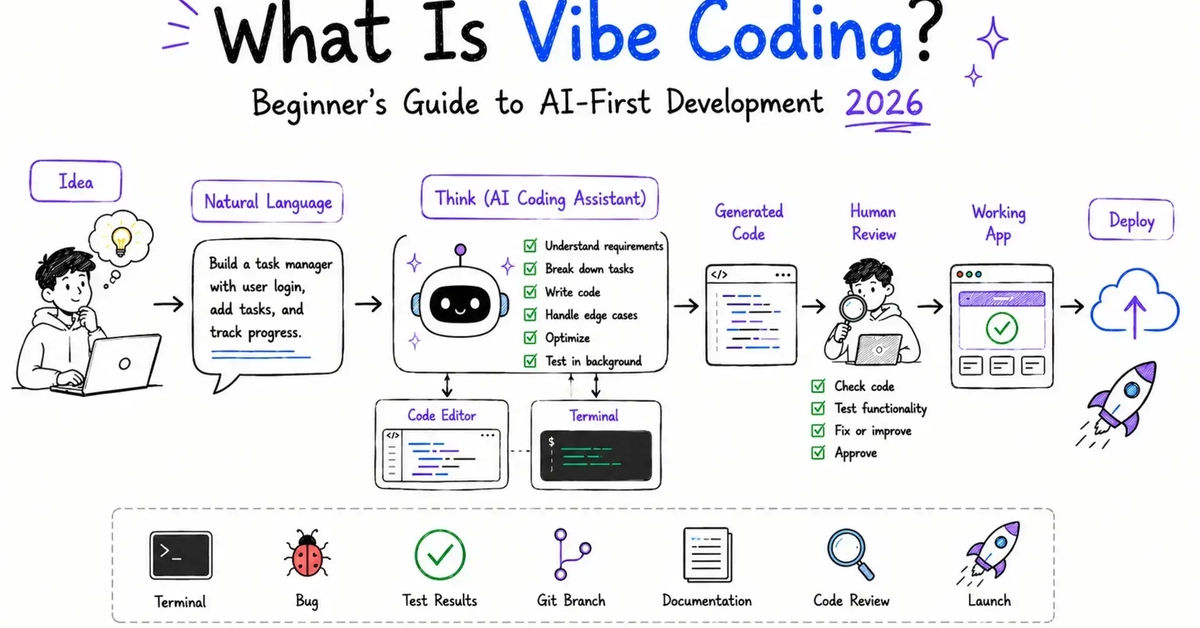
For years, coding had a certain stereotype attached to it: sleep-deprived programmers typing aggressively into glowing screens filled with confusing symbols and error messages. But vibe coding flips that image completely.Instead of writing every single line of code manually, people now describe what they want in plain English and let AI generate the technical stuff. You might type something like, “Make me a study app with lo-fi colours and animated buttons,” and the AI will build a working version within seconds.That is basically what vibe coding is — using AI tools to create apps, games, websites, and software by guiding the overall vibe rather than painstakingly coding everything from scratch.The term was popularised in early 2025 by Andrej Karpathy, an AI researcher, co-founder of OpenAI, and former Director of AI at Tesla, who described it as a style of programming where people “fully give in to the vibes” and let AI handle most of the coding. The phrase quickly spread across X, GitHub, and developer communities online.There's a new kind of coding I call "vibe coding", where you fully give in to the vibes, embrace exponentials, and forget that the code even exists. It's possible because the LLMs (e.g. Cursor Composer w Sonnet) are getting too good. Also I just talk to Composer with SuperWhisper…— Andrej Karpathy (@karpathy) February 2, 2025As AI coding tools started getting surprisingly good at understanding human instructions, users began talking to AI almost like a creative partner:“Make this look more futuristic.”“Add dark mode.”“Give it retro game music.”The AI handles the code in the background while the human focuses on ideas, aesthetics, and experimentation.In a way, vibe coding turns programming into something that feels less like solving a maths worksheet and more like directing a movie or designing a moodboard.How does it actually work?Vibe coding is more like having a chat with Al assistant. Instead of manually typing hundreds of lines of code, users simply describe what they want the software to do and the AI translates those instructions into working code.It usually starts with a prompt. Someone might type:“Make me a website for rating cafeteria food.” Or: “Create a pixel-art game where a cat collects snacks.”The AI then generates the foundation of the project almost instantly. It can create layouts, buttons, animations, menus, and even entire apps using coding languages like HTML, CSS, JavaScript, or Python behind the scenes.But the interesting part is what happens next. People keep refining the project through more prompts, almost like giving directions to a designer:“Make the colours softer.”“Change the font to look more retro.”“Make the animations smoother.”The AI adjusts the code each time, while the user focuses more on ideas and aesthetics than technical syntax. That’s why it is called vibe coding, the creator is steering the overall feeling, style, and experience rather than building every tiny piece manually.Of course, the AI is not magically “thinking” on its own. These tools are trained on huge amounts of existing code and patterns, allowing them to predict what kind of code would best match a user’s request.The result is that building software suddenly feels far more accessible. Someone with little coding experience can experiment, prototype ideas, and even build functional apps just by describing what they imagine.Why are people obsessed with it?Because it makes coding feel less intimidating and way more creative. Instead of spending hours learning complicated syntax, people can jump straight into building ideas by simply describing what they want.For beginners, it lowers the barrier to entry. For experienced programmers, it speeds up repetitive tasks and brainstorming. And for the internet? It turns coding into something that feels fast, fun, and oddly addictive.One minute someone is asking AI to make a study timer. The next minute they’ve accidentally built a working app.People have been using vibe coding to create everything from study planners and games to calorie-counting apps and even simple SaaS (Software as a Service) products online tools that people use through a web browser, such as note-taking apps or project planners.One famous example is Fly Pieter, a browser-based game created by entrepreneur Pieter Levels using the AI coding tool Cursor. The game went viral, attracted thousands of daily users, and reportedly earned hundreds of thousands of dollars in monthly revenue.— @levelsio (@levelsio) February 22, 2025The catchVibe coding might look effortless, but the AI is not always right. It can generate broken code, create security problems, or completely misunderstand what the user wants.That is why actual coding knowledge still matters. Even if AI writes most of the code, someone still needs to test it, fix errors, and understand what is happening behind the scenes.Many programmers also point out that vibe coding is not the same as regular AI-assisted coding. Tools like GitHub Copilot mainly help programmers write code faster, while vibe coding is more hands-off — the AI generates most of the code while the human guides the overall idea, style, and direction.Some other popular projectsCal AI – An AI calorie-counting app whose founders said they relied heavily on AI coding tools to build large parts of the product quickly.Death Clock AI – An app that estimates life expectancy and was widely cited online as being built with extensive help from AI-generated code.Levelsio’s Fly.pieter.com – Entrepreneur Pieter Levels publicly shared how he used AI and prompt-based coding to rapidly create games and web tools.Photo AI – Another project by Pieter Levels that has often been mentioned in discussions around AI-assisted and vibe-coded startups.Brain over botsAl is making coding feel more conversational, which means future programmers may spend less time typing every line manually and more time guiding, editing, and problem-solving. In the same way smartphones changed photography and Canva changed graphic design, Al tools are changing how software gets made. But coding itself is not disappearing. Logic, creativity, and critical thinking still matter because even the smartest Al needs humans to tell it what to build and check whether it actually works.For now, vibe coding is less about replacing programmers and more about letting more people experiment with creating technology.
What is vibe coding?
Discover vibe coding, a trend that simplifies software creation using AI and plain language prompts instead of traditional coding.
1,002 words~5 min read