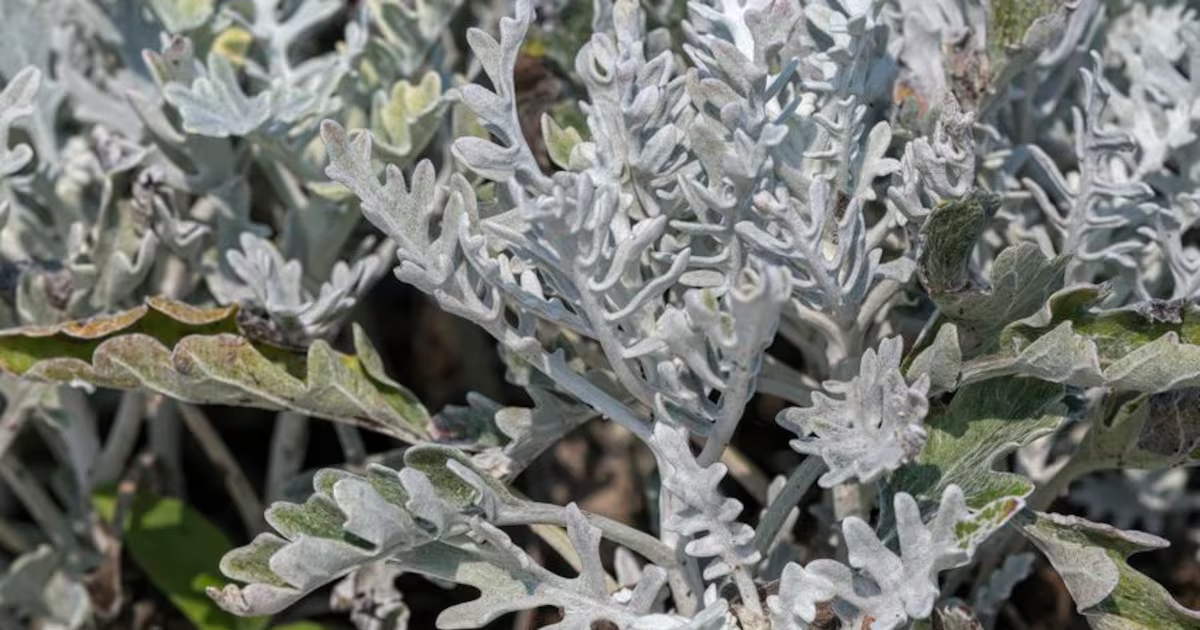
An industry estimated to generate about R2.9bn annually, support at least 133,000 income-earning opportunities and serve millions of South Africans occupies surprisingly little space in our economic conversations.It is the traditional medicine and medicinal plant economy. Research estimates show about 27-million South Africans use traditional medicine and that about 20,000 tonnes of medicinal plant material are consumed in the country each year. By any measure, these are not insignificant figures. This is not a niche market. It is an industry that intersects with healthcare, biodiversity, agriculture, retail, entrepreneurship and livelihoods. It supports harvesters, cultivators, transporters, market traders, processors and traditional health practitioners. For many households, particularly in rural areas where formal employment opportunities may be limited, it is also a source of income and economic participation. Yet despite its scale, the sector rarely features prominently in discussions about industrial strategy, biodiversity-based economies or sectors capable of driving inclusive growth. That absence matters. Industries that are insufficiently understood, measured and prioritised often struggle to attract investment, research funding and long-term planning. In the case of medicinal plants, the stakes are particularly high because the future of the industry is inseparable from questions of sustainability and conservation. Much of South Africa’s medicinal plant trade still relies on species harvested from the wild. Researchers have repeatedly warned that unsustainable harvesting practices place pressure on certain species and threaten biodiversity. An industry worth billions cannot depend indefinitely on ecosystems that receive insufficient protection and investment. The sector also presents an economic opportunity that warrants serious consideration. South Africa possesses extraordinary botanical diversity and equally remarkable knowledge systems relating to medicinal plants. Worldwide, demand for herbal medicines, botanical products and plant-based wellness solutions continues to grow. Countries are increasingly treating biodiversity and natural products as strategic economic assets capable of generating employment, innovation and export opportunities. South Africa should be asking whether it is doing enough to position itself in this growing global economy. Much of the value in botanical products is often captured further along value chains through cultivation, scientific research, processing, product development, branding and intellectual property. Yet conversations about medicinal plants in South Africa frequently remain concentrated on raw materials rather than higher-value activities that can generate additional economic opportunities. South Africa should be asking whether it is doing enough to position itself in this growing global economy. What would it mean to approach the botanical economy with the same seriousness that we afford other industries? Would we see greater investment in cultivation and conservation? More support for research into African plants? Better data on the sector’s contribution to employment and economic activity? More deliberate efforts to encourage value addition and entrepreneurship? More meaningful partnerships between biodiversity conservation, scientific research and economic development? These are not simply questions about medicinal plants. They are questions about industrial policy. They are questions about whether South Africa recognises biodiversity as an economic asset and whether we are prepared to build industries around resources we already possess in abundance. The country is rightly searching for new sources of growth, employment and inclusive development. Yet one of its most significant biodiversity-based industries already exists. It supports livelihoods, serves millions of consumers and generates billions of rand in economic activity. The question is not whether South Africa possesses a botanical economy. It already does. The question is whether we intend to develop it deliberately or continue allowing one of our biodiversity-based industries to remain largely outside the centre of our economic imagination. • Mosese, a traditional healer and indigenous knowledge researcher, founded The Kitchen Alchemist, an educational platform dedicated to exploring Africa’s botanical heritage and indigenous knowledge systems.
KATLEHO MOSESE | SA barely talks about R2.9bn medicinal plant industry
South Africa overlooks a R2.9bn botanical industry with major growth potential
600 words~3 min read