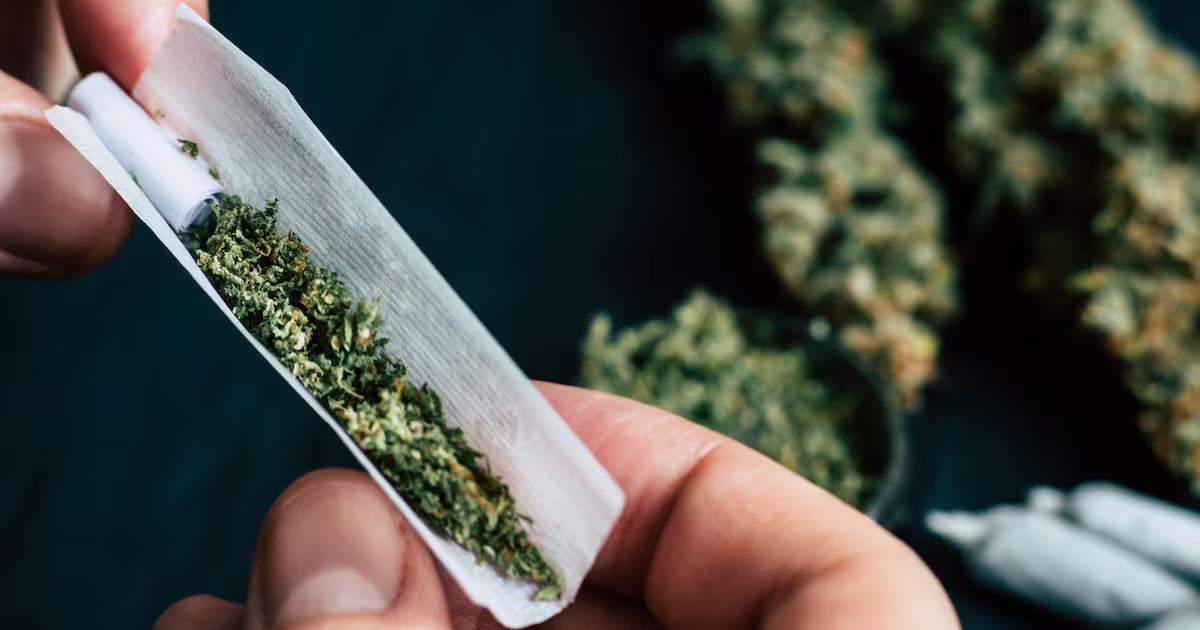
South Africa’s cannabis sector is routinely promoted as a big opportunity for exports, job creation, rural development and BEE. On paper, the numbers look attractive. In practice, the burden of building a credible, export-ready industry is being placed almost entirely on the shoulders of individual facility owners, while critical supporting infrastructure remains underdeveloped. This is far more than a minor implementation hiccup or a simple teething problem. It is a deep structural weakness in the entire system. The department of trade, industry & competition’s March update to the National Cannabis Master Plan positions cannabis and hemp as important drivers of economic growth, job creation, rural development and poverty alleviation. It projects annual sector growth of 10% from a R14bn base, while wider government messaging continues to speak of a R28bn opportunity. These projections have been effective at generating interest. They should now be used as a benchmark for delivery. A R28bn industry will not emerge simply by issuing licences. It requires a fully functional value chain, reliable genetics, efficient customs clearance, compliant production facilities, internationally accredited testing laboratories, proper export documentation, quality systems, finance, logistics and policy certainty. Without that ecosystem individual operators, whether large or small, are forced to carry the full commercial risk. Operators targeting medicinal cannabis or export markets face especially demanding conditions. South African Health Products Regulatory Authority (Sahpra) guidelines require pharmaceutical-grade standards, including good manufacturing practices (GMP), good laboratory practices and good agricultural & collection practices.A R28bn industry will not emerge simply by issuing licences. It requires a fully functional value chain, reliable genetics, efficient customs clearance, compliant production facilities, internationally accredited testing laboratories, proper export documentation, quality systems, finance, logistics and policy certainty. That translates into heavy capital expenditure on secure infrastructure, controlled environments, skilled personnel, quality management systems, documentation, testing and ongoing compliance costs that must be absorbed for years before any meaningful revenue is generated. Even well-capitalised players that comply fully with the current framework find themselves severely disadvantaged. They absorb years of regulatory uncertainty and exceptionally high compliance costs with little to no certainty of return on investment. A licence grants legal entry into the regulated space, but it does not secure buyers, deliver international recognition of South African GMP compliance, or resolve practical bottlenecks such as delays in seed imports, laboratory capacity constraints or shifting requirements in destination markets. International buyers of medicinal cannabis demand more than promises. They require comprehensive batch records, validated analytical results, strict contaminant controls, stability data and certificates of analysis that meet the standards of their own regulators. While South Africa has several laboratories capable of testing cannabis, the country still lacks a robust, scalable and internationally trusted testing network with full accreditation and method validation across potency, pesticides, heavy metals, microbiology, mycotoxins and residual solvents. When this evidence chain fails, the consequences are borne by the operator: rejected shipments, extended storage costs, compliance penalties and eroded margins as global medicinal cannabis prices continue to decline amid rising supply from lower-cost producers such as Colombia and Lesotho. The economic stakes are significant. Even achieving only 10% of the projected R28bn opportunity would represent a R2.8bn shortfall. Should policy and implementation gaps cause half the potential value to be lost, the notional damage rises to R14bn before taking into account business failures, job losses, unpaid suppliers, forfeited tax revenue and damage to South Africa’s reputation as a reliable origin country. The current framework disadvantages all serious participants. Well-capitalised operators that attempt to do things correctly are in effect penalised by the same systemic gaps that exclude smaller and rural players. Both groups face prolonged uncertainty and high compliance costs with no guaranteed path to commercial viability. Co-ordinated action neededTurning ambition into sustainable export success requires more than regulation. It demands co-ordinated action across the Sahpra, the department of agriculture, the department of trade, industry & competition, customs, provincial authorities, laboratories and export promotion agencies. Priorities should include expedited pathways for genetics and seed imports, faster clearance of critical inputs, expanded and accredited laboratory capacity, practical GMP support programmes, and genuine market linkage initiatives that connect compliance investment to actual revenue. South Africa has a developing cannabis economy with huge international investment potential. What we desperately need now is the commercial and institutional infrastructure to turn that ambition into genuine export success. Issuing licences is only the first step. It does not, by itself, create a functioning industry. If the government is truly serious about building a successful cannabis export sector, it must move beyond licensing and urgently start building the systems that will allow responsible operators, large and small, to compete effectively on the global stage. This is not just about growing an industry; it is about delivering meaningful economic growth, job creation and rural development for the country. • Botha, a legal strategist and cannabis policy specialist, is cofounder of H3 Legal Solutions.
CHARL BOTHA | SA’s cannabis sector is being left high and dry
Government must expedite support systems to unlock job creation and rural development
808 words~4 min read