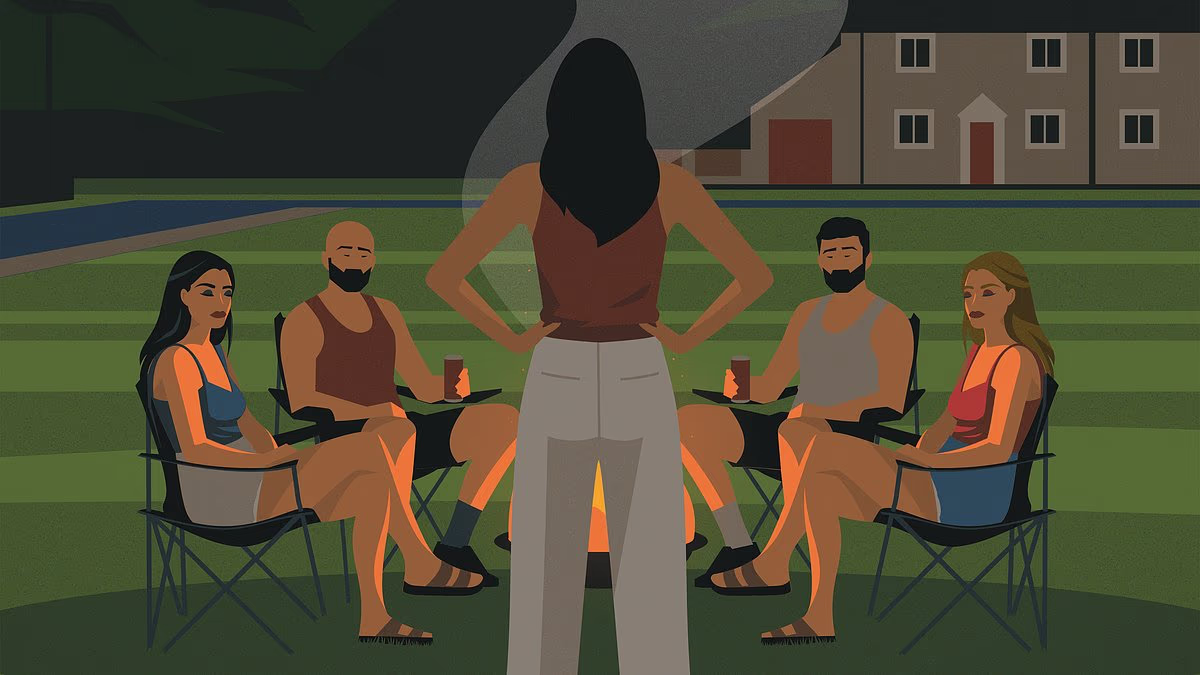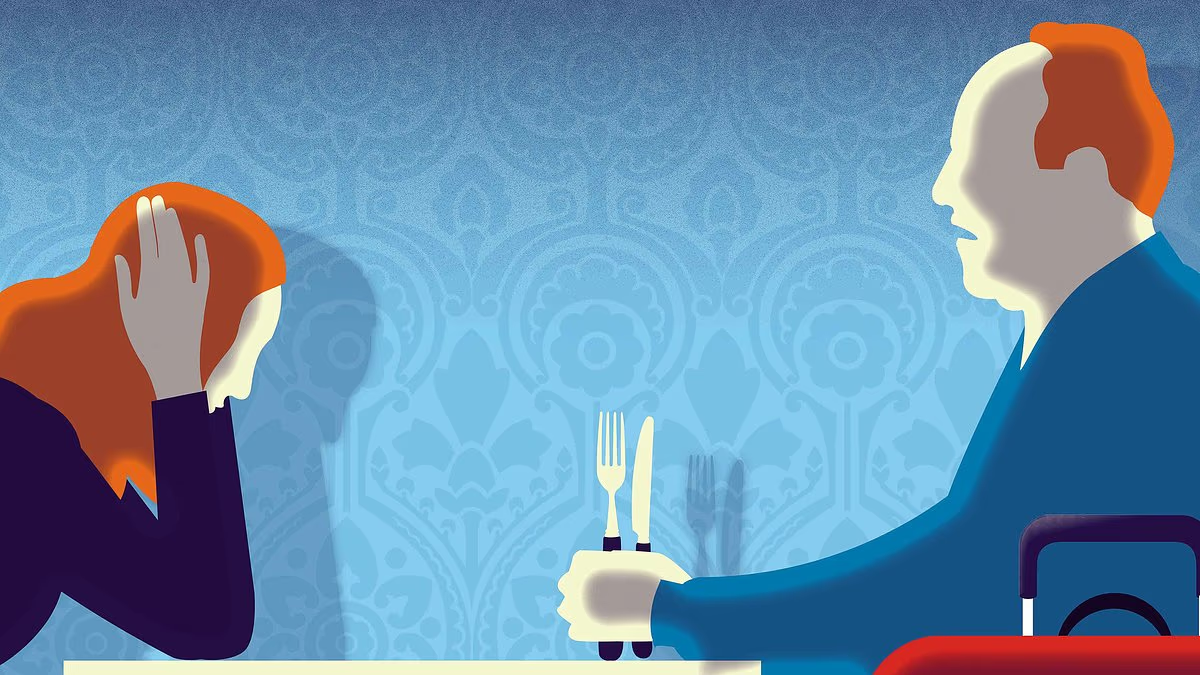
Dear Bel,I have been bullied by my family all my life – used as a vessel into which they pour all their moans about everything.I left home as soon as I could and lived in London. But this problem concerns my younger brother, Rod.Since his second divorce he was living with my mother. I bought a house in Newcastle, in readiness for my retirement, and to spend more time with her.I continued to work in London during the week, but to get Rod away from my mother (he dominates the household), I offered him use of the house during the week. We agreed on 12 months, until he sorted himself out financially. Big mistake. He ended up living there for three and a half years and only decided to move out when I retired and moved in permanently.Up until then he treated me like a barely welcomed guest in my own home! There were a lot of rows at weekends, where he bellowed at me that he felt he wasn’t welcome there.When Rod was relocated by his company to East Yorkshire, which he hated, he still drove back each weekend and expected to stay at my house. We had tears when I told him he couldn’t.My mother, by then, was living in sheltered housing and they had a guest room where he could stay. She has now died. Rod regards it as his right to have extended visits with me. The problem is trying to curtail them.He is very fond of lengthy visits – he expects free board and lodgings, arranges to see friends and his son, and tells me we might visit a stately home or something, expecting me to be grateful.When here he rants at me, bellowing across the room that he is brilliant at his job and everybody loves him. Or (the next time) that he is unlucky and alone and without a house, unlike me. I am expected to massage his ego – and to make it worse, he rarely showers.He can be good company but mostly his narcissistic personality is overwhelming. Rod lives in a rented house, spends money on cars and will retire soon. I know he’ll expect to move in with me. And it can’t happen. My life will be over.If/when I tell him no, he’ll beg ‘Oh just a short while till I get back on my feet.’If I refuse he’ll cry and shout. So I’m thinking of starting afresh in a one-bed retirement home on the coast, which has a payable guest room for visitors. I think it is the only way to preserve my sanity. Am I a coward? Should I stay put?JenniferBel replies: This is one of those situations when I must inform readers that your original letter was over four times as long as this edited version, therefore I have much more information about your family, and brother Rod in particular.It’s also fascinating that you first wrote in 2020, during lockdown, when you were driven mad by your brother’s presence. It was as if he was ‘squatting’ in your life, depriving you of all agency.You sent me that particular long letter, with the updated information that now your brother is close to retirement you dread being persuaded that he should house-share.Most readers will surely be wondering why you have always given in to this brother who (you explain at length) was always so ready to ‘bad-mouth’ you to the rest of the family. You were like putty in his hands – never able to break free from his demands. Thought for the day We need to have love and tenderness for our own life because we know it will not last. For instance, if someone were to tell you, ‘Oh, look on the right, there is a rainbow’ – you will never answer, ‘I will look at it tomorrow.’From a 2002 interview with the late Jeanne-Claude and Christo – husband and wife modern artist team acclaimed for large-scale, international installations You describe a pattern within your family which started when you were about nine, when first your father then your mother would complain endlessly to you about each other. Then both your brothers grew up to do the same.You explain that they were never grateful to be listened to, but castigated you for ‘looking unhappy.’ They all used you and, at the same time, undermined your confidence by criticising you, too.Such patterns laid down in childhood are very hard to break. That’s why it’s not really surprising that you have allowed yourself to be your brother’s victim.You didn’t have to grant him the use of your house – but you did, understandably afraid of looking mean, yet also following the familiar pattern.In your uncut letter you also explain that Rod’s son moved in with you for quite some time, too, and that, ‘my home has always felt like some kind of halfway house, people passing through all the time, while I watched.’There we have it. You were the passive observer of your own exploitation. You need fully to understand that before deciding what to do next. The important question is this: do you have a circle of friends and activities in the city which you would miss?Or would the move to a retirement home nearby enable you to keep all that?Since your house has proved a burden you might find a move refreshing, as long as it wouldn’t isolate you from a life you enjoy. So – not too far. An alternative (since you can’t say No) would be to take a lodger – to make it impossible for your brother to move in. But that could bring its own problems.In your place I’d start decluttering and getting ready for a new stage. A coward? On the contrary, quietly putting your house on the market might be the bravest thing you have ever done.I feel horrible for resenting cancer fundDear Bel,Sadly, a colleague was diagnosed with cancer. Now undergoing treatment, they look to have a very good prognosis. Initially there was a collection (flowers, gifts etc) which is fine and nice.But since then there’s been a barrage of further requests under the guise of a cancer charity donation, but which have since been revealed to have gone directly (thousands of pounds by all accounts!) to my colleague.I do not begrudge some financial support to anyone, and that sort of news must be very harrowing.But they have family and sick pay and I feel it’s unnecessary to ask people who do not personally know my colleague (who has a much higher and well paid position than those expected to donate) to keep giving. I believe any further collections or sponsorships should be sent direct to the charity. I have never come across anything like this in my working life.Obviously, the colleague with cancer has good friends in the department. But while their feelings have been the ongoing drive for this, is it fair and reasonable to expect us all to feel the same?And it goes on. A sports event, another ‘charity’ walk soon and something else in the pipeline – and I feel guilty wanting to resist because I honestly don’t want to give more.I work in a busy public service department and work can be very stressful. For me this hounding for money is adding to it.Am I a horrible person?CaroleBel replies: This is such an interesting and unusual email, and I’m glad you’ve raised an issue which is probably more common than you think, since the internet has made both asking and giving very easy indeed.Once upon a time those who wanted to raise money for charity by doing (say) a sponsored walk had to get signatures on a sponsorship form and then, when the task was completed, collect cash or cheques. Contact Bel Bel answers readers' questions on emotional and relationship problems each week. Write to Bel Mooney, Daily Mail, 9 Derry Street, London W8 5HY, or email bel.mooney@dailymail.co.uk. Names are changed to protect identities. Bel reads all letters but regrets she cannot enter into personal correspondence. Now they set up a Just Giving page (or similar) meaning that raising money is just a series of clicks away. I remember times when I dreaded such appeals, because I knew that if I didn’t respond I would look pretty mean. And nobody wants that, do they? So I always stump up.It goes without saying (at least, it should…) that in principle charitable giving is as wonderful as it is necessary. Large-scale philanthropists like the Sainsbury family (to offer but one example) support many worthwhile causes, while the individual giver knows quite well that even a modest tenner will bump up the total. All good.Yet you can have too much of a good thing and generosity can become a double-edged sword. It’s quite understandable to feel good about yourself when you answer one of the appeals for somebody you know, or maybe ‘know’ at one remove.But what if you feel morally coerced to give in bad faith? In other words, to act generously not because you want to, but because you feel pushed into doing so, for appearance’s sake. That’s where you find yourself right now.There’s another painful truth. From time to time we read of a dreadful scam when many thousands of pounds have been raised on false pretences.You seem to be suggesting there is a lack of honesty in the fundraising at your workplace, but may I suggest you could have got the wrong end of the stick.No matter – I think you are well within your rights to say ‘enough is enough’. Why would that make you ‘a horrible person’?There should never be any pressure to give, give, give – no matter how deserving the case. Why not pick a good charity in your locality that needs funds – a hospice, say?Then if you are asked to support the colleague yet again you can say, quietly and firmly, that you have decided to prioritise charitable giving to just one worthy cause in the future.And finally... Ghosted Alan shows why we should be more gentleYou might have noticed both letters in last week’s column dealt with issues around men.First was poor, bewildered ‘Alan’ who’d been ‘ghosted’ by a woman when he thought all was well.Then came the sister anxious about her younger brother, devastated that his wife had a lover and was calling time on motherhood and marriage.I half-expected some women to crow that men are usually villains. The surprise was a man castigating miserable Alan.Mr JS wrote: ‘As someone who has never been on a dating site, but has had prostate cancer, and is now clear of it...my sympathies lie with the woman and not Alan. I think he led her on.‘She was 50 and they met on a dating site.‘Presumably at that age she would still be sexually active and looking for a partner to spend the rest of her life with. Alan did not tell her until they were in bed together about his prostate “problem”.‘After treatment for prostate cancer, it is not possible to get an erection... Presumably the woman was expecting sex.‘It must have been very daunting to be told that at 50 her sex life was over if she stuck with this man!’I replied that she could still have talked to Alan instead of blocking his phone.But JS retorted that Alan should have put his problem on the dating profile.Now I ask you, what man would do that? Would a woman confide her breast cancer operation so publicly? I don’t think so.It takes a lot of courage for older people to go on a dating site. It can harm self-esteem even more, so some self-protection is necessary.And do all women want a stud? Whatever the complications, it’s essential for us to be gentle with each other.
BEL MOONEY: Should I escape my brother by moving to a new home?
Dear Bel, I have been bullied by my family all my life - used as a vessel into which they pour all their moans about everything. Should I stay put? Bel Mooney replies...
1,966 words~9 min read