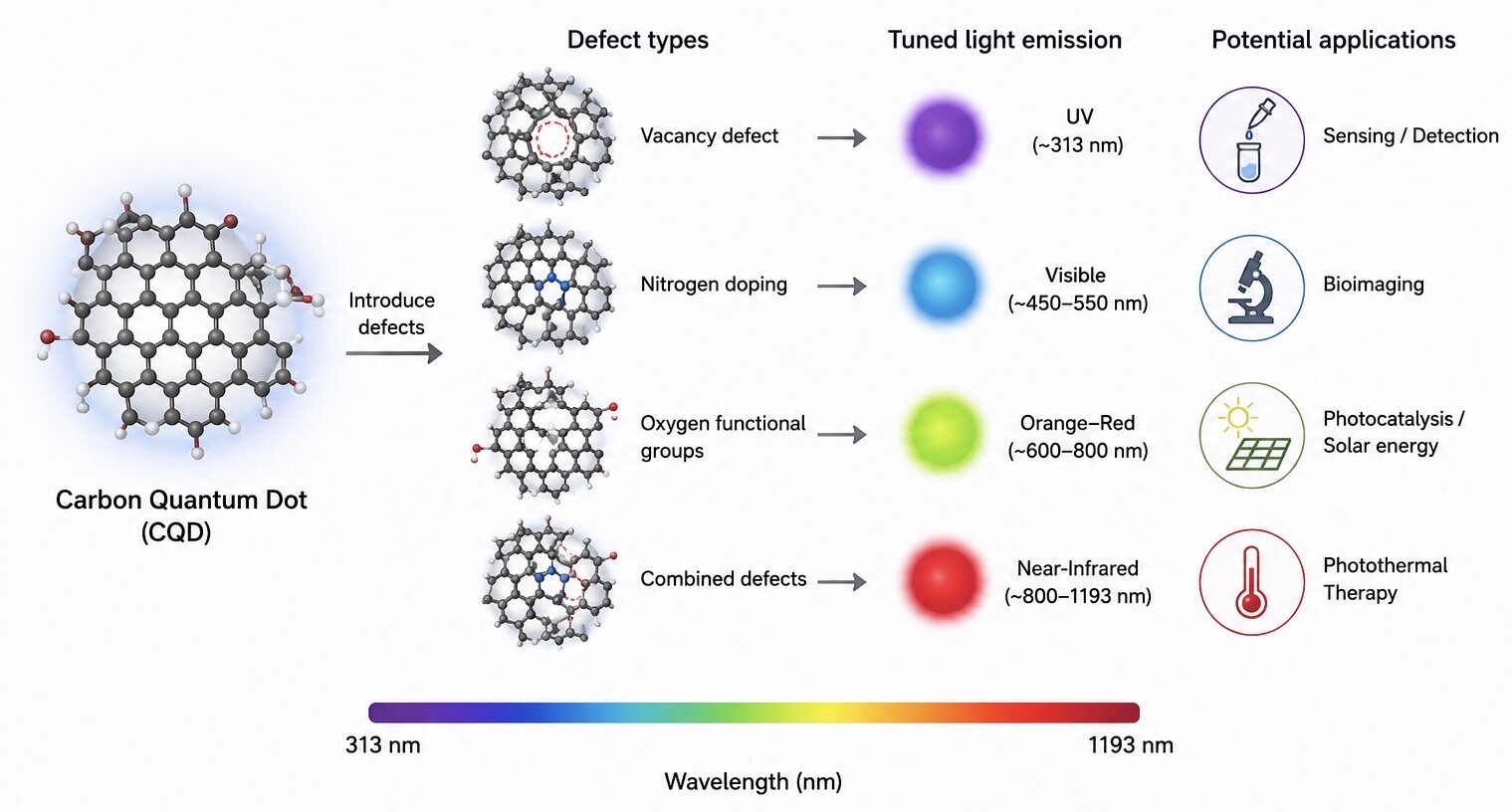
Schematic showing how introducing different types of atomic-scale defects into carbon quantum dots (CQDs) can tune their optical behavior across a wide wavelength range. Credit: Christian Ebere Enyoh, Saitama University
Carbon quantum dots (CQDs) are tiny carbon-based nanomaterials that have attracted increasing attention as environmentally friendly alternatives to conventional heavy-metal quantum dots. They are lightweight, photostable and potentially biocompatible, and their light absorption and emission properties can be tuned.
These features make CQDs promising for a wide range of applications, including fluorescence sensing, bioimaging, cancer-related photothermal technologies, optoelectronic devices and solar energy conversion.
However, a major challenge remains: researchers still lack a sufficient atomistic understanding of how CQDs interact with light and how this interaction can be precisely controlled.
Conventional approaches, such as adjusting particle size or introducing surface functional groups, can tune optical properties to some extent. Yet a predictive framework for designing CQDs that operate at specific wavelengths, especially in technologically important visible and near-infrared regions, has not been fully established.