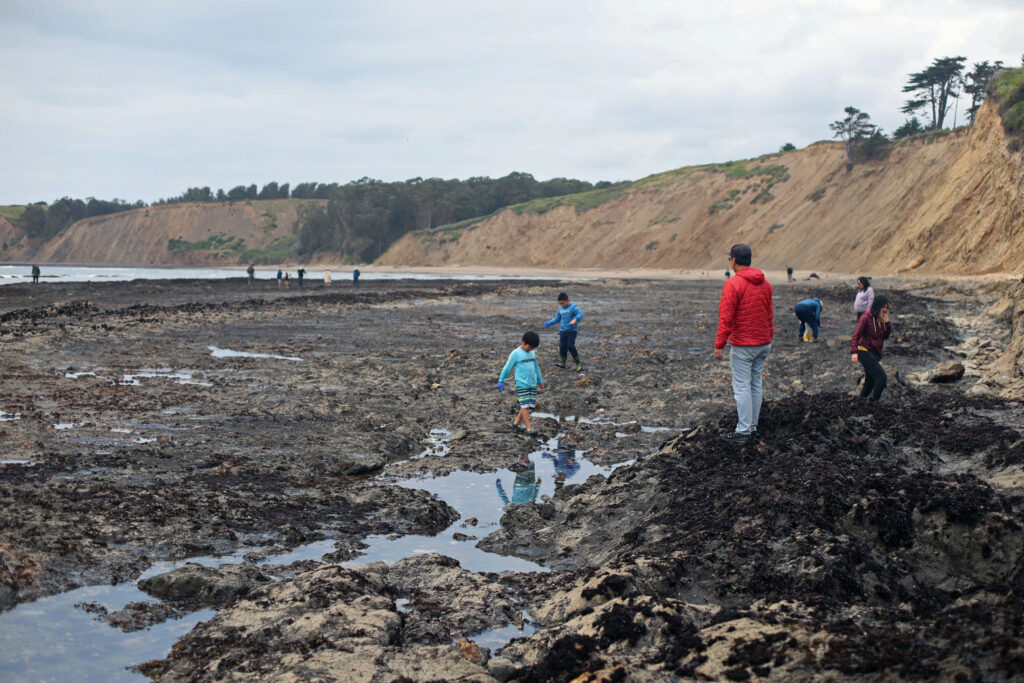
BOLINAS, Calif.—Kent Khtikian pointed at a seemingly barren inch of reef. His hair, curly, long and grey blew wildly in the wind underneath a tan cowboy hat. He hunched over and kneeled close to a tiny tide pool, observing how a small, black periwinkle snail wiggled its way into a protected corner of rock.
Khtikian has lived in this small Marin County since 1986, a stone’s throw away from Duxbury Reef—one of the largest shale reefs in North America, nearly two miles long. He is, in many ways, the local face of protecting Duxbury, spearheading a volunteer program to educate visitors about the reef.
In a raspy, quiet tenor he carefully repeats the latin names of the invertebrates that creep and wash along its shoreline—tegula funebralis, littorina littorea, mesoglossis intermedius, lottia.
Duxbury’s accessible and diverse sea life has made it a widely loved biological curiosity, as a dizzying array of anemones, worms, slugs, crabs, algae, urchin and more supports a complex food web. Bolinas is intimately shaped by the slab of rock which attracts tourists, school groups and fishermen. Many come up from San Francisco and the greater Bay Area to marvel at its tidepools.
But an ongoing debate over the reef’s future has torn apart many Bolinas residents and others who love the region. Some are fervent in their belief that the reef needs to be protected further, while others rebuff those efforts. The conflict is tearing at community bonds. “It’s been quite painful,” said Khtikian.