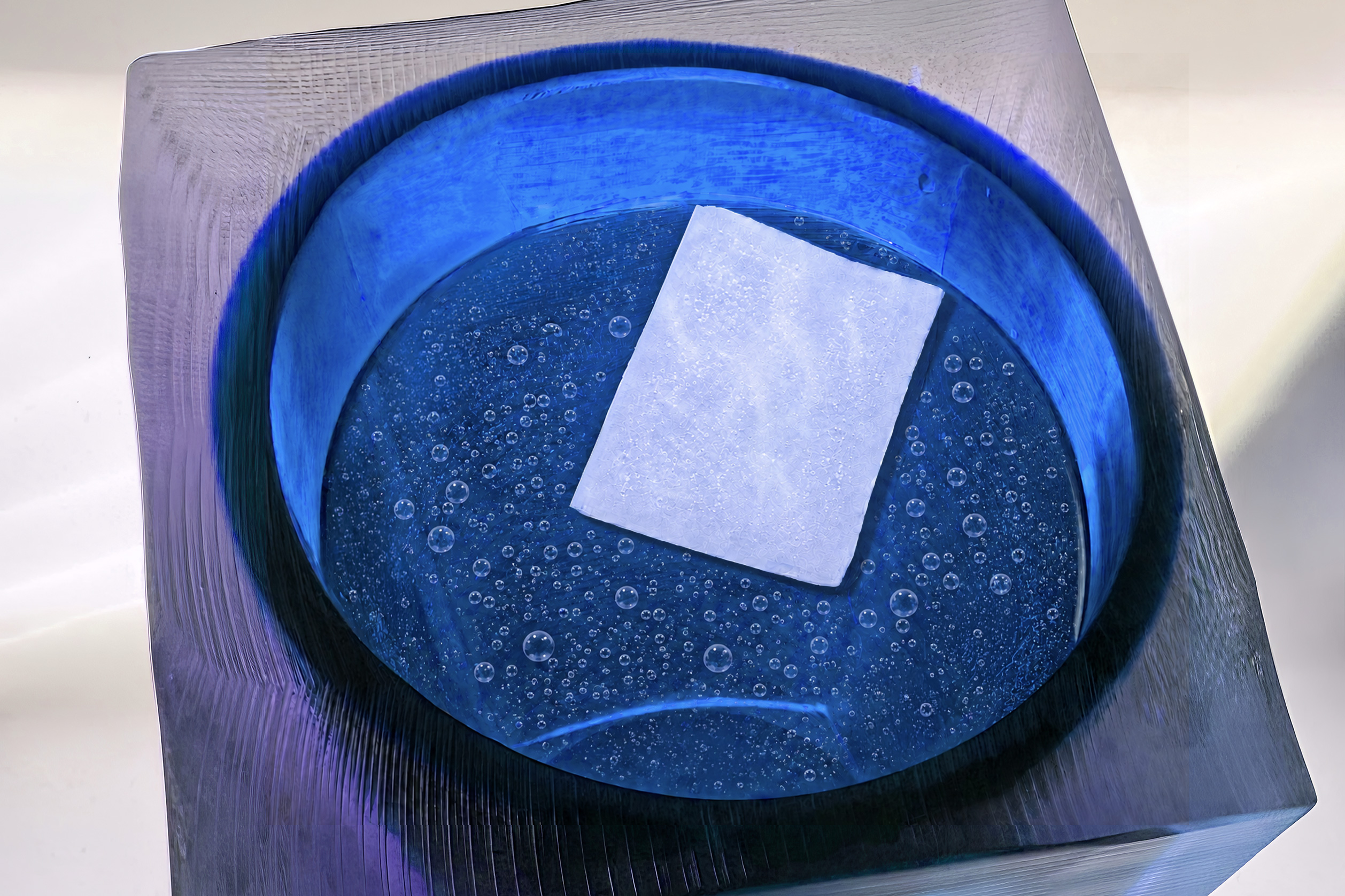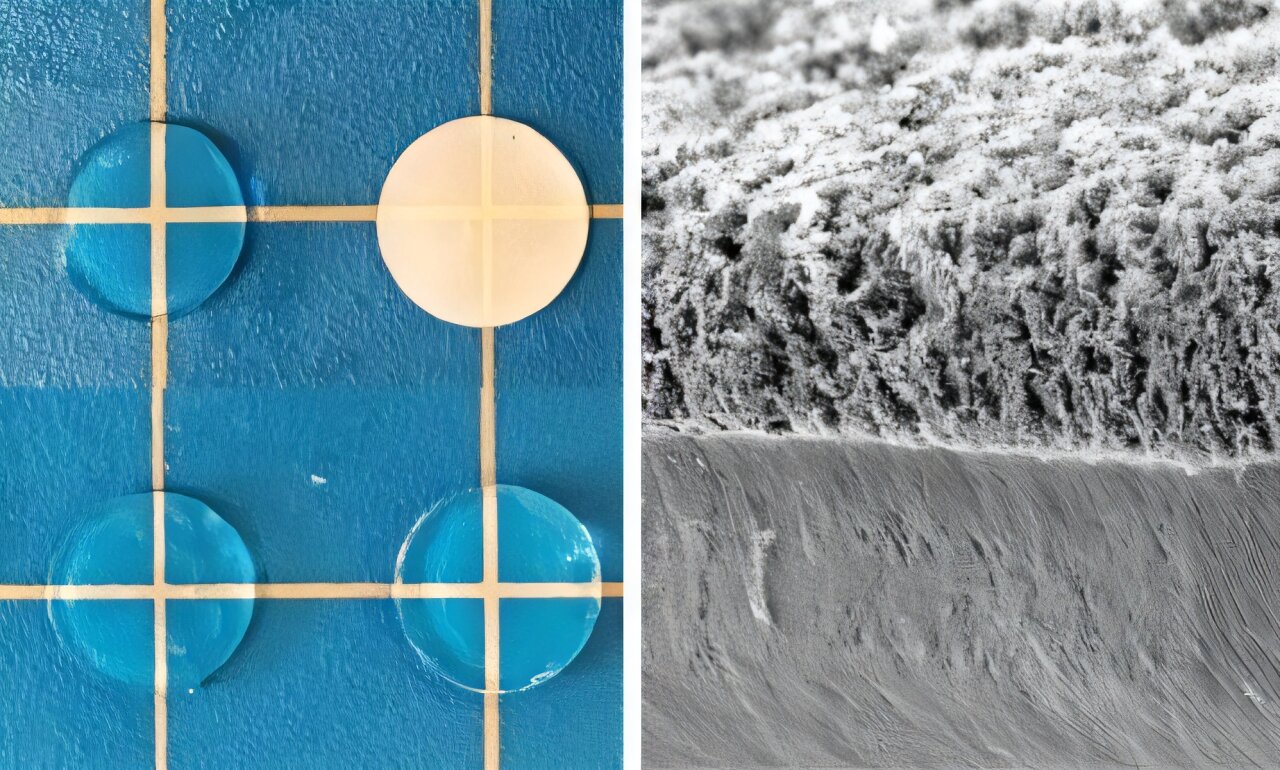
At left, hydrogels developed by Jiawei Yang and a team of researchers exhibit different colors according to their coatings. At right, a microscopic image of a hydrogel surface. Credit: Jiawei Yang
Researchers led by Jiawei Yang, Worcester Polytechnic Institute (WPI) Assistant Professor in the Department of Mechanical and Materials Engineering, have designed a modular system that could potentially improve hydrogel implants in the body by customizing the materials for stiffness and functionality.
The system, described in the journal Science Advances, uses coatings to treat the surface of hydrogels, which are flexible, water-loaded polymers. The researchers reported that by customizing different types of hydrogels with unique coatings, they were able to create two distinct hydrogel implants that maintained adhesion in living tissue and resisted an immune system response.
"It is difficult for a material with a single chemical composition to play two distinct roles in an implant," Yang said. "We addressed that by developing a way to customize hydrogel implants with two sets of chemical compositions that can be tailored to address specific needs and achieve better results."
The research addresses two critical challenges in the design of hydrogel implants—functionality and immune rejection. In the body, hydrogel implants need to adhere to tissues that may have different levels of stiffness, ranging from soft tissues in the brain to stiffer tissues in muscles and cartilage. Hydrogel implants also need to function, perhaps by delivering medicine to tissue or holding a device in place.